


Page 2396 - Hematology_ Basic Principles and Practice ( PDFDrive )
P. 2396
2138   Part XII  Hemostasis and Thrombosis

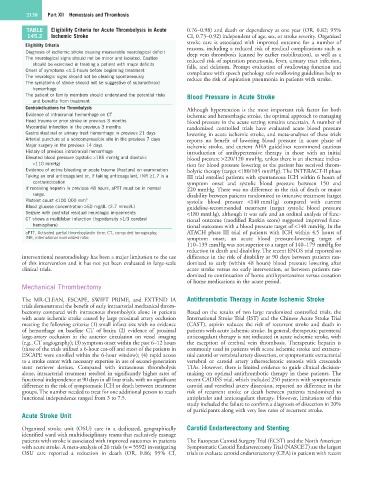
          TABLE   Eligibility Criteria for Acute Thrombolysis in Acute   0.76–0.98) and death or dependency at one year (OR, 0.82; 95%
          145.2   Ischemic Stroke                             CI, 0.73–0.92) independent of age, sex, or stroke severity. Organized
                                                              stroke  care  is  associated  with  improved  outcome  for  a  number  of
         Eligibility Criteria                                 reasons, including a reduced risk of medical complications such as
         Diagnosis of ischemic stroke causing measurable neurological deficit  deep vein thrombosis (caused by earlier mobilization), as well as a
         The neurological signs should not be minor and isolated. Caution   reduced risk of aspiration pneumonia, fever, urinary tract infection,
            should be exercised in treating a patient with major deficits  falls, and delirium. Prompt evaluation of swallowing function and
         Onset of symptoms <4.5 hours before beginning treatment  compliance with speech pathology safe swallowing guidelines help to
         The neurologic signs should not be clearing spontaneously  reduce the risk of aspiration pneumonia in patients with stroke.
         The symptoms of stroke should not be suggestive of subarachnoid
            hemorrhage
         The patient or family members should understand the potential risks   Blood Pressure in Acute Stroke
            and benefits from treatment
         Contraindications for Thrombolysis                   Although  hypertension  is  the  most  important  risk  factor  for  both
         Evidence of intracranial hemorrhage on CT            ischemic and hemorrhagic stroke, the optimal approach to managing
         Head trauma or prior stroke in previous 3 months     blood pressure in the acute setting remains uncertain. A number of
         Myocardial infarction in the previous 3 months       randomized  controlled  trials  have  evaluated  acute  blood  pressure
         Gastrointestinal or urinary tract hemorrhage in previous 21 days  lowering in acute ischemic stroke, and meta-analyses of these trials
         Arterial puncture at a noncompressible site in the previous 7 days  reports  no  benefit  of  lowering  blood  pressure  in  acute  phase  of
         Major surgery in the previous 14 days                ischemic stroke, and current AHA guidelines recommend cautious
         History of previous intracranial hemorrhage          introduction  of  antihypertensive  therapy  in  those  with  an  initial
         Elevated blood pressure (systolic >185 mmHg and diastolic   blood pressure >220/120 mmHg, unless there is an alternate indica-
            >110 mmHg)                                        tion for blood pressure lowering or the patient has received throm-
         Evidence of active bleeding or acute trauma (fracture) on examination  bolytic therapy (target <180/105 mmHg). The INTERACT-II phase
         Taking an oral anticoagulant or, if taking anticoagulant, INR ≥1.7 is a   III trial enrolled patients with spontaneous ICH within 6 hours of
            contraindication                                  symptom  onset  and  systolic  blood  pressure  between  150  and
         If receiving heparin in previous 48 hours, aPTT must be in normal   220 mmHg. There was no difference in the risk of death or major
            range.                                            disability between patients randomized to intensive treatment (target
         Platelet count ≤100 000 mm 3                         systolic  blood  pressure  <140 mmHg)  compared  with  current
         Blood glucose concentration ≥50 mg/dL (2.7 mmol/L)   guideline-recommended  treatment  (target  systolic  blood  pressure
         Seizure with postictal residual neurologic impairments  <180 mmHg), although it was safe and an ordinal analysis of func-
         CT shows a multilobar infarction (hypodensity >1/3 cerebral   tional outcome (modified Rankin score) suggested improved func-
            hemisphere)                                       tional outcomes with a blood pressure target of <140 mmHg. In the
         aPTT, Activated partial thromboplastin time; CT, computed tomography;    ATACH  phase  III  trial  of  patients  with  ICH  within  4.5  hours  of
         INR, international normalized ratio.                 symptom  onset,  an  acute  blood  pressure-lowering  target  of
                                                              110–139 mmHg was not superior to a target of 140–179 mmHg for
                                                              reduction in death and disability. The recent ENOS trial reported no
        interventional neuroradiology has been a major limitation to the use   difference in the risk of disability at 90 days between patients ran-
        of this intervention and it has not yet been evaluated in large-scale   domized  to  early  (within  48  hours)  blood  pressure  lowering  after
        clinical trials.                                      acute stroke versus no early intervention, or between patients ran-
                                                              domized to continuation of home antihypertensives versus cessation
                                                              of home medications in the acute period.
        Mechanical Thrombectomy
        The  MR-CLEAN,  ESCAPE,  SWIFT  PRIME,  and  EXTEND  IA   Antithrombotic Therapy in Acute Ischemic Stroke
        trials demonstrated the benefit of early intraarterial mechanical throm-
        bectomy  compared  with  intravenous  thrombolysis  alone  in  patients   Based on the results of two large randomized controlled trials, the
        with acute ischemic stroke caused by large proximal artery occlusion   International Stroke Trial (IST) and the Chinese Acute Stroke Trial
        meeting the following criteria: (1) small infarct size with no evidence   (CAST),  aspirin  reduces  the  risk  of  recurrent  stroke  and  death  in
        of  hemorrhage  on  baseline  CT  of  brain;  (2)  evidence  of  proximal   patients with acute ischemic stroke. In general, therapeutic parenteral
        large-artery  occlusion  in  the  anterior  circulation  on  vessel  imaging   anticoagulant therapy is not indicated in acute ischemic stroke, with
        (e.g., CT angiography); (3) symptom onset within the past 6–12 hours   the  exception  of  cerebral  vein  thrombosis. Therapeutic  heparin  is
        (three of the trials utilized a 6-hour cut-off and most of the patients in   commonly used in patients with acute ischemic stroke and extracra-
        ESCAPE were enrolled within the 6-hour window); (4) rapid access   nial carotid or vertebral artery dissection, or symptomatic extracranial
        to a stroke center with necessary expertise in use of second-generation   vertebral  or  carotid  artery  atherosclerotic  stenosis  with  crescendo
        stent  retriever  devices.  Compared  with  intravenous  thrombolysis   TIAs. However, there is limited evidence to guide clinical decision-
        alone, intraarterial treatment resulted in significantly higher rates of   making  on  optimal  antithrombotic  therapy  in  these  patients. The
        functional independence at 90 days in all four trials, with no significant   recent CADISS trial, which included 250 patients with symptomatic
        difference in the risk of symptomatic ICH or death between treatment   carotid and vertebral artery dissection, reported no difference in the
        groups. The number needed to treat for one additional person to reach   risk  of  recurrent  stroke  or  death  between  patients  randomized  to
        functional independence ranged from 3 to 7.5.         antiplatelet and anticoagulant therapy. However, limitations of this
                                                              study included the failure to confirm a diagnosis of dissection in 20%
                                                              of participants along with very low rates of recurrent stroke.
        Acute Stroke Unit

        Organized  stroke  unit  (OSU)  care  in  a  dedicated,  geographically   Carotid Endarterectomy and Stenting
        identified ward with multidisciplinary teams that exclusively manage
        patients with stroke is associated with improved outcomes in patients   The European Carotid Surgery Trial (ECST) and the North American
        with acute stroke. A meta-analysis of 26 trials (n = 5592) investigating   Symptomatic Carotid Endarterectomy Trial (NASCET) are the largest
        OSU  care  reported  a  reduction  in  death  (OR,  0.86;  95%  CI,   trials to evaluate carotid endarterectomy (CEA) in patients with recent

