


Page 2401 - Hematology_ Basic Principles and Practice ( PDFDrive )
P. 2401
Chapter 146  Acute Coronary Syndromes  2143


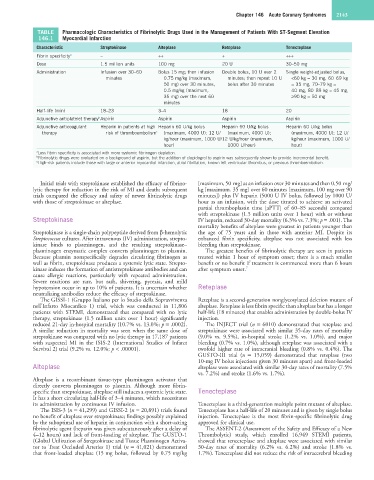
             TABLE   Pharmacologic Characteristics of Fibrinolytic Drugs Used in the Management of Patients With ST-Segment Elevation
              146.1  Myocardial Infarction
             Characteristic       Streptokinase      Alteplase            Reteplase            Tenecteplase
             Fibrin specificity a  –                 ++                   +                    +++
             Dose                 1.5 million units  100 mg               20 U                 30–50 mg
             Administration       Infusion over 30–60   Bolus 15 mg; then infusion   Double bolus, 10 U over 2   Single weight-adjusted bolus,
                                    minutes            0.75 mg/kg (maximum,   minutes; then repeat 10 U   <60 kg = 30 mg, 60–69 kg
                                                       50 mg) over 30 minutes,   bolus after 30 minutes  = 35 mg, 70–79 kg =
                                                       0.5 mg/kg (maximum,                      40 mg, 80–89 kg = 45 mg,
                                                       35 mg) over the next 60                  ≥90 kg = 50 mg
                                                       minutes
             Half-life (min)      18–23              3–4                  18                   20
             Adjunctive antiplatelet therapy Aspirin  Aspirin             Aspirin              Aspirin
                                 b
             Adjunctive anticoagulant   Heparin in patients at high  Heparin 60 U/kg bolus   Heparin 60 U/kg bolus   Heparin 60 U/kg bolus
               therapy              risk of thromboembolism c  (maximum, 4000 U); 12 U/  (maximum, 4000 U);  (maximum, 4000 U); 12 U/
                                                       kg/hour (maximum, 1000 U/12 U/kg/hour (maximum,   kg/hour (maximum, 1000 U/
                                                       hour)               1000 U/hour)         hour)
             a Less fibrin specificity is associated with more systemic fibrinogen depletion.
             b Fibrinolytic drugs were evaluated on a background of aspirin, but the addition of clopidogrel to aspirin was subsequently shown to provide incremental benefit.
             c High-risk patients include those with large or anterior myocardial infarction, atrial fibrillation, known left ventricular thrombus, or previous thromboembolism.


              Initial trials with streptokinase established the efficacy of fibrino-  [maximum, 50 mg] as an infusion over 30 minutes and then 0.50 mg/
            lytic therapy for reduction in the risk of MI and death; subsequent   kg [maximum. 35 mg] over 60 minutes [maximum, 100 mg over 90
            trials  compared  the  efficacy  and  safety  of  newer  fibrinolytic  drugs   minutes]) plus IV heparin (5000 U IV bolus, followed by 1000 U/
            with those of streptokinase or alteplase.             hour as an infusion, with the dose titrated to achieve an activated
                                                                  partial  thromboplastin  time  [aPTT]  of  60–85  seconds)  compared
                                                                  with streptokinase (1.5 million units over 1 hour) with or without
            Streptokinase                                         IV heparin, reduced 30-day mortality (6.3% vs. 7.3%; p = .001). The
                                                                  mortality benefits of alteplase were greatest in patients younger than
            Streptokinase is a single-chain polypeptide derived from β-hemolytic   the  age  of  75  years  and  in  those  with  anterior  MI.  Despite  its
            Streptococcus cultures. After intravenous (IV) administration, strepto-  enhanced  fibrin  specificity,  alteplase  was  not  associated  with  less
            kinase  binds  to  plasminogen,  and  the  resulting  streptokinase–  bleeding than streptokinase.
            plasminogen enzymatic complex converts plasminogen to plasmin.   The greatest benefits of fibrinolytic therapy are seen in patients
            Because  plasmin  nonspecifically  degrades  circulating  fibrinogen  as   treated  within  1  hour  of  symptom  onset;  there  is  a  much  smaller
            well as fibrin, streptokinase produces a systemic lytic state. Strepto-  benefit or no benefit if treatment is commenced more than 6 hours
            kinase induces the formation of antistreptokinase antibodies and can   after symptom onset. 7
            cause  allergic  reactions,  particularly  with  repeated  administration.
            Severe  reactions  are  rare,  but  rash,  shivering,  pyrexia,  and  mild
            hypotension occur in up to 10% of patients. It is uncertain whether   Reteplase
            neutralizing antibodies reduce the efficacy of streptokinase.
              The GISSI-1 (Gruppo Italiano per lo Studio della Sopravvivenza   Reteplase is a second-generation nonglycosylated deletion mutant of
            nell’Infarto  Miocardico  1)  trial,  which  was  conducted  in  11,806   alteplase. Reteplase is less fibrin specific than alteplase but has a longer
            patients  with  STEMI,  demonstrated  that  compared  with  no  lytic   half-life (18 minutes) that enables administration by double-bolus IV
            therapy, streptokinase (1.5 million units over 1 hour) significantly   injection.
            reduced 21-day in-hospital mortality (10.7% vs. 13.0%; p = .0002).   The INJECT trial (n = 6010) demonstrated that reteplase and
            A  similar  reduction  in  mortality  was  seen  when  the  same  dose  of   streptokinase were associated with similar 35-day rates of mortality
            streptokinase was compared with no lytic therapy in 17,187 patients   (9.0%  vs.  9.5%),  in-hospital  stroke  (1.2%  vs.  1.0%),  and  major
            with  suspected  MI  in  the  ISIS-2  (International  Studies  of  Infarct   bleeding (0.7% vs. 1.0%), although reteplase was associated with a
            Survival 2) trial (9.2% vs. 12.0%; p < .00001).       twofold higher rate of intracranial bleeding (0.8% vs. 0.4%). The
                                                                  GUSTO-III  trial  (n  =  15,059)  demonstrated  that  reteplase  (two
                                                                  10-mg IV bolus injections given 30 minutes apart) and front-loaded
            Alteplase                                             alteplase were associated with similar 30-day rates of mortality (7.5%
                                                                  vs. 7.2%) and stroke (1.6% vs. 1.7%).
            Alteplase  is  a  recombinant  tissue-type  plasminogen  activator  that
            directly  converts  plasminogen  to  plasmin.  Although  more  fibrin-
            specific than streptokinase, alteplase still induces a systemic lytic state.   Tenecteplase
            It has a short circulating half-life of 3–4 minutes, which necessitates
            its administration by continuous IV infusion.         Tenecteplase is a third-generation multiple point mutant of alteplase.
              The ISIS-3 (n = 41,299) and GISSI-2 (n = 20,891) trials found   Tenecteplase has a half-life of 20 minutes and is given by single bolus
            no benefit of alteplase over streptokinase; findings possibly explained   injection. Tenecteplase  is  the  most  fibrin-specific  fibrinolytic  drug
            by the suboptimal use of heparin in conjunction with a short-acting   approved for clinical use.
            fibrinolytic agent (heparin was given subcutaneously after a delay of   The ASSENT-2 (Assessment of the Safety and Efficacy of a New
            4–12 hours) and lack of front-loading of alteplase. The GUSTO-1   Thrombolytic)  study,  which  enrolled  16,949  STEMI  patients,
            (Global Utilization of Streptokinase and Tissue Plasminogen Activa-  showed that tenecteplase and alteplase were associated with similar
            tor to Treat Occluded Arteries 1) trial (n = 41,021) demonstrated   30-day  rates  of  mortality  (6.2%  vs.  6.2%)  and  stroke  (1.8%  vs.
            that  front-loaded  alteplase  (15 mg  bolus,  followed  by  0.75 mg/kg   1.7%). Tenecteplase did not reduce the risk of intracerebral bleeding

