


Page 241 - Hematology_ Basic Principles and Practice ( PDFDrive )
P. 241
Chapter 18  Cell Death  193


                                                                        Cytochrome c
                                                                          Release


                                                                        MOMP
                                                                                            Active
                                                                                           BAX/BAK

                                                     Proapoptotic
                                                      BAX/BAK
                              Activator BH3-only


                                                                      MITOCHONDRION


                                                    Antiapoptotic

                                                  Sensitizer BH3-only


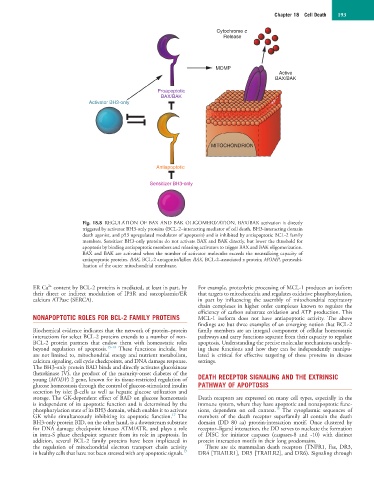
                            Fig. 18.8  REGULATION OF BAX AND BAK OLIGOMERIZATION. BAX/BAK activation is directly
                            triggered by activator BH3-only proteins (BCL-2–interacting mediator of cell death, BH3-interacting domain
                            death agonist, and p53 upregulated modulator of apoptosis) and is inhibited by antiapoptotic BCL-2 family
                            members. Sensitizer BH3-only proteins do not activate BAX and BAK directly, but lower the threshold for
                            apoptosis by binding antiapoptotic members and releasing activators to trigger BAX and BAK oligomerization.
                            BAX and BAK are activated when the number of activator molecules exceeds the neutralizing capacity of
                            antiapoptotic proteins. BAK, BCL-2 antagonist/killer; BAX, BCL-2–associated x protein; MOMP, permeabi-
                            lization of the outer mitochondrial membrane.


                 2+
            ER Ca  content by BCL-2 proteins is mediated, at least in part, by   For example, proteolytic processing of MCL-1 produces an isoform
            their  direct  or  indirect  modulation  of  IP3R  and  sarcoplasmic/ER   that targets to mitochondria and regulates oxidative phosphorylation,
            calcium ATPase (SERCA).                               in  part  by  influencing  the  assembly  of  mitochondrial  respiratory
                                                                  chain complexes in higher order complexes known to regulate the
                                                                  efficiency of carbon substrate oxidation and ATP production. This
            NONAPOPTOTIC ROLES FOR BCL-2 FAMILY PROTEINS          MCL-1  isoform  does  not  have  antiapoptotic  activity.  The  above
                                                                  findings are but three examples of an emerging notion that BCL-2
            Biochemical evidence indicates that the network of protein–protein   family members are an integral component of cellular homeostatic
            interactions for select BCL-2 proteins extends to a number of non-  pathways and carry functions separate from their capacity to regulate
            BCL-2  protein  partners  that  endow  them  with  homeostatic  roles   apoptosis. Understanding the precise molecular mechanisms underly-
            beyond  regulation  of  apoptosis. 15–18   These  functions  include,  but   ing  these  functions  and  how  they  can  be  independently  manipu-
            are not limited to, mitochondrial energy and nutrient metabolism,   lated  is  critical  for  effective  targeting  of  these  proteins  in  disease
            calcium signaling, cell cycle checkpoints, and DNA damage response.   settings.
            The BH3-only protein BAD binds and directly activates glucokinase
            (hexokinase IV), the product of the maturity-onset diabetes of the
            young (MODY) 2 gene, known for its tissue-restricted regulation of   DEATH RECEPTOR SIGNALING AND THE EXTRINSIC
            glucose homeostasis through the control of glucose-stimulated insulin   PATHWAY OF APOPTOSIS
            secretion  by  islet  β-cells  as  well  as  hepatic  glucose  utilization  and
            storage. The GK-dependent effect of BAD on glucose homeostasis   Death receptors are expressed on many cell types, especially in the
            is independent of its apoptotic function and is determined by the   immune system, where they have apoptotic and nonapoptotic func-
                                                                                           19
            phosphorylation state of its BH3 domain, which enables it to activate   tions,  dependent  on  cell  context.   The  cytoplasmic  sequences  of
                                                         17
            GK  while  simultaneously  inhibiting  its  apoptotic  function.   The   members  of  the  death  receptor  superfamily  all  contain  the  death
            BH3-only protein BID, on the other hand, is a downstream substrate   domain  (DD  80  aa)  protein-interaction  motif.  Once  clustered  by
            for DNA damage checkpoint kinases ATM/ATR, and plays a role   receptor–ligand interaction, the DD serves to nucleate the formation
            in intra-S phase checkpoint separate from its role in apoptosis. In   of  DISC  for  initiator  caspases  (caspases-8  and  -10)  with  distinct
            addition,  several  BCL-2  family  proteins  have  been  implicated  in   protein interaction motifs in their long prodomains.
            the  regulation  of  mitochondrial  electron  transport  chain  activity    There  are  six  mammalian  death  receptors  (TNFR1,  Fas,  DR3,
                                                             17
            in healthy cells that have not been stressed with any apoptotic signals.    DR4 [TRAILR1], DR5 [TRAILR2], and DR6). Signaling through

