


Page 2413 - Hematology_ Basic Principles and Practice ( PDFDrive )
P. 2413
Chapter 147  Atrial Fibrillation  2153

                                                                  Key Investigations
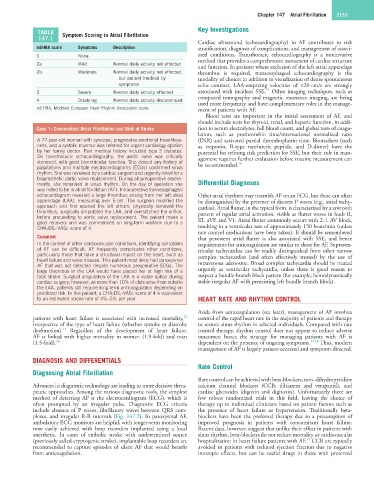
             TABLE   Symptom Scoring in Atrial Fibrillation
              147.1
                                                                  Cardiac  ultrasound  (echocardiography)  in  AF  contributes  to  risk
             mEHRA score   Symptoms   Description                 stratification, diagnosis of complications, and management of associ-
             1             None                                   ated  conditions.  Transthoracic  echocardiography  is  a  noninvasive
                                                                  method that provides a comprehensive assessment of cardiac structure
             2a            Mild       Normal daily activity not affected
                                                                  and function. In patients where exclusion of the left atrial appendage
             2b            Moderate   Normal daily activity not affected,   thrombus  is  required,  transesophageal  echocardiography  is  the
                                        but patient troubled by   modality of choice; in addition to visualization of dense spontaneous
                                        symptoms                  echo  contrast,  LAA-emptying  velocities  of  <20 cm/s  are  strongly
                                                                                        15
             3             Severe     Normal daily activity affected  associated with incident SSE.  Other imaging techniques, such as
                                                                  computed tomography and magnetic resonance imaging, are being
             4             Disabling  Normal daily activity discontinued
                                                                  used more frequently and have complementary roles in the manage-
             mEHRA, Modified European Heart Rhythm Association score.  ment of patients with AF.
                                                                    Blood  tests  are  important  in  the  initial  assessment  of  AF,  and
                                                                  should include tests for thyroid, renal, and hepatic function, in addi-
             Case 1: Concomitant Atrial Fibrillation and Risk of Stroke  tion to serum electrolytes, full blood count, and global tests of coagu-
                                                                  lation,  such  as  prothrombin  time/international  normalized  ratio
             A 77-year-old woman with syncope, progressive exertional breathless-  (INR) and activated partial thromboplastin time. Biomarkers (such
             ness, and a systolic murmur was referred for urgent cardiology opinion   as  troponin,  B-type  natriuretic  peptide,  and  D-dimer)  have  the
             by her family doctor. Past medical history included type 2 diabetes.   potential for refining risk prediction for SSE, but their role in man-
             On  transthoracic  echocardiography,  the  aortic  valve  was  critically   agement requires further evaluation before routine measurement can
             stenosed, with good biventricular function. She denied any history of   16
             palpitations and multiple electrocardiograms (ECGs) confirmed sinus   be recommended.
             rhythm. She was reviewed by a cardiac surgeon and urgently listed for a
             bioprosthetic aortic valve replacement. During all preoperative assess-
             ments,  she  remained  in  sinus  rhythm.  On  the  day  of  operation  she   Differential Diagnoses
             was noted to be in atrial fibrillation (AF). Intraoperative transesophageal
             echocardiogram revealed a large thrombus arising from her left atrial   Other atrial rhythms may resemble AF on an ECG, but these can often
             appendage  (LAA),  measuring  over  5 cm.  The  surgeon  modified  the   be distinguished by the presence of discrete P waves (e.g., atrial tachy-
             approach  and  first  opened  the  left  atrium,  physically  removed  the   cardias). Atrial flutter, in the typical form, is characterized by a sawtooth
             thrombus, surgically amputated the LAA, and overstitched the orifice,   pattern of regular atrial activation, visible as flutter waves in leads II,
             before  proceeding  to  aortic  valve  replacement.  The  patient  made  a
             good recovery and was commenced on long-term warfarin due to a   III, aVF, and V1. Atrial flutter commonly occurs with 2 : 1 AV block,
             CHA 2DS 2-VASc score of 4.                           resulting in a ventricular rate of approximately 150 beats/min (unless
                                                                  rate control medications have been taken). It should be remembered
             Comment                                              that  persistent  atrial  flutter  is  also  associated  with  SSE,  and  hence
             In the context of other cardiovascular conditions, identifying symptoms   requirements for anticoagulation are similar to those for AF. Supraven-
             of  AF  can  be  difficult.  AF  frequently  complicates  other  conditions,   tricular tachycardias can be readily distinguished from other narrow
             particularly those that have a structural impact on the heart, such as   complex  tachycardias  (and  often  effectively  treated)  by  the  use  of
             heart failure and valve disease. This patient most likely had paroxysmal
             AF that was not detected despite numerous preoperative ECGs. The   intravenous adenosine. Broad complex tachycardia should be treated
             large  thrombus  in  the  LAA  would  have  placed  her  at  high  risk  of  a   urgently  as  ventricular  tachycardia,  unless  there  is  good  reason  to
             fatal stroke. Surgical amputation of the LAA is a viable option during   suspect a bundle-branch block pattern (for example, hemodynamically
             cardiac surgery; however, as more than 10% of clots arise from outside   stable irregular AF with preexisting left bundle branch block).
             the LAA, patients still require long-term anticoagulation depending on
             predicted risk. In this patient, a CHA 2DS 2-VASc score of 4 is equivalent
             to an estimated stroke rate of 4%–5% per year.       HEART RATE AND RHYTHM CONTROL

                                                                  Aside from anticoagulation (see later), management of AF involves
                                                             12
            patients  with  heart  failure  is  associated  with  increased  mortality,    control of the rapid heart rate in the majority of patients and therapy
            irrespective of the type of heart failure (whether systolic or diastolic   to restore sinus rhythm in selected individuals. Compared with rate
                      13
            dysfunction).   Regardless  of  the  development  of  heart  failure,   control therapy, rhythm control does not appear to reduce adverse
            AF  is  linked  with  higher  mortality  in  women  (1.9-fold)  and  men    outcomes;  hence  the  strategy  for  managing  patients  with  AF  is
            (1.5-fold). 14                                        dependent on the presence of ongoing symptoms. 17,18  Thus, modern
                                                                  management of AF is largely patient-centered and symptom-directed.
            DIAGNOSIS AND DIFFERENTIALS
                                                                  Rate Control
            Diagnosing Atrial Fibrillation
                                                                  Rate control can be achieved with beta-blockers, non–dihydropyridine
            Advances in diagnostic technology are leading to more decisive thera-  calcium  channel  blockers  (CCB;  diltiazem  and  verapamil),  and
            peutic approaches. Among the various diagnostic tools, the simplest   cardiac glycosides (digoxin and digitoxin). Unfortunately there are
            method of detecting AF is the electrocardiogram (ECG), which is   few  robust  randomized  trials  in  this  field,  leaving  the  choice  of
            often  prompted  by  an  irregular  pulse.  Diagnostic  ECG  criteria   therapy up to individual clinicians based on patient factors such as
            include absence of P waves, fibrillatory waves between QRS com-  the  presence  of  heart  failure  or  hypertension.  Traditionally  beta-
            plexes, and irregular R-R intervals (Fig. 147.2). In paroxysmal AF,   blockers have been the preferred therapy due to a presumption of
            ambulatory ECG monitors are helpful, with longer-term monitoring   improved  prognosis  in  patients  with  concomitant  heart  failure.
            now  easily  achieved  with  loop  recorders  implanted  using  a  local   Recent data, however, suggest that unlike their effect in patients with
            anesthetic.  In  cases  of  embolic  stroke  with  undetermined  source   sinus rhythm, beta-blockers do not reduce mortality or cardiovascular
                                                                                                     19
            (previously called cryptogenic stroke), implantable loop recorders are   hospitalization in heart failure patients with AF.  CCB are typically
            recommended to capture episodes of silent AF that would benefit   avoided in patients with reduced ejection fraction due to negative
            from anticoagulation.                                 inotropic  effects,  but  can  be  useful  drugs  in  those  with  preserved

