


Page 2414 - Hematology_ Basic Principles and Practice ( PDFDrive )
P. 2414
2154   Part XII  Hemostasis and Thrombosis


                           Mitral valve

                                     Left atrium
                                                                                    Left atrium
                                                          Left atrial appendage


                      Left ventricle
                         cavity


                                                        Left atrial appendage
                                                          thrombus in AF


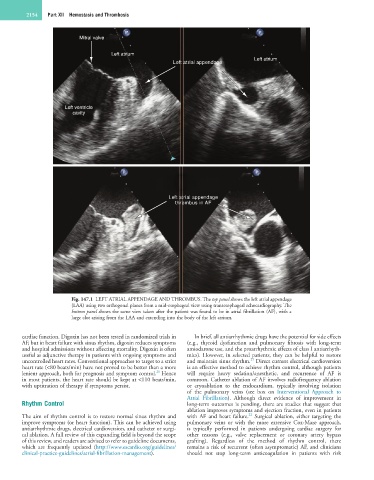
                        Fig. 147.1  LEFT ATRIAL APPENDAGE AND THROMBUS. The top panel shows the left atrial appendage
                        (LAA) using two orthogonal planes from a mid-esophageal view using transesophageal echocardiography. The
                        bottom panel shows the same view taken after the patient was found to be in atrial fibrillation (AF), with a
                        large clot arising from the LAA and extending into the body of the left atrium.


        cardiac function. Digoxin has not been tested in randomized trials in   In brief, all antiarrhythmic drugs have the potential for side effects
        AF, but in heart failure with sinus rhythm, digoxin reduces symptoms   (e.g.,  thyroid  dysfunction  and  pulmonary  fibrosis  with  long-term
        and hospital admissions without affecting mortality. Digoxin is often   amiodarone use, and the proarrhythmic effects of class I antiarrhyth-
        useful as adjunctive therapy in patients with ongoing symptoms and   mics). However, in selected patients, they can be helpful to restore
                                                                                   21
        uncontrolled heart rates. Conventional approaches to target to a strict   and maintain sinus rhythm.  Direct current electrical cardioversion
        heart rate (<80 beats/min) have not proved to be better than a more   is an effective method to achieve rhythm control, although patients
                                                    20
        lenient approach, both for prognosis and symptom control.  Hence   will  require  heavy  sedation/anesthetic,  and  recurrence  of  AF  is
        in most patients, the heart rate should be kept at <110 beats/min,   common. Catheter ablation of AF involves radiofrequency ablation
        with uptitration of therapy if symptoms persist.      or  cryoablation  to  the  endocardium,  typically  involving  isolation
                                                              of  the  pulmonary  veins  (see  box  on  Interventional  Approach  to
                                                              Atrial  Fibrillation).  Although  direct  evidence  of  improvement  in
        Rhythm Control                                        long-term outcomes is pending, there are studies that suggest that
                                                              ablation improves symptoms and ejection fraction, even in patients
                                                                                  22
        The aim of rhythm control is to restore normal sinus rhythm and   with  AF  and  heart  failure.   Surgical  ablation,  either  targeting  the
        improve symptoms (or heart function). This can be achieved using   pulmonary  veins  or  with  the  more  extensive  Cox-Maze  approach,
        antiarrhythmic drugs, electrical cardioversion, and catheter or surgi-  is  typically  performed  in  patients  undergoing  cardiac  surgery  for
        cal ablation. A full review of this expanding field is beyond the scope   other  reasons  (e.g.,  valve  replacement  or  coronary  artery  bypass
        of this review, and readers are advised to refer to guideline documents,   grafting).  Regardless  of  the  method  of  rhythm  control,  there
        which  are  frequently  updated  (http://www.escardio.org/guidelines/  remains a risk of recurrent (often asymptomatic) AF, and clinicians
        clinical-practice-guidelines/atrial-fibrillation-management).  should  not  stop  long-term  anticoagulation  in  patients  with  risk

