


Page 2462 - Hematology_ Basic Principles and Practice ( PDFDrive )
P. 2462
2200   Part XII  Hemostasis and Thrombosis


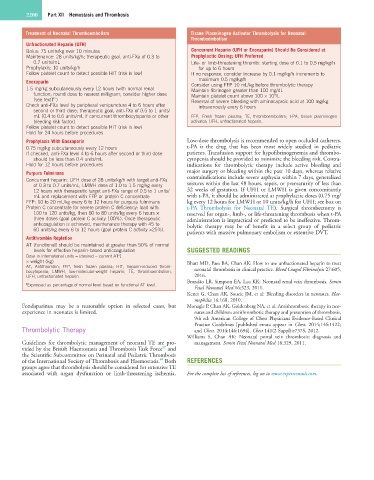
         Treatment of Neonatal Thromboembolism                 Tissue Plasminogen Activator Thrombolysis for Neonatal
                                                               Thromboembolism
          Unfractionated Heparin (UFH)
          Bolus: 75 units/kg over 10 minutes                    Concurrent Heparin (UFH or Enoxaparin) Should Be Considered at
          Maintenance: 28 units/kg/h; therapeutic goal, anti-FXa of 0.3 to    Prophylactic Dosing; UFH Preferred
            0.7 units/mL                                        Life- or limb-threatening thrombi: starting dose of 0.1 to 0.5 mg/kg/h
          Prophylaxis: 10 units/kg/h                              for up to 6 hours
          Follow platelet count to detect possible HIT (risk is low)  If no response, consider increase by 0.1 mg/kg/h increments to
                                                                  maximum 0.5 mg/kg/h
          Enoxaparin                                            Consider using FFP 10 mL/kg before thrombolytic therapy
          1.5 mg/kg subcutaneously every 12 hours (with normal renal   Maintain fibrinogen greater than 100 mg/dL
            function; round dose to nearest milligram; consider higher dose   Maintain platelet count above 100 × 10 /L
                                                                                           9
                  42
            [see text] )                                        Reversal of severe bleeding with aminocaproic acid at 100 mg/kg
          Check anti-FXa level by peripheral venipuncture 4 to 6 hours after   intravenously every 6 hours
            second or third dose; therapeutic goal, anti-FXa of 0.5 to 1 units/
            mL (0.4 to 0.6 units/mL if concurrent thrombocytopenia or other   FFP,  Fresh  frozen  plasma;  TE,  thromboembolism;  t-PA,  tissue  plasminogen
            bleeding risk factor)                              activator; UFH, unfractionated heparin.
          Follow platelet count to detect possible HIT (risk is low)
          Hold for 24 hours before procedures
          Prophylaxis With Enoxaparin                         Low-dose thrombolysis is recommended to open occluded catheters.
          0.75 mg/kg subcutaneously every 12 hours            t-PA  is  the  drug  that  has  been  most  widely  studied  in  pediatric
          If checked, anti-FXa level 4 to 6 hours after second or third dose   patients. Transfusion support for hypofibrinogenemia and thrombo-
            should be less than 0.4 units/mL                  cytopenia should be provided to minimize the bleeding risk. Contra-
          Hold for 12 hours before procedures                 indications  for  thrombolytic  therapy  include  active  bleeding  and
          Purpura Fulminans                                   major surgery or bleeding within the past 10 days, whereas relative
          Concurrent heparin: UFH dose of 28 units/kg/h with target anti-FXa   contraindications include severe asphyxia within 7 days, generalized
            of 0.3 to 0.7 units/mL; LMWH dose of 1.0 to 1.5 mg/kg every    seizures within the last 48 hours, sepsis, or prematurity of less than
            12 hours with therapeutic target anti-FXa range of 0.5 to 1 units/  32 weeks of gestation. If UFH or LMWH is given concomitantly
            mL and replacement with FFP or protein C concentrate  with t-PA, it should be administered at prophylactic doses (0.75 mg/
          FFP: 10 to 20 mL/kg every 6 to 12 hours for purpura fulminans  kg every 12 hours for LMWH or 10 units/kg/h for UFH; see box on
          Protein C concentrate for severe protein C deficiency: load with   t-PA  Thrombolysis  for  Neonatal  TE).  Surgical  thrombectomy  is
            100 to 120 units/kg, then 60 to 80 units/kg every 6 hours ×   reserved for organ-, limb-, or life-threatening thrombosis when t-PA
            three doses (goal protein C activity 100%). Once therapeutic   administration is impractical or predicted to be ineffective. Throm-
            anticoagulation is achieved, maintenance therapy with 45 to    bolytic  therapy  may  be  of  benefit  in  a  select  group  of  pediatric
            60 units/kg every 6 to 12 hours (goal protein C activity >25%).
                                                              patients with massive pulmonary embolism or extensive DVT.
          Antithrombin Repletion
          AT (functional) should be maintained at greater than 50% of normal
            levels for effective heparin-based anticoagulation  SUGGESTED READINGS
          Dose in international units = (desired – current AT )
                                        a
          × weight (kg)                                       Bhatt MD, Paes BA, Chan AK: How to use unfractionated heparin to treat
          AT,  Antithrombin;  FFP,  fresh  frozen  plasma;  HIT,  heparin-induced  throm-
          bocytopenia;  LMWH,  low-molecular-weight  heparin;  TE,  thromboembolism;    neonatal thrombosis in clinical practice. Blood Coagul Fibrinolysis 27:605,
          UFH, unfractionated heparin.                           2016.
                                                              Brandão LR, Simpson EA, Lau KK: Neonatal renal vein thrombosis. Semin
         a Expressed as percentage of normal level based on functional AT level.
                                                                 Fetal Neonatal Med 16:323, 2011.
                                                              Kenet G, Chan AK, Soucie JM, et al: Bleeding disorders in neonates. Hae-
                                                                 mophilia 16:168, 2010.
        Fondaparinux  may  be  a  reasonable  option  in  selected  cases,  but   Monagle P, Chan AK, Goldenberg NA, et al: Antithrombotic therapy in neo-
        experience in neonates is limited.                       nates and children: antithrombotic therapy and prevention of thrombosis,
                                                                 9th ed: American College of Chest Physicians Evidence-Based Clinical
                                                                 Practice  Guidelines  [published  errata  appear  in  Chest.  2014;146:1422;
        Thrombolytic Therapy                                     and Chest. 2014;146:1694]. Chest 141(2 Suppl):e737S, 2012.
                                                              Williams  S,  Chan  AK:  Neonatal  portal  vein  thrombosis:  diagnosis  and
        Guidelines for thrombolytic  management  of  neonatal TE  are  pro-  management. Semin Fetal Neonatal Med 16:329, 2011.
                                                      37
        vided by the British Haemostasis and Thrombosis Task Force  and
        the Scientific Subcommittee on Perinatal and Pediatric Thrombosis
                                                     44
        of the International Society of Thrombosis and Haemostasis.  Both   REFERENCES
        groups agree that thrombolysis should be considered for extensive TE
        associated  with  organ  dysfunction  or  limb-threatening  ischemia.   For the complete list of references, log on to www.expertconsult.com.

