


Page 2460 - Hematology_ Basic Principles and Practice ( PDFDrive )
P. 2460
2198   Part XII  Hemostasis and Thrombosis

                                                              Portal Vein Thrombosis
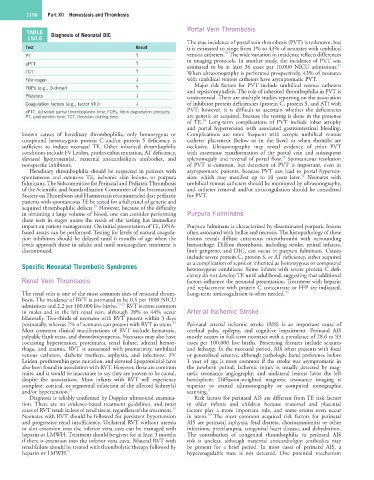
          TABLE   Diagnosis of Neonatal DIC
          150.6
                                                              The true incidence of portal vein thrombosis (PVT) is unknown, but
         Test                                Result           it is estimated to range from 1% to 43% of neonates with umbilical
                                                                           30
         PT                                  ↑                venous catheters.  The wide variation in incidence reflects differences
         aPTT                                ↑                in imaging protocols. In another study, the incidence of PVT was
                                                                                                               31
                                                              estimated  to  be  at  least  36  cases  per  10,000  NICU  admissions.
         TCT                                 ↑                When ultrasonography is performed prospectively, 43% of neonates
         Fibrinogen                          ↓                with umbilical venous catheters have asymptomatic PVT.
                                                                 Major  risk  factors  for  PVT  include  umbilical  venous  catheters
         FDPs (e.g., D-dimer)                ↑
                                                              and sepsis/omphalitis. The role of inherited thrombophilia in PVT is
         Platelets                           ↓                controversial. There are multiple studies reporting on the association
         Coagulation factors (e.g., factor VIII)  ↓           of inhibitor protein deficiencies (protein C, protein S, and AT) with
         aPTT, Activated partial thromboplastin time; FDPs, fibrin degradation products;   PVT;  however,  it  is  difficult  to  ascertain  whether  the  deficiencies
         PT, prothrombin time; TCT, thrombin clotting time.   are genetic or acquired, because the testing is done in the presence
                                                                   30
                                                              of  TE.   Long-term  complications  of  PVT  include  lobar  atrophy
                                                              and  portal  hypertension  with  associated  gastrointestinal  bleeding.
        known  causes  of  hereditary  thrombophilia,  only  homozygous  or   Complications  are  more  frequent  with  ectopic  umbilical  venous
        compound  heterozygous  protein  C  and/or  protein  S  deficiency  is   catheter  placement  (below  or  in  the  liver)  or  when  thrombi  are
        sufficient  to  induce  neonatal  TE.  Other  inherited  thrombophilic   occlusive.  Ultrasonography  may  reveal  evidence  of  prior  PVT
        conditions include FV Leiden, prothrombin mutation, AT deficiency,   with  cavernous  transformation  of  the  portal  vein  and  subsequent
                                                                                             32
        elevated  lipoprotein(a),  maternal  anticardiolipin  antibodies,  and   splenomegaly and reversal of portal flow.  Spontaneous resolution
        nonspecific inhibitors.                               of  PVT  is  common,  but  detection  of  PVT  is  important,  even  in
           Hereditary thrombophilia should be suspected in patients with   asymptomatic  patients,  because  PVT  can  lead  to  portal  hyperten-
                                                                                                   32
        spontaneous  and  extensive  TE,  ischemic  skin  lesions,  or  purpura   sion,  which  may  manifest  up  to  10  years  later.   Neonates  with
        fulminans. The Subcommittee for Perinatal and Pediatric Thrombosis   umbilical venous catheters should be monitored by ultrasonography,
        of the Scientific and Standardization Committee of the International   and  catheter  removal  and/or  anticoagulation  should  be  considered
        Society on Thrombosis and Haemostasis recommended that pediatric   for PVT.
        patients with spontaneous TE be tested for a full panel of genetic and
                                28
        acquired thrombophilic defects.  However, because of the difficulty
        in obtaining a large volume of blood, one can consider performing   Purpura Fulminans
        these  tests in stages unless  the result  of  the testing has  immediate
        impact on patient management. On initial presentation of TE, DNA-  Purpura fulminans is characterized by disseminated purpuric lesions
        based assays can be performed. Testing for levels of natural coagula-  often associated with bullae and necrosis. The histopathology of these
        tion inhibitors should be delayed until 6 months of age when the   lesions  reveals  diffuse  cutaneous  microthrombi  with  surrounding
        levels approach those in adults and until anticoagulant treatment is   hemorrhage.  Diffuse  thrombosis,  including  stroke,  retinal  infarcts,
        discontinued.                                         limb gangrene, and DIC, can occur in purpura fulminans. Causes
                                                              include severe protein C, protein S, or AT deficiency, either acquired
        Specific Neonatal Thrombotic Syndromes                as a complication of sepsis or inherited as homozygous or compound
                                                              heterozygous conditions. Some infants with severe protein C defi-
                                                              ciency do not develop TE until adulthood, suggesting that additional
        Renal Vein Thrombosis                                 factors influence the neonatal presentation. Treatment with heparin
                                                              and replacement with protein C concentrate or FFP are indicated.
        The renal vein is one of the most common sites of neonatal throm-  Long-term anticoagulation is often needed. 33
        bosis. The incidence of RVT is estimated to be 0.5 per 1000 NICU
        admissions and 2.2 per 100,000 live births. 23,25  RVT is more common
        in  males  and  in  the  left  renal  vein,  although  28%  to  44%  occur   Arterial Ischemic Stroke
        bilaterally. Two-thirds of neonates with RVT present within 3 days
                                                         29
        postnatally, whereas 7% of neonates can present with RVT in utero.    Perinatal  arterial  ischemic  stroke  (AIS)  is  an  important  cause  of
        Most  common  clinical  manifestations  of  RVT  include  hematuria,   cerebral  palsy,  epilepsy,  and  cognitive  impairment.  Perinatal  AIS
        palpable flank mass, and thrombocytopenia. Neonates may also have   mostly occurs in full-term neonates with a prevalence of 28.6 to 93
        coexisting  hypertension,  proteinuria,  renal  failure,  adrenal  hemor-  cases  per  100,000  live  births.  Presenting  features  include  seizures
        rhage,  and  anemia.  RVT  is  associated  with  prematurity,  umbilical   and lethargy. In the neonatal period, AIS often presents with focal
        venous  catheters,  diabetic  mothers,  asphyxia,  and  infections.  FV   or generalized seizures, although pathologic hand preference before
        Leiden, prothrombin gene mutation, and elevated lipoprotein(a) have   1  year  of  age  is  most  common  if  the  stroke  was  asymptomatic  in
        also been found in association with RVT. However, these are common   the  newborn  period.  Ischemic  injury  is  usually  detected  by  mag-
        traits, and it would be inaccurate to say they are proven to be causal,   netic  resonance  angiography,  and  unilateral  lesions  favor  the  left
        despite  the  associations.  Most  infants  with  RVT  will  experience   hemisphere.  Diffusion-weighted  magnetic  resonance  imaging  is
        complete, cortical, or segmental infarction of the affected kidney(s)   superior  to  cranial  ultrasonography  or  computed  tomographic
        and/or hypertension. 21                               scanning. 7
           Diagnosis is reliably confirmed by Doppler ultrasound examina-  Risk factors for perinatal AIS are different from TE risk factors
        tion. There  are  no  evidence-based  treatment  guidelines,  and  most   in  older  infants  and  children  because  maternal  and  placental
                                                         29
        cases of RVT result in loss of renal tissue, regardless of the treatment.    factors  play  a  more  important  role,  and  some  events  even  occur
                                                                     34
        Neonates with RVT should be followed for persistent hypertension   in  utero.   The  most  common  acquired  risk  factors  for  perinatal
        and progressive renal insufficiency. Unilateral RVT without uremia   AIS are perinatal asphyxia, fetal distress, chorioamnionitis or other
        or clot extension into the inferior vena cava can be managed with   infections, preeclampsia, congenital heart disease, and dehydration.
        heparin or LMWH. Treatment should be given for at least 3 months   The  contribution  of  congenital  thrombophilia  to  perinatal  AIS
        if there is extension into the inferior vena cava. Bilateral RVT with   risk  is  unclear,  although  maternal  anticardiolipin  antibodies  may
        renal failure should be treated with thrombolytic therapy followed by   be  present  for  a  brief  period.  In  most  cases  of  perinatal  AIS,  a
        heparin or LMWH. 7                                    hypercoagulable  state  is  not  detected.  One  potential  mechanism

