


Page 2458 - Hematology_ Basic Principles and Practice ( PDFDrive )
P. 2458
2196   Part XII  Hemostasis and Thrombosis


        plasma-derived concentrates that contain vWF (e.g., Humate-P or   D-dimer occur because of delayed hepatic clearance. Assays of FV,
        Alphanate), dosed initially at 40 to 60 ristocetin cofactor units/kg.  FVII, and FVIII can help distinguish between liver disease, vitamin
           Although most of the bleeding problems in neonates are acquired,   K  deficiency,  and  consumptive  coagulopathy  (e.g.,  DIC).  FV  and
        patients with severe deficiencies of coagulation factors can present in   FVIII are not vitamin K–dependent clotting factors. FV is synthesized
        the  neonatal  period.  Autosomal  recessive  deficiencies,  in  either   in the liver, whereas FVIII is synthesized in multiple cell types, and
        homozygous or compound heterozygous state, are grouped as rare   the levels of both in neonates are similar to those in adults. Deficiency
        coagulation disorders that can manifest as severe bleeding diatheses.   of all three implies consumption, whereas decreased levels of FV and
        In the neonatal period, severe deficiencies of fibrinogen, FVII, FX,   FVII with a normal FVIII level suggest liver disease.
        and  FXIII  are  the  most  likely  disorders  to  present  with  bleeding   Treatment should include replacement with FFP and/or cryopre-
        conditions. One common feature of these disorders is the association   cipitate, as well as platelet transfusion. Fibrinogen concentrate has
                20
        with ICH.  Deficiency of fibrinogen can manifest with bleeding in   been used as an alternative to cryoprecipitate. Patients with biliary
        the soft tissues, bleeding after circumcision, or bleeding after umbili-  atresia or other cholestatic liver failure syndromes may also benefit
        cal stump detachment. The diagnosis can be established with fibrino-  from parenteral vitamin K. The outcome is dependent on treatment
        gen assays, and treatment involves replacement with cryoprecipitate   of the underlying cause of liver disease.
        or,  if  available,  fibrinogen  concentrate  (see  box  on  Recommended
        Dosing for Transfusion in Neonatal Hemorrhage). Severe FXI defi-
        ciency  is  more  prevalent  in  Ashkenazi  Jews  and  can  present  with   Intraventricular Hemorrhage
        bleeding in newborns after hemostatic challenges, such as circumci-
        sion. FV and prothrombin deficiencies are the other rare autosomal   Intraventricular  hemorrhage  (IVH)  is  associated  with  significant
        recessive  homozygous  deficiencies  that  can  cause  hemorrhagic   morbidity and mortality in the newborn period, particularly in pre-
        symptoms. 11                                          mature infants. In the United States, it is estimated that approximately
           Not all deficiencies result in a bleeding diathesis. Even complete   12,000 premature infants and 20% to 25% of very low-birth-weight
        deficiencies  of  the  contact  factors,  which  include  high-molecular-  infants develop IVH each year. With improvements in neonatal care,
        weight kininogen, prekallikrein, and FXII, are not associated with a   the incidence of IVH is decreasing.
        bleeding  phenotype.  Autosomal  recessive  deficiencies  of  α 2 AP  and   The etiology of IVH is multifactorial and includes prematurity of
        PAI-1 have been associated with bleeding, but not in the neonatal   the  cerebral  vasculature  and  ischemia-reperfusion  injury  related  to
        period.                                               ventilatory support, blood pressure lability, and ECMO. Other risk
                                                              factors for IVH include vaginal delivery, severe respiratory distress
                                                              syndrome (RDS), low Apgar scores, pneumothorax, hypoxia, hyper-
        Liver Disease                                         capnia,  seizures,  patent  ductus  arteriosus,  and  infection.  Many  of
                                                              these risk factors induce IVH by altering cerebral blood flow. Coagu-
        Acute liver disease or hepatic failure is uncommon in neonates. Liver   lopathy and thrombocytopenia can contribute to IVH, but their role
        disease in neonates may be caused by viral hepatitis, parenteral nutri-  in the pathogenesis of IVH is uncertain. One study reported hypo-
        tion, cholestasis, hypoxic injury, or metabolic disease. Rare disorders   fibrinogenemia, thrombocytopenia, or prolonged clotting time in 11
        that  cause  liver  failure  in  neonates  include  hereditary  tyrosinemia,   of 15 neonates with IVH and in only 5 of 35 unaffected newborns.
        neonatal hemochromatosis, and hemophagocytic lymphohistiocyto-  Hemorrhage  complicating  cerebral  vein  thrombosis  may  explain
        sis. Liver dysfunction can affect the hemostatic balance, resulting in   some cases of IVH (especially in full-term infants), and heterozygosity
        activation of the coagulation and fibrinolytic systems, reduced syn-  for the FV Leiden mutation was reported in 18% of neonates with
        thesis of coagulation factors, poor clearance of activated hemostatic   grades 2 to 4 IVH compared with 3% of controls. Cerebellar hemor-
        components, thrombocytopenia, platelet dysfunction, loss of coagu-  rhage should raise suspicion of organic acidemia, such as methylma-
        lation proteins into ascites fluid, and failure to use vitamin K. 21  lonic, propionic, or isovaleric acidemia.
           Owing  to  reduced  synthesis  of  multiple  coagulation  proteins,   Vitamin K, indomethacin, AT, FFP, FXIII, tranexamic acid, and
        laboratory workup typically reveals a prolonged PT and aPTT. Acute   ethamsylate has been evaluated for prevention of IVH with mixed
        liver disease also results in elevated liver enzyme levels, direct hyper-  results. rFVIIa may be useful for treatment of IVH, but additional
        bilirubinemia,  and  elevated  ammonia  concentrations. The  platelet   studies are needed to determine its efficacy and safety.
        count  may  be  reduced,  especially  if  hypersplenism  is  present,  and
        platelet dysfunction is common. Hypofibrinogenemia is a late mani-
        festation of liver disease, and elevated fibrin degradation products and   Extracorporeal Membrane Oxygenation

                                                              ECMO  is  occasionally  used  for  treatment  of  neonates  with  severe
                                                              pulmonary  hypertension  or  cardiomyopathy.  The  ECMO  pump,
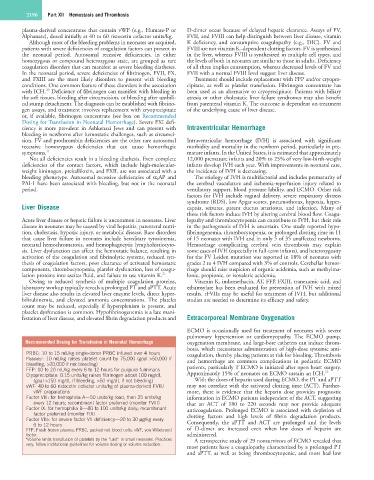
         Recommended Dosing for Transfusion in Neonatal Hemorrhage  oxygenation membrane, and large-bore catheters can induce throm-
                                                              bosis, which necessitates administration of high-dose systemic anti-
          PRBC: 10 to 15 mL/kg single-donor PRBC infused over 4 hours  coagulation, thereby placing patients at risk for bleeding. Thrombosis
          Platelets :  10 mL/kg  raises  platelet  count  by  75,000  (goal  >50,000  if   and  hemorrhage  are  common  complications  in  pediatric  ECMO
               a
          bleeding, >20,000 if not bleeding)
          FFP: 10 to 20 mL/kg every 6 to 12 hours for purpura fulminans  patients, particularly if ECMO is initiated after open heart surgery.
                                                                                                           22
          Cryoprecipitate: 0.15 units/kg raises fibrinogen about 100 mg/dL   Approximately 15% of neonates on ECMO sustain an ICH.
            (goal >150 mg/dL if bleeding, >50 mg/dL if not bleeding)  With the doses of heparin used during ECMO, the PT and aPTT
          vWF: 40 to 60 ristocetin cofactor units/kg of plasma-derived FVIII/  may not correlate with the activated clotting time (ACT). Further-
            vWF preparations                                  more,  there  is  evidence  that  the  heparin  dose  provides  prognostic
          Factor VIII: for hemophilia A—50 units/kg load, then 25 units/kg   information in ECMO patients independent of the ACT, suggesting
            every 12 hours; recombinant factor preferred (monitor FVIII)  that  an  ACT  of  180  to  220  seconds  may  not  provide  adequate
          Factor IX: for hemophilia B—80 to 100 units/kg daily; recombinant   anticoagulation.  Prolonged  ECMO  is  associated  with  depletion  of
            factor preferred (monitor FIX)                    clotting  factors  and  high  levels  of  fibrin  degradation  products.
          Factor VIIa: for severe factor VII deficiency—20 to 30 µg/kg every
            6 to 12 hours                                     Consequently,  the  aPTT  and  ACT  are  prolonged  and  the  levels
          FFP, Fresh frozen plasma; PRBC, packed red blood cells; vWF, von Willebrand   of  D-dimer  are  increased  even  when  low  doses  of  heparin  are
          factor.                                             administered.
         a Volume limits transfusion of platelets by the “unit” in small neonates. Practices   A retrospective study of 29 nonsurvivors of ECMO revealed that
         vary; follow institutional guidelines for volume dosing or volume reduction.
                                                              most patients have a coagulopathy characterized by a prolonged PT
                                                              and  aPTT,  as  well  as  being  thrombocytopenic,  and  most  had  low

