


Page 2469 - Hematology_ Basic Principles and Practice ( PDFDrive )
P. 2469
2206   Part XIII  Consultative Hematology


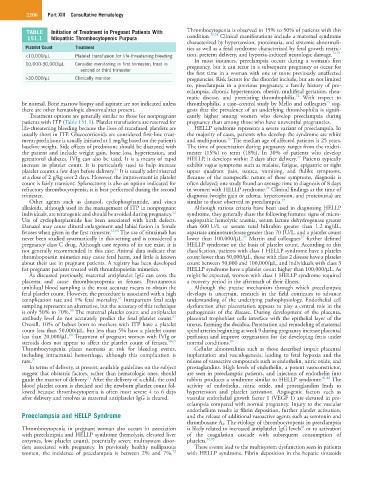
          TABLE   Initiation of Treatment in Pregnant Patients With   Thrombocytopenia is observed in 15% to 50% of patients with this
                                                                      73,74
          151.1   Idiopathic Thrombocytopenic Purpura         condition.   Clinical manifestations include a maternal syndrome
                                                              characterized by hypertension, proteinuria, and systemic abnormali-
         Platelet Count   Treatment                           ties as well as a fetal syndrome characterized by fetal growth restric-
         <10,000/µL       Platelet transfusion for life-threatening bleeding  tion, preterm delivery, and hypoxia-induced neurologic damage. 72,74
                                                                 In  most  instances,  preeclampsia  occurs  during  a  woman’s  first
         10,000-30,000/µL  Consider monitoring in first trimester; treat in   pregnancy, but it can recur in a subsequent pregnancy or occur for
                           second or third trimester
                                                              the first time in a woman with one or more previously unaffected
         >30,000/µL       Clinically monitor                  pregnancies. Risk factors for the disorder include, but are not limited
                                                              to,  preeclampsia  in  a  previous  pregnancy,  a  family  history  of  pre-
                                                              eclampsia, chronic hypertension, obesity, multifetal gestation, rheu-
                                                                                                  72
                                                              matic  disease,  and  preexisting  thrombophilia.   With  respect  to
                                                                                                            75
        be normal. Bone marrow biopsy and aspirate are not indicated unless   thrombophilia, a case–control study by Mello and colleagues  sug-
        there are other hematologic abnormalities present.    gests that the prevalence of an underlying thrombophilia is signifi-
           Treatment options are generally similar to those for nonpregnant   cantly  higher  among  women  who  develop  preeclampsia  during
        patients with ITP (Table 151.1). Platelet transfusions are reserved for   pregnancy than among those who have uneventful pregnancies.
        life-threatening bleeding because the lives of transfused platelets are   HELLP syndrome represents a severe variant of preeclampsia. In
        usually short in ITP. Glucocorticoids are considered first-line treat-  the majority of cases, patients who develop the syndrome are white
                                                                           76
        ment; prednisone is usually initiated at 1 mg/kg based on the patient’s   and multiparious.  The median age of affected patients is 25 years.
        baseline weight. Side effects of prednisone should be discussed with   The time of presentation during pregnancy ranges from the midtri-
        the  patient  and  include  weight  gain,  bone  loss,  hypertension,  and   mester  (15%)  to  term  (18%).  In  30%  of  patients  who  develop
                                                                                                  77
        gestational diabetes. IVIg can also be used. It is a means of rapid   HELLP, it develops within 2 days after delivery.  Patients typically
        increase  in  platelet  count.  It  is  particularly  used  to  help  increase   exhibit vague symptoms such as malaise, fatigue, epigastric or right
                                       61
        platelet counts a few days before delivery.  It is usually administered   upper  quadrant  pain,  nausea,  vomiting,  and  flulike  symptoms.
        at a dose of 2 g/kg over 2 days. However, the improvement in platelet   Because  of  the  nonspecific  nature  of  these  symptoms,  diagnosis  is
        count is fairly transient. Splenectomy is also an option indicated for   often delayed; one study found an average time to diagnosis of 8 days
                                                                                        78
        refractory thrombocytopenia; it is best performed during the second   in women with HELLP syndrome.  Clinical findings at the time of
        trimester.                                            diagnosis (weight gain or edema, hypertension, and proteinuria) are
           Other  agents  such  as  danazol,  cyclophosphamide,  and  vinca   similar to those observed in preeclampsia. 77
        alkaloids, although used in the management of ITP in nonpregnant   Although various criteria have been used in diagnosing HELLP
                                                         62
        individuals, are teratogenic and should be avoided during pregnancy.    syndrome, they generally share the following features: signs of micro-
        Use  of  cyclophosphamide  has  been  associated  with  birth  defects.   angiopathic hemolytic anemia, serum lactate dehydrogenase greater
        Danazol may cause clitoral enlargement and labial fusion in female   than  600 U/L  or  serum  total  bilirubin  greater  than  1.2 mg/dL,
        fetuses when given in the first trimester. 63,64  The use of rituximab has   aspartate aminotransferase greater than 70 IU/L, and a platelet count
                                                                                 79
                                                                                                   77
        never been studied systematically in this setting and is considered a   lower  than  100,000/µL.   Martin  and  colleagues   further  defined
        pregnancy class C drug. Although case reports of its use exist, it is   HELLP syndrome on the basis of platelet count. According to this
        not generally recommended in this case. Animal data indicate that   classification, patients with class 1 HELLP syndrome have a platelet
        thrombopoietin mimetics may cause fetal harm, and little is known   count lower than 50,000/µL, those with class 2 disease have a platelet
        about their use in pregnant patients. A registry has been developed   count between 50,000 and 100,000/µL, and individuals with class 3
        for pregnant patients treated with thrombopoietin mimetics.  HELLP syndrome have a platelet count higher than 100,000/µL. As
           As discussed previously, maternal antiplatelet IgG can cross the   might be expected, women with class 1 HELLP syndrome required
        placenta  and  cause  thrombocytopenia  in  fetuses.  Percutaneous   a recovery period in the aftermath of their illness.
        umbilical blood sampling is the most accurate means to obtain the   Although  the  precise  mechanism  through  which  preeclampsia
        fetal platelet count. However, the procedure is associated with a high   develops  is  uncertain,  research  in  the  field  continues  to  advance
                                        65
        complication rate and 1% fetal mortality.  Intrapartum fetal scalp   understanding  of  the  underlying  pathophysiology.  Endothelial  cell
        sampling represents an alternative, but the accuracy of this technique   dysfunction after placentation appears to play a central role in the
                        66
        is only 50% to 70%.  The maternal platelet count and antiplatelet   pathogenesis  of  the  disease.  During  development  of  the  placenta,
                                                         67
        antibody  level  do  not  accurately  predict  the  fetal  platelet  count.    placental trophoblast cells interface with the epithelial layer of the
        Overall,  10%  of  babies  born to  mothers with  ITP  have a  platelet   uterus, forming the decidua. Penetration and remodeling of maternal
        count less than 50,000/µL, but less than 5% have a platelet count   spiral arteries beginning at week 9 during pregnancy increase placental
                        68
        less than 20,000/µL.  Treatment of pregnant women with IVIg or   perfusion and improve oxygenation for the developing fetus under
        steroids does not appear to affect the platelet count of fetuses. 68,69    normal conditions. 80
        Thrombocytopenia  places  neonates  at  risk  for  bleeding  events,   Cellular  abnormalities  such  as  those  described  impair  placental
        including  intracranial  hemorrhage,  although  this  complication  is   implantation  and  vasculogenesis,  leading  to  fetal  hypoxia  and  the
        rare. 70                                              release of vasoactive compounds such as endothelin, nitric oxide, and
           In terms of delivery, at present, available guidelines on the subject   prostaglandins. High levels of endothelin, a potent vasoconstrictor,
        suggest that obstetric factors, rather than hematologic ones, should   are seen in preeclamptic patients, and injection of endothelin into
                              71
        guide the manner of delivery.  After the delivery of a child, the cord   rabbits produces a syndrome similar to HELLP syndrome. 81,82  The
        blood platelet count is checked and the newborn platelet count fol-  activity  of  endothelin,  nitric  oxide,  and  prostaglandins  leads  to
        lowed because thrombocytopenia is often most severe 4 to 6 days   hypertension  and  platelet  activation.  Angiogenic  factors  such  as
        after delivery and resolves as maternal antiplatelet IgG is cleared.  vascular endothelial growth factor 1 (VEGF 1) are elevated in pre-
                                                              eclampsia compared with normal pregnancy. Injury to the vascular
                                                              endothelium results in fibrin deposition, further platelet activation,
        Preeclampsia and HELLP Syndrome                       and the release of additional vasoactive agents such as serotonin and
                                                              thromboxane A 2. The etiology of thrombocytopenia in preeclampsia
                                                                                                   83
        Thrombocytopenia  in  pregnant  woman  also  occurs  in  association   is likely related to increased antiplatelet IgG levels  or to activation
        with preeclampsia and HELLP syndrome (hemolysis, elevated liver   of  the  coagulation  cascade  with  subsequent  consumption  of
        enzymes, low platelet count), potentially severe multisystem disor-  platelets. 84,85
        ders  associated  with  pregnancy.  In  previously  healthy  nulliparous   These events lead to the multisystem dysfunction seen in patients
                                                         72
        women,  the  incidence  of  preeclampsia  is  between  2%  and  7%.    with HELLP syndrome. Fibrin deposition in the hepatic sinusoids

