


Page 2470 - Hematology_ Basic Principles and Practice ( PDFDrive )
P. 2470
Chapter 151  Hematologic Changes in Pregnancy  2207


            causes hepatocellular injury. Patients can develop right upper quad-  when signs and symptoms of preeclampsia or HELLP develop. In a
                                                                                                             104
            rant  pain  if  intraparenchymal  or  subcapsular  hemorrhage  occurs.   clinically stable woman, vaginal delivery can be attempted.  When
            DIC was observed in 21% of patients with HELLP in one series, and   cesarean section is required, transfusion of RBCs, platelets, and fresh
                                                86
            placental abruption was seen in 16% of patients.  Other manifesta-  frozen  plasma  (FFP)  is  performed  as  necessary  before  and  during
            tions  of  HELLP  syndrome  include  acute  renal  failure,  pulmonary   surgery.  Severe  hypofibrinogenemia  should  be  treated  with
            edema,  shock,  cerebrovascular  accident  (CVA),  eclampsia,  retinal   cryoprecipitate.
            detachment, diabetes insipidus, and an increased incidence of cesar-  Patients are monitored closely in the postpartum period. Magne-
            ean section.                                          sium should be continued for 12 to 48 hours after delivery and blood
              HELLP syndrome is associated with high maternal and neonatal   pressure  controlled  appropriately.  Although  hypertension  typically
                                                             87
            mortality rates. Maternal mortality rates range from 1.1% to 24.2%.    resolves within 6 weeks after delivery, some women require long-term
                                                                                    102
            The immediate cause of death is most often rupture of the liver, DIC,   antihypertensive therapy.   Coagulation  and platelet abnormalities
            acute  renal  failure,  pulmonary  edema  or  acute  respiratory  distress   tend to resolve within 24 to 48 hours after delivery. Some patients,
            syndrome (ARDS), shock, or CVA. Perinatal deaths resulting from   however, experience an ongoing decline in platelet count and should
            placental abruption, asphyxia, or extreme prematurity occur in 10%   be  followed  until  counts  normalize.  Postpartum  eclampsia  can
            to 15% of patients. After delivery, infants born to women with pre-  occur  for  up  to  48  hours  after  delivery;  thus  patients  and  health
            eclampsia or HELLP can develop a self-limited neonatal thrombocy-  care providers should remain vigilant in monitoring for suggestive
                                                                                  105
            topenia. Uncertainty exists regarding whether infant thrombocytopenia   signs  and  symptoms.  Treatment  options  in  the  setting  of  severe
            in these instances results from preeclampsia or HELLP itself or from   postpartum  preeclampsia  and  HELLP  include  corticosteroids  and
            a related complication such as neonatal sepsis. 88–90  HELLP recurs in   plasmapheresis. 106,107
            subsequent pregnancies of affected women in 3% to 27% of cases.   In light of the morbidity and mortality associated with preeclamp-
            There is also an increased risk of preeclampsia, placental abruption,   sia and HELLP, considerable research has been focused on prevention
            and preterm delivery in these pregnancies. 91–100     of  these  conditions.  The  efficacy  of  various  preventive  strategies,
              In caring for a patient with preeclampsia or HELLP syndrome,   including magnesium supplementation, low-dose aspirin, zinc supple-
            the clinician’s primary concerns are the mother’s health and safety.   mentation,  antihypertensive  drugs,  and  heparin  therapy,  among
            The clinician must also consider the stage of pregnancy at time of   others, has been the focus of observational studies, systematic reviews,
            diagnosis, the condition of the fetus, and desires of the patient in   and randomized trials. Initial small studies suggested that low-dose
            making management decisions. Definitive treatment for preeclampsia   aspirin  reduces  the  risk  of  preeclampsia,  although  patients  who
            and HELLP involves delivery of the fetus; it is indicated for women   received aspirin had a higher incidence of placental abruption and
            who present after 34 weeks of gestation and those with evidence of   bleeding. 108–115  Larger, randomized trials failed to confirm the benefit
            multisystem  dysfunction.  However,  conservative,  supportive  care   of low-dose aspirin. 109,110
            without immediate delivery can be pursued for women who are rela-
            tively asymptomatic, hemodynamically stable, at less than 32 to 34
            weeks of gestation, and without evidence of abnormal coagulation   Thrombotic Thrombocytopenic Purpura–
            parameters. 100,101  Magnesium sulfate, which reduces cerebral vasocon-  Atypical Hemolytic Uremic Syndrome
            striction and ischemia, should be administered for seizure prophy-
               102
            laxis.  Parenteral labetalol or hydralazine is given for blood pressure   TTP and HUS/atypical HUS are also important considerations in
            control. Systemic corticosteroids appear to lessen the risk of maternal   the evaluation of pregnant women with thrombocytopenia (Chapter
            ARDS  and  reduce  neonatal  complications  when  administered  to   135).  Similar  to  preeclampsia  and  HELLP  syndrome,  they  are
                                                    103
            women who present at less than 34 weeks of gestation.  In addition   multisystem disorders associated with high morbidity and mortality
            to  these  measures,  volume  status  is  closely  monitored  to  prevent   rates in the absence of appropriate therapy. Microvascular injury and
            plasma volume expansion and ensure adequate urine output.  platelet agglutination with resulting thrombocytopenia and microan-
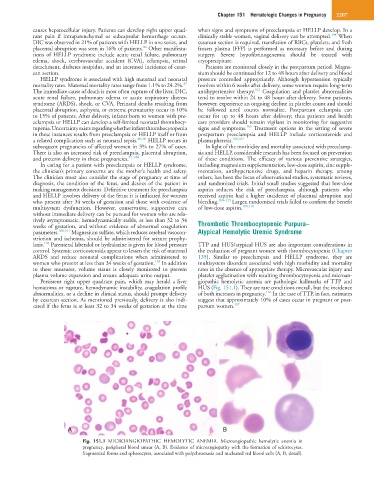
              Persistent  right  upper  quadrant  pain,  which  may  herald  a  liver   giopathic  hemolytic  anemia  are  pathologic  hallmarks  of TTP  and
            hematoma or rupture, hemodynamic instability, coagulation profile   HUS (Fig. 151.1). They are rare conditions overall, but the incidence
                                                                                        116
            abnormalities, or a decline in clinical status, should prompt delivery   of both increases in pregnancy.  In the case of TTP, in fact, estimates
            by cesarean section. As mentioned previously, delivery is also indi-  suggest that approximately 10% of cases occur in pregnant or post-
            cated if the fetus is at least 32 to 34 weeks of gestation at the time   partum women. 117


                       A                                                  B
                            Fig.  151.1  MICROANGIOPATHIC  HEMOLYTIC  ANEMIA.  Microangiopathic  hemolytic  anemia  in
                            pregnancy, peripheral blood smear (A, B). Evidence of microangiopathy with the formation of schistocytes,
                            fragmented forms and spherocytes, associated with polychromasia and nucleated red blood cells (A, B, detail).

