


Page 2474 - Hematology_ Basic Principles and Practice ( PDFDrive )
P. 2474
Chapter 151  Hematologic Changes in Pregnancy  2211

                                      179
            affected father and carrier mother.  In the United States, women   supine position. This phenomenon likely explains the increased risk
                                                                                                        191
            account for 1.7% of patients with hemophilia A and 3.2% of patients   of  left  leg  thrombosis  among  pregnant  women.   Furthermore,
                          180
            with hemophilia B.  Fifty percent of male offspring from a female   whereas  the  concentration  of  coagulation  factors  changes  during
            carrier inherit the disorder, whereas 100% of male offspring from an   pregnancy, the concentration of vWF, fibrinogen, and prothrombin,
            affected mother inherit the disease. Female carriers in both disorders   along  with  factors  V,  VII,  VIII,  IX,  X,  and  XII  increase,  and  the
                                                            181
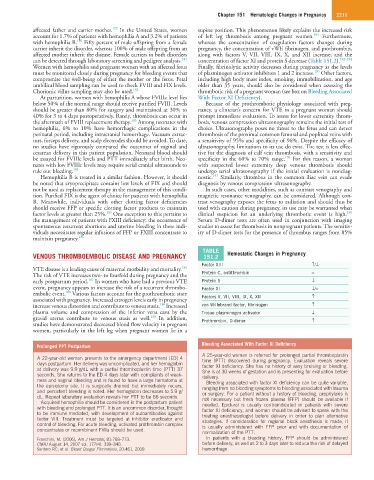
            can be detected through laboratory screening and pedigree analysis.    concentration of factor XI and protein S decrease (Table 151.2). 192–194
            Women with hemophilia and pregnant women with an affected fetus   Finally, fibrinolytic activity decreases during pregnancy as the levels
                                                                                                        195
            must be monitored closely during pregnancy for bleeding events that   of plasminogen activator inhibitors 1 and 2 increase.  Other factors,
            compromise the well-being of either the mother or the fetus. Fetal   including high body mass index, smoking, immobilization, and age
            umbilical blood sampling can be used to check FVIII and FIX levels.   older than 35 years, should also be considered when assessing the
            Chorionic villus sampling may also be used. 182       thrombotic risk of a pregnant woman (see box on Bleeding Associated
              At parturition, women with hemophilia A whose FVIIIc level lies   With Factor XI Deficiency).
            below 50% of the normal range should receive purified FVIII. Levels   Because  of  the  prothrombotic  physiology  associated  with  preg-
            should be greater than 80% for surgery and maintained at 30% to   nancy, a clinician’s concern for VTE in a pregnant woman should
            40% for 3 to 4 days postoperatively. Rarely, thrombosis can occur in   prompt immediate evaluation. To assess for lower extremity throm-
                                            183
            the aftermath of FVIII replacement therapy.  Among neonates with   bosis, venous compression ultrasonography remains the initial test of
            hemophilia,  6%  to  10%  have  hemorrhagic  complications  in  the   choice. Ultrasonography poses no threat to the fetus and can detect
            perinatal period, including intracranial hemorrhage. Vacuum extrac-  thrombosis of the proximal common femoral and popliteal veins with
            tors, forceps delivery, and scalp electrodes should be avoided. To date,   a sensitivity of 95% and specificity of 96%. Despite the efficacy of
            no  studies  have  rigorously  compared  the  outcomes  of  vaginal  and   ultrasonography, limitations to its use do exist. The test is less effec-
            cesarean delivery in this patient population. Neonatal blood should   tive for the diagnosis of calf vein thrombosis, with a sensitivity and
                                                                                              196
            be assayed for FVIIIc levels and PTT immediately after birth. Neo-  specificity in the 60% to 70% range.  For this reason, a woman
            nates with low FVIIIc levels may require serial cranial ultrasounds to   with  suspected  lower  extremity  deep  venous  thrombosis  should
            rule out bleeding. 184                                undergo serial ultrasonography if the initial evaluation is nondiag-
                                                                       197
              Hemophilia B is treated in a similar fashion. However, it should   nostic.   Similarly,  thrombus  in  the  common  iliac  vein  can  evade
            be noted that cryoprecipitate contains low levels of FIX and should   diagnosis by venous compression ultrasonography.
            not be used as replacement therapy in the management of this condi-  In such cases, other modalities, such as contrast venography and
            tion. Purified FIX is the agent of choice for patients with hemophilia   magnetic resonance venography, can be considered. Although con-
            B.  Meanwhile,  individuals  with  other  clotting  factor  deficiencies   trast venography exposes the fetus to radiation and should thus be
            should receive FFP or specific clotting factor products to maintain   used with caution during pregnancy, its use may be warranted when
                                                                                                                  196
                                    185
            factor levels at greater than 25%.  One exception to this pertains to   clinical  suspicion  for  an  underlying  thrombotic  event  is  high.
            the management of patients with FXIII deficiency; the occurrence of   Serum  D-dimer  tests  are  often  used  in  conjunction  with  imaging
            spontaneous recurrent abortions and uterine bleeding in these indi-  studies to assess for thrombosis in nonpregnant patients. The sensitiv-
            viduals necessitates regular infusions of FFP or FXIII concentrate to   ity of D-dimer tests for the presence of thrombus ranges from 85%
            maintain pregnancy. 186
                                                                   TABLE
            VENOUS THROMBOEMBOLIC DISEASE AND PREGNANCY             151.2  Hemostatic Changes in Pregnancy
                                                                   Factor XIII                         ↑/↓
                                                            186
            VTE disease is a leading cause of maternal morbidity and mortality.
            The risk of VTE increases two- to fourfold during pregnancy and the   Protein C, antithrombin  =
                              187
            early postpartum period.  In women who have had a previous VTE   Protein S                 ↓
            event, pregnancy appears to increase the risk of a recurrent thrombo-  Factor XI           ↓/=
                      188
            embolic event.  Various factors account for the prothrombotic state   Factors V, VII, VIII, IX, X, XII  ↑
            associated with pregnancy. Increased estrogen levels early in pregnancy
                                                     189
            increase venous distention and contribute to venous stasis.  Increased   von Willebrand factor, fibrinogen  ↑
            plasma  volume  and  compression  of  the  inferior  vena  cava  by  the   Tissue plasminogen activator  ↓
                                                  190
            gravid  uterus  contribute  to  venous  stasis  as  well.   In  addition,   Prothrombin, D-dimer  ↑
            studies have demonstrated decreased blood flow velocity in pregnant
            women, particularly in the left leg when pregnant women lie in a
             Prolonged PPT Postpartum                              Bleeding Associated With Factor XI Deficiency
                                                                   A 25-year-old woman is referred for prolonged partial thromboplastin
             A 22-year-old woman presents to the emergency department (ED) 4   time  (PTT)  discovered  during  pregnancy.  Evaluation  reveals  severe
             days postpartum. Her delivery was uncomplicated, and her hemoglobin   factor XI deficiency. She has no history of easy bruising or bleeding.
             at delivery was 9.9 g/dL with a partial thromboplastin time (PTT) 37   She is at 30 weeks of gestation and is presenting for evaluation before
             seconds. She returns to the ED 4 days later with complaints of weak-  delivery.
             ness and vaginal bleeding and is found to have a large hematoma at   Bleeding associated with factor XI deficiency can be quite variable,
             the  episiotomy  site.  It  is  surgically  drained  but  immediately  recurs,   ranging from no bleeding symptoms to bleeding associated with trauma
             and persistent bleeding is noted. Her hemoglobin decreases to 5.9 g/  or surgery. For a patient without a history of bleeding, prophylaxis is
             dL. Repeat laboratory evaluation reveals her PTT to be 66 seconds.  not  necessary  but  fresh  frozen  plasma  (FFP)  should  be  available  if
              Acquired hemophilia should be considered in the postpartum patient   needed.  Epidural  is  usually  contraindicated  in  patients  with  severe
             with bleeding and prolonged PTT. It is an uncommon disorder, thought   factor XI deficiency, and women should be advised to speak with the
             to be immune mediated, with development of autoantibodies against   treating  anesthesiologist  before  delivery  in  order  to  plan  alternative
             factor  VIII.  Treatment  must  be  targeted  at  inhibitor  eradicator  and   strategies.  If  consideration  for  regional  block  anesthesia  is  made,  it
             control of bleeding. For acute bleeding, activated prothrombin complex   is  usually  administered  with  FFP  prior  and  with  documentation  of
             concentrates or recombinant FVIIa should be used.     normalization of the PTT.
             Franchini, M. (2006), Am J Hematol, 81:768–773.        In  patients  with  a  bleeding  history,  FFP  should  be  administered
             CMAJ August 14, 2007 vol. 177(4): 339–340.            before delivery, as well as 2 to 3 days later to reduce the risk of delayed
             Santoro RC, et al. Blood Coagul Fibrinolysis, 20:461, 2009.  hemorrhage.

