


Page 2594 - Hematology_ Basic Principles and Practice ( PDFDrive )
P. 2594
Chapter 159  Hematologic Problems in the Surgical Patient  2311


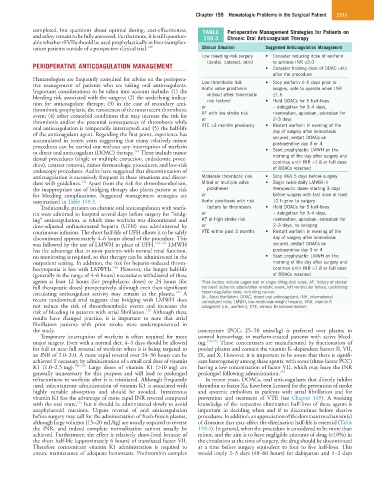
            completed,  but  questions  about  optimal  dosing,  cost-effectiveness,   TABLE   Perioperative Management Strategies for Patients on
            and safety remain to be fully answered. Furthermore, it is still question-  159.3  Chronic Oral Anticoagulant Therapy
            able whether rFVIIa should be used prophylactically in liver transplan-
            tation patients outside of a prospective clinical trial. 140  Clinical Situation  Suggested Anticoagulation Management
                                                                   Low bleeding-risk surgery   •  Consider reducing dose of warfarin
                                                                     (dental, cataract, skin)  to achieve INR ≤2.0
            PERIOPERATIVE ANTICOAGULATION MANAGEMENT                                    •  Consider holding dose of DOAC until
                                                                                          after the procedure
            Hematologists are frequently consulted for advice on the periopera-
            tive  management  of  patients  who  are  taking  oral  anticoagulants.   Low thrombotic risk  •  Stop warfarin 4–5 days prior to
            Important considerations to be taken into account include: (1) the   Aortic valve prosthesis   surgery, safe to operate when INR
            bleeding risk associated with the surgery; (2) the underlying indica-  without other thrombotic   ≤1.5
                                                                            a
            tion  for  anticoagulant  therapy;  (3)  in  the  case  of  secondary  anti-  risk factors  •  Hold DOACs for 5 half-lives
            thrombotic prophylaxis, the remoteness of the most recent thrombotic   or     – dabigatran for 3–4 days,
            event; (4) other comorbid conditions that may increase the risk for   AF with low stroke risk  rivaroxaban, apixaban, edoxaban for
            thrombosis and/or the potential consequences of thrombosis while   or         2–3 days
            oral anticoagulation is temporarily interrupted; and (5) the half-life   VTE >3 months previously  •  Restart warfarin in evening of the
            of the anticoagulant agent. Regarding the first point, experience has         day of surgery after hemostasis
            accumulated in recent years suggesting that many relatively minor             secured; restart DOACs on
            procedures can be carried out without any interruption of warfarin            postoperative day 3 or 4
                                             141
            or direct oral anticoagulant (DOAC) therapy.  These include minor           •  Start prophylactic LMWH on the
            dental procedures (single or multiple extraction, endodontic proce-           morning of the day after surgery and
            dure), cataract removal, minor dermatologic procedures, and low-risk          continue until INR >1.8 or full dose
            endoscopy procedures. Audits have suggested that discontinuation of           of DOACs resumed
            anticoagulation is excessively frequent in these situations and discor-  Moderate thrombotic risk  •  Stop VKA 5 days before surgery
                            142
            dant with guidelines.  Apart from the risk for thromboembolism,   Mitral or multiple valve   •  Begin twice-daily LMWH in
            the inappropriate use of bridging therapy also places patient at risk   prostheses  therapeutic doses starting 3 days
            for  bleeding  complications.  Suggested  management  strategies  are   or    before surgery with last dose at least
            summarized in Table 159.3.                             Aortic prosthesis with risk   12 h prior to surgery
              Traditionally, patients on chronic oral anticoagulation with warfa-  factors for thrombosis  •  Hold DOACs for 5 half-lives
            rin were admitted to hospital several days before surgery for “bridg-  or     – dabigatran for 3–4 days,
            ing” anticoagulation, at which time warfarin was discontinued and   AF at high stroke risk  rivaroxaban, apixaban, edoxaban for
            dose-adjusted  unfractionated  heparin  (UFH)  was  administered  by   or     2–3 days; no bridging
            continuous infusion. The short half-life of UFH allows it to be safely   VTE within past 3 months  •  Restart warfarin in evening of the
            discontinued approximately 4–6 hours ahead of the procedure. This             day of surgery after hemostasis
            was followed by the use of LMWH in place of UFH. 143-145  LMWH                secured; restart DOACs on
            has the advantage that in most patients with normal renal function,           postoperative day 3 or 4
            no monitoring is required, so that therapy can be administered in the       •  Start prophylactic LMWH on the
            outpatient setting. In addition, the risk for heparin-induced throm-          morning of the day after surgery and
                                      146
            bocytopenia  is  less  with  LMWHs.   However,  the  longer  half-life        continue until INR >1.8 or full dose
            (generally in the range of 4–6 hours) necessitates withdrawal of these        of DOACs resumed
            agents  at  least  12  hours  (for  prophylactic  doses)  or  24  hours  (for   a Risk factors include caged-ball or single tilting-disk valve, AF, history of stroke/
            full therapeutic doses) preoperatively, although even then significant   transient ischemic attack/other embolic event, left ventricular failure, underlying
                                                          147
            circulating  anticoagulant  activity  may  remain  in  the  plasma.   A   hypercoagulable state, including cancer.
            recent  randomized  trial  suggests  that  bridging  with  LMWH  does   AF, Atrial fibrillation; DOAC, direct oral anticoagulant; INR, international
                                                                   normalized ratio; LMWH, low-molecular-weight heparin; VKA, vitamin K
            not  reduce  the  risk  of  thromboembolic  events  and  increases  the   antagonist (i.e., warfarin); VTE, venous thromboembolism.
                                                 148
            risk of bleeding in patients with atrial fibrillation.  Although these
            results  have  changed  practice,  it  is  important  to  note  that  atrial
            fibrillation  patients  with  prior  stroke  were  underrepresented  in
            the study.                                            concentrate  (PCC;  25–50  units/kg)  is  preferred  over  plasma  to
              Temporary  interruption  of  warfarin  is  often  required  for  more   control  hemorrhage  in  warfarin-treated  patients  with  active  bleed-
            major surgery. Even with a normal diet, 4–5 days should be allowed   ing. 150,152  These  concentrates  are  manufactured  by  fractionation  of
            for full or near-full reversal of warfarin when it is being targeted to   pooled plasma and contain the vitamin K–dependent factors II, VII,
            an INR of 2.0–3.0. A more rapid reversal over 24–36 hours can be   IX, and X. However, it is important to be aware that there is signifi-
            achieved if necessary by administration of a small oral dose of vitamin   cant heterogeneity among these agents, with some (three-factor PCC)
            K1  (1.0–2.5 mg). 149,150   Large  doses  of  vitamin  K1  (>10 mg)  are   having a low concentration of factor VII, which may leave the INR
            generally  unnecessary  for  this  purpose  and  will  lead  to  prolonged   prolonged following administration. 153
            refractoriness to warfarin after it is reinitiated. Although frequently   In recent years, DOACs, oral anticoagulants that directly inhibit
            used, subcutaneous administration of vitamin K1 is associated with   thrombin or factor Xa, have been licensed for the prevention of stroke
            highly  variable  absorption  and  should  be  avoided.  Intravenous   and  systemic  embolism  in  patients  with  atrial  fibrillation  and  for
            vitamin K1 has the advantage of more rapid INR reversal compared   prevention  and  treatment  of  VTE  (see  Chapter  149).  A  working
                          151
            with the oral route,  but it should be administered slowly to avoid   knowledge of the respective elimination half-lives of these agents is
            anaphylactoid  reactions.  Urgent  reversal  of  oral  anticoagulation   important  in  deciding  when  and  if  to  discontinue  before  elective
            before surgery may call for the administration of fresh-frozen plasma,   procedures. In addition, an appreciation of the dominant mechanism(s)
            although large volumes (15–20 mL/kg) are usually required to reverse   of clearance that may affect the elimination half-life is essential (Table
            the  INR,  and  indeed  complete  normalization  cannot  usually  be   159.4). In general, when the procedure is considered to be more than
            achieved. Furthermore, the effect is relatively short-lived because of   minor, and the aim is to have negligible amounts of drug (<10%) in
            the short half-life (approximately 6 hours) of transfused factor VII.   the circulation at the time of surgery, the drug should be discontinued
            Therefore  concomitant  vitamin  K1  administration  is  required  to   at  a  time  before  surgery  equivalent  to  four  to  five  half-lives. This
            ensure maintenance of adequate hemostasis. Prothrombin complex   would imply 2–3 days (48–60 hours) for dabigatran and 1–2 days

