


Page 2595 - Hematology_ Basic Principles and Practice ( PDFDrive )
P. 2595
2312   Part XIII  Consultative Hematology


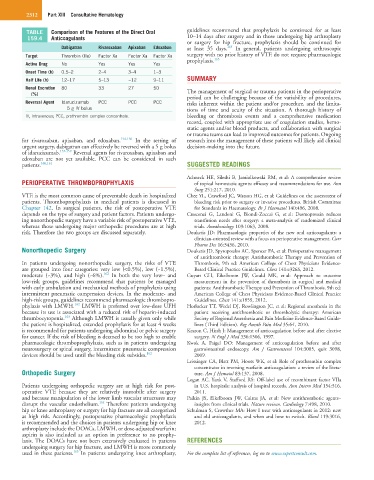
          TABLE   Comparison of the Features of the Direct Oral   guidelines  recommend  that  prophylaxis  be  continued  for  at  least
          159.4   Anticoagulants                              10–14 days after surgery and in those undergoing hip arthroplasty
                                                              or  surgery  for  hip  fracture,  prophylaxis  should  be  continued  for
                                                                           165
                     Dabigatran  Rivaroxaban  Apixaban  Edoxaban  at  least  35  days.   In  general,  patients  undergoing  arthroscopic
         Target      Thrombin (IIa)  Factor Xa  Factor Xa  Factor Xa  surgery with no prior history of VTE do not require pharmacologic
                                                              prophylaxis. 165
         Active Drug  No         Yes       Yes     Yes
         Onset Time (h)  0.5–2   2–4       3–4     1–3
         Half Life (h)  12–17    5–13      ~12     9–11       SUMMARY
         Renal Excretion   80    33        27      50         The management of surgical or trauma patients in the perioperative
           (%)
                                                              period can be challenging because of the variability of procedures,
         Reversal Agent  Idarucizumab   PCC  PCC   PCC        risks inherent within the patient and/or procedure, and the limita-
                       5 g IV bolus                           tions  of  time  and  acuity  of  the  situation.  A  thorough  history  of
         IV, Intravenous; PCC, prothrombin complex concentrate.  bleeding  or  thrombosis  events  and  a  comprehensive  medication
                                                              record, coupled with appropriate use of coagulation studies, hemo-
                                                              static agents and/or blood products, and collaboration with surgical
                                                              or trauma teams can lead to improved outcomes for patients. Ongoing
        for  rivaroxaban,  apixaban,  and  edoxaban. 154-156   In  the  setting  of   research into the management of these patients will likely aid clinical
        urgent surgery, dabigatran can effectively be reversed with a 5 g bolus   decision-making into the future.
        of idarucizumab. 157-159  Reversal agents for rivaroxaban, apixaban and
        edoxaban  are  not  yet  available.  PCC  can  be  considered  in  such
        patients. 160,161                                     SUGGESTED READINGS

                                                              Achneck  HE,  Sileshi  B,  Jamiolkowski  RM,  et al:  A  comprehensive  review
        PERIOPERATIVE THROMBOPROPHYLAXIS                         of topical hemostatic agents: efficacy and recommendations for use. Ann
                                                                 Surg 251:217, 2010.
        VTE is the most common cause of preventable death in hospitalized   Chee YL, Crawford JC, Watson HG, et al: Guidelines on the assessment of
        patients.  Thromboprophylaxis  in  medical  patients  is  discussed  in   bleeding risk prior to surgery or invasive procedures. British Committee
        Chapter  142.  In  surgical  patients,  the  risk  of  postoperative  VTE   for Standards in Haematology. Br J Haematol 140:496, 2008.
        depends on the type of surgery and patient factors. Patients undergo-  Crescenzi  G,  Landoni  G,  Biondi-Zoccai  G,  et al:  Desmopressin  reduces
        ing nonorthopedic surgery have a variable risk of postoperative VTE,   transfusion  needs  after  surgery:  a  meta-analysis  of  randomized  clinical
        whereas those undergoing major orthopedic procedures are at high   trials. Anesthesiology 109:1063, 2008.
        risk. Therefore the two groups are discussed separately.  Douketis  JD:  Pharmacologic  properties  of  the  new  oral  anticoagulants:  a
                                                                 clinician-oriented review with a focus on perioperative management. Curr
                                                                 Pharm Des 16:3436, 2010.
        Nonorthopedic Surgery                                 Douketis JD, Spyropoulos AC, Spencer FA, et al: Perioperative management
                                                                 of antithrombotic therapy: Antithrombotic Therapy and Prevention of
        In  patients  undergoing  nonorthopedic  surgery,  the  risks  of  VTE   Thrombosis,  9th  ed:  American  College  of  Chest  Physicians  Evidence-
        are  grouped  into  four  categories:  very  low  (<0.5%),  low  (~1.5%),   Based Clinical Practice Guidelines. Chest 141:e326S, 2012.
                                   162
        moderate  (~3%),  and  high  (~6%).   In  both  the  very  low–  and   Guyatt  GH,  Eikelboom  JW,  Gould  MK,  et al:  Approach  to  outcome
        low-risk  groups,  guidelines  recommend  that  patients  be  managed   measurement  in  the  prevention  of  thrombosis  in  surgical  and  medical
        with early ambulation and mechanical methods of prophylaxis using   patients: Antithrombotic Therapy and Prevention of Thrombosis, 9th ed:
        intermittent pneumatic compression devices. In the moderate- and   American College of Chest Physicians Evidence-Based Clinical Practice
        high-risk groups, guidelines recommend pharmacologic thrombopro-  Guidelines. Chest 141:e185S, 2012.
                         162
        phylaxis with LMWH.  LMWH is preferred over low-dose UFH   Horlocker TT, Wedel DJ, Rowlingson JC, et al: Regional anesthesia in the
        because its use is associated with a reduced risk of heparin-induced   patient  receiving  antithrombotic  or  thrombolytic  therapy:  American
                      163
        thrombocytopenia.  Although LMWH is usually given only while   Society of Regional Anesthesia and Pain Medicine Evidence-Based Guide-
        the patient is hospitalized, extended prophylaxis for at least 4 weeks   lines (Third Edition). Reg Anesth Pain Med 35:64, 2010.
        is recommended for patients undergoing abdominal or pelvic surgery   Kearon C, Hirsh J: Management of anticoagulation before and after elective
        for cancer. If the risk of bleeding is deemed to be too high to enable   surgery. N Engl J Med 336:1506, 1997.
        pharmacologic thromboprophylaxis, such as in patients undergoing   Kwok  A,  Faigel  DO:  Management  of  anticoagulation  before  and  after
        neurosurgery or spinal surgery, intermittent pneumatic compression   gastrointestinal  endoscopy.  Am  J  Gastroenterol  104:3085,  quiz  3098,
        devices should be used until the bleeding risk subsides. 162  2009.
                                                              Leissinger CA, Blatt PM, Hoots WK, et al: Role of prothrombin complex
                                                                 concentrates in reversing warfarin anticoagulation: a review of the litera-
        Orthopedic Surgery                                       ture. Am J Hematol 83:137, 2008.
                                                              Logan AC, Yank V, Stafford RS: Off-label use of recombinant factor VIIa
        Patients  undergoing  orthopedic  surgery  are  at  high  risk  for  post-  in U.S. hospitals: analysis of hospital records. Ann Intern Med 154:516,
        operative  VTE  because  they  are  relatively  immobile  after  surgery   2011.
        and because manipulation of the lower limb vascular structures may   Paikin  JS,  Eikelboom  JW,  Cairns  JA,  et al:  New  antithrombotic  agents–
                                  164
        disrupt the vascular endothelium.  Therefore patients undergoing   insights from clinical trials. Nature reviews. Cardiology 7:498, 2010.
        hip or knee arthroplasty or surgery for hip fracture are all categorized   Schulman S, Crowther MA: How I treat with anticoagulants in 2012: new
        as high risk. Accordingly, postoperative pharmacologic prophylaxis   and old anticoagulants, and when and how to switch. Blood 119:3016,
        is recommended and the choices in patients undergoing hip or knee   2012.
        arthroplasty include the DOACs, LMWH, or dose-adjusted warfarin;
        aspirin  is  also  included  as  an  option  in  preference  to  no  prophy-
        laxis. The DOACs have not been extensively evaluated in patients   REFERENCES
        undergoing surgery for hip fracture, and LMWH is more commonly
                         165
        used in these patients.  In patients undergoing knee arthroplasty,   For the complete list of references, log on to www.expertconsult.com.

