


Page 293 - Hematology_ Basic Principles and Practice ( PDFDrive )
P. 293
244    Part III  Immunologic Basis of Hematology


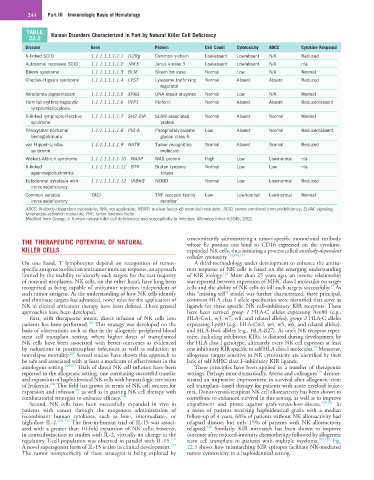
          TABLE   Human Disorders Characterized in Part by Natural Killer Cell Deficiency
          22.2
         Disease               Gene                 Protein         Cell Count  Cytotoxicity  ADCC  Cytokine Response
         X-linked SCID         1.1.1.1.1.1.1.1  IL2Rg  Common γ-chain  Low/absent  Low/absent  N/A  Reduced
         Autosomal recessive SCID  1.1.1.1.1.1.1.2  JAK3  Janus kinase 3  Low/absent  Low/absent  N/A  n/a
         Bloom syndrome        1.1.1.1.1.1.1.3  BLM  Bloom helicase  Normal   Low        N/A        Normal
         Chediak-Higashi syndrome  1.1.1.1.1.1.1.4  LYST  Lysosome trafficking   Normal  Absent  Absent  Reduced
                                                      regulator
         Xeroderma pigmentosum  1.1.1.1.1.1.1.5  XPAG  DNA repair enzymes  Normal  Low   N/A        Normal
         Familial erythrophagocytic   1.1.1.1.1.1.1.6  PFP1  Perforin  Normal  Absent    Absent     Reduced/absent
           lymphohistiocytosis
         X-linked lymphoproliferative   1.1.1.1.1.1.1.7  SH2-DIA  SLAM-associated   Normal  Absent  Normal  Normal
           syndrome                                   protein
         Paroxysmal nocturnal   1.1.1.1.1.1.1.8  PIG-A  Phosphatidylinositol   Low  Absent  Normal  Reduced/absent
           hemoglobinuria                             glycan class A
         von Hippel–Lindau     1.1.1.1.1.1.1.9  NKTR  Tumor recognition   Normal  Absent  Normal    Reduced
           syndrome                                   molecule
         Wiskott-Aldrich syndrome  1.1.1.1.1.1.1.10  WASP  WAS protein  High  Low        Low/normal  n/a
         X-linked              1.1.1.1.1.1.1.11  BTK  Bruton tyrosine   Normal  Low      Low        n/a
           agammaglobulinemia                         kinase
         Ectodermal dysplasia with   1.1.1.1.1.1.1.12  IKBKG  NEMO  Normal    Low        Low/normal  Reduced
           immunodeficiency
         Common variable       TACI                 TNF receptor family   Low  Low/normal  Low/normal  Normal
           immunodeficiency                           member
         ADCC, Antibody-dependent cytotoxicity; N/A, not applicable; NEMO, nuclear factor-κB essential modulator; SCID, severe combined immunodeficiency; SLAM, signaling
         lymphocyte-activation molecule; TNF, tumor necrosis factor.
         Modified from Orange J: Human natural killer cell deficiencies and susceptibility to infection. Microbes Infect 4:1545, 2002.


        THE THERAPEUTIC POTENTIAL OF NATURAL                  concomitantly administering a tumor-specific monoclonal antibody
                                                              whose  Fc  portion  can  bind  to  CD16  expressed  on  the  cytokine-
        KILLER CELLS                                          expanded NK cells, thus initiating a process called antibody-dependent
                                                              cellular cytotoxicty. 112,116,117
        On  one  hand,  T  lymphocytes  depend  on  recognition  of  tumor-  A third methodology under development to enhance the antitu-
        specific antigens to effect an antitumor immune response, an approach   mor response of NK cells is based on the emerging understanding
                                                                          118
        limited by the inability to identify such targets for the vast majority   of KIR biology.  More than 25 years ago, an inverse relationship
        of nonviral neoplasms. NK cells, on the other hand, have long been   was reported between expression of MHC class I molecules on target
                                                                                                             39
        recognized as being capable of antitumor rejection independent of   cells and the ability of NK cells to kill such targets successfully.  As
        such tumor antigens. As the understanding of how NK cells identify   this “missing self” model was further characterized, three principal,
        and eliminate targets has advanced, novel roles for the application of   common HLA class I allele specificities were identified that serve as
        NK in clinical anticancer therapy have been defined. Three general   ligands  for  three  specific  NK  cell–inhibitory  KIR  receptors. These
        approaches have been developed.                       have  been  termed  group  1  HLA-C  alleles  expressing  Asn80  (e.g.,
           First,  with  therapeutic  intent,  direct  infusion  of  NK  cells  into   HLA-Cw1, w3, w7, w8, and related alleles), group 2 HLA-C alleles
                              102
        patients has been performed.  This strategy was developed on the   expressing Lys80 (e.g., HLA-Cw2, w4, w5, w6, and related alleles),
        basis of observations such as that in the allogeneic peripheral blood   and HLA-Bw4 alleles (e.g., HLA-B27). As one’s NK receptor reper-
        stem  cell  transplant  setting,  where  higher  doses  of  transplanted   toire, including inhibitory KIRs, is dictated during development by
        NK  cells  have  been  associated  with  better  outcomes  as  evidenced   the HLA class I genotype, ultimately every NK cell expresses at least
                                                                                                        18
        by  reductions  in  posttransplant  infections  as  well  as  reduction  in   one inhibitory KIR specific to self HLA class I molecules.  Moreover,
                        103
        nonrelapse mortality.  Several studies have shown this approach to   allogeneic targets sensitive to NK cytotoxicity are identified by their
        be safe and associated with at least a modicum of effectiveness in the   lack of self MHC class I–inhibitory KIR ligands.
        autologous setting. 104,105  Trials of direct NK cell infusion have been   These principles have been applied in a number of therapeutic
                                                                                                         119
        reported in the allogeneic setting, one correlating successful transfer   settings. Perhaps most dramatically, Aversa and colleagues  demon-
        and expansion of haploidentical NK cells with hematologic remission   strated an impressive improvement in survival after allogeneic stem
                 106
        of leukemia.  This field has grown in terms of NK cell sources for   cell transplant–based therapy for patients with acute myeloid leuke-
                         107
        expansion and infusion  as well as in pairing NK cell therapy with   mia. Donor-versus-recipient NK cell alloreactivity has been shown to
        combinatorial strategies to enhance efficacy. 108     contribute to enhanced survival in this setting, as well as to improve
           Second,  NK  cells  have  been  successfully  expanded  in  vivo  in   engraftment  and  protec  against  graft-versus-host-disease. 120,121   In
        patients  with  cancer  through  the  exogenous  administration  of   a  series  of  patients  receiving  haploidentical  grafts  with  a  median
        recombinant  human  cytokines,  such  as  low-,  intermediate-,  or   follow-up of 4 years, 68% of patients without NK alloreactivity had
        high-dose IL-2. 109–113  The first-in-human trial of IL-15 was associ-  relapsed  disease,  but  only  15%  of  patients  with  NK  alloreactivity
                                                                     120
        ated  with  a  greater  than  10-fold  expansion  of  NK  cells;  however,   relapsed.   Similarly,  KIR  mismatch  has  been  shown  to  improve
        in contradistinction to studies with IL-2, virtually no change in the   outcome after reduced-intensity chemotherapy followed by allogeneic
                                                         114
        regulatory T-cell population was observed in parallel with IL-15.    stem  cell  transplant  in  patients  with  multiple  myeloma. 109,122   Fig.
                                                         115
        A novel superagonist form of IL-15 is also in clinical development.    22.3 shows how mismatching KIR epitopes facilitate NK-mediated
        The  tumor  nonspecificity  of  these  strategies  is  being  explored  by   tumor cytotoxicity in a haploidentical setting.

