


Page 362 - Hematology_ Basic Principles and Practice ( PDFDrive )
P. 362
298    Part IV  Disorders of Hematopoietic Cell Development


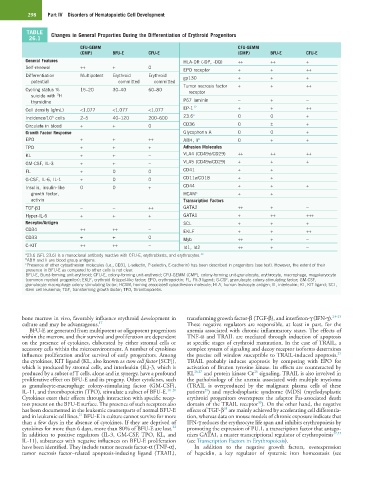
          TABLE   Changes in General Properties During the Differentiation of Erythroid Progenitors
          26.1
                           CFU-GEMM                                            CFU-GEMM
                           (CMP)      BFU-E       CFU-E                        (CMP)      BFU-E      CFU-E
         General Features                                    HLA-DR (-DP, -DQ)  ++        ++         +
         Self-renewal      ++         +           0          EPO receptor      +          +          ++
         Differentiation   Multipotent  Erythroid   Erythroid   gp130          +          +          +
           potential                    committed  committed
                                                             Tumor necrosis factor   +    +          ++
         Cycling status %   15–20     30–40       60–80        receptor
                    3
           suicide with  H
           thymidine                                         P67 laminin       −          +          −
         Cell density (g/mL)  <1.077  <1.077      <1.077     EP-1 12           +          +          ++
         Incidence/10  cells  2–5     40–120      200–600    23.6 a            0          0          +
                  5
         Circulate in blood  +        +           0          CD36              0          ±          +
         Growth Factor Response                              Glycophorin A     0          0          +
         EPO               +          +           ++         ABH, Ii b         0          +          +
         TPO               +          +           +          Adhesion Molecules
         KL                +          +           −          VLA4 (CD49d/CD29)  ++       ++          ++
         GM-CSF, IL-3      +          +           −          VLA5 (CD49e/CD29)  +        +           +
         FL                +          0           0          CD41              +         +
         G-CSF, IL-6, IL-1  +         0           0          CD11a/CD18        +         +
         Insulin, insulin-like   0    0           +          CD44              +         +           +
           growth factor,                                    HCAM c            +          +
           activin                                           Transcription Factors
         TGF-β1            −          −           ++         GATA2             ++        +           −
         Hyper-IL-6        +          +           +          GATA1             +         ++          +++
         Receptor/Antigen                                    SCL               +         +           +
         CD34              ++         ++          −          EKLF              +         +           ++
         CD33              +          +           0          Myb               ++        +           −
         C-KIT             ++         ++          −          Id1, Id2          ++        +           −
         a 23.6 (SFL 23.6) is a monoclonal antibody reactive with CFU-E, erythroblasts, and erythrocytes. 13
         b ABH and Ii are blood group antigens.
         c Presence of other cytoadhesion molecules (i.e., CD31, L-selectin, P-selectin, E-cadherin) has been described in progenitors (see text). However, the extent of their
         presence in BFU-E as compared to other cells is not clear.
         BFU-E, Burst-forming unit-erythroid; CFU-E, colony-forming unit-erythroid; CFU-GEMM (CMP), colony-forming unit-granulocyte, erythrocyte, macrophage, megakaryocyte
         (common myeloid progenitor); EKLF, erythroid Krüppel-like factor; EPO, erythropoietin; FL, Flt-3 ligand; G-CSF, granulocyte colony-stimulating factor; GM-CSF,
         granulocyte-macrophage colony-stimulating factor; HCAM, homing-associated cytoadhesion molecule; HLA, human leukocyte antigen; IL, interleukin; KL, KIT ligand; SCL,
         stem cell leukemia; TGF, transforming growth factor; TPO, thrombopoietin.


        bone marrow in vivo, favorably influence erythroid development in   transforming growth factor-β (TGF-β), and interferon-γ (IFN-γ). 23–25
        culture and may be advantageous. 17                   These  negative  regulators  are  responsible,  at  least  in  part,  for  the
           BFU-E are generated from multipotent or oligopotent progenitors   anemia associated with chronic inflammatory states. The effects of
        within the marrow, and their survival and proliferation are dependent   TNF-α  and TRAIL  are  mediated  through  induction  of  apoptosis
        on the presence of cytokines, elaborated by either stromal cells or   at specific stages of erythroid maturation. In the case of TRAIL, a
        accessory cells within the microenvironment. A number of cytokines   complex system of signaling and decoy receptor isoforms determines
                                                                                                               25
        influence proliferation and/or survival of early progenitors. Among   the precise cell window susceptible to TRAIL-induced apoptosis.
        the cytokines, KIT ligand (KL, also known as stem cell factor [SCF]),   TRAIL  probably  induces  apoptosis  by  competing  with  EPO  for
        which is produced by stromal cells, and interleukin (IL)-3, which is   activation of Bruton tyrosine kinase. Its effects are counteracted by
                                                                                    28
        produced by a subset of T cells, alone and in synergy, have a profound   KL 26,27  and protein kinase Cε  signaling. TRAIL is also involved in
        proliferative effect on BFU-E and its progeny. Other cytokines, such   the pathobiology of the anemia associated with multiple myeloma
        as  granulocyte-macrophage  colony-stimulating  factor  (GM-CSF),   (TRAIL  is  overproduced  by  the  malignant  plasma  cells  of  these
                                                                    29
        IL-11, and thrombopoietin (TPO), stimulate a subset of BFU-E. 18–20    patients )  and  myelodysplastic  syndrome  (MDS)  (myelodysplastic
        Cytokines exert their effects through interaction with specific recep-  erythroid  progenitors  overexpress  the  adaptor  Fas-associated  death
                                                                                     30
        tors present on the BFU-E surface. The presence of such receptors also   domain of the TRAIL receptor ). On the other hand, the negative
                                                                          31
        has been documented in the leukemic counterparts of normal BFU-E   effects of TGF-β  are mainly achieved by accelerating cell differentia-
                           21
        and in leukemic cell lines.  BFU-E in culture cannot survive for more   tion, whereas data on mouse models of chronic exposure indicate that
        than a few days in the absence of cytokines. If they are deprived of   IFN-γ reduces the erythrocyte life span and inhibits erythropoiesis by
                                                         22
        cytokines for more than 6 days, more than 80% of BFU-E are lost.    promoting the expression of PU.1, a transcription factor that antago-
        In  addition  to  positive  regulators  (IL-3,  GM-CSF, TPO,  KL,  and   nizes GATA1, a master transcriptional regulator of erythropoiesis 32,33
        IL-11), substances with negative influences on BFU-E proliferation   (see Transcription Factors in Erythropoiesis).
        have been identified. They include tumor necrosis factor-α (TNF-α),   In  addition  to  the  negative  growth  factors,  overexpression
        tumor  necrosis  factor–related  apoptosis-inducing  ligand  (TRAIL),   of  hepcidin,  a  key  regulator  of  systemic  iron  homeostasis  (see

