


Page 365 - Hematology_ Basic Principles and Practice ( PDFDrive )
P. 365
Chapter 26  Biology of Erythropoiesis, Erythroid Differentiation, and Maturation  301


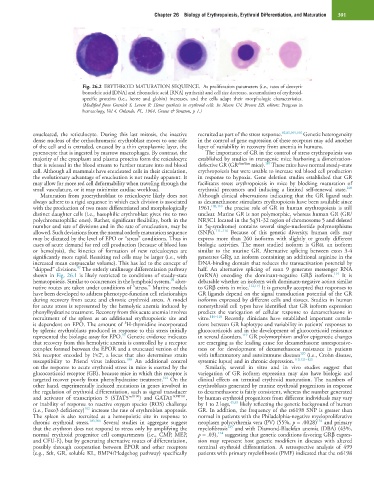
                            Fig. 26.2  ERYTHROID MATURATION SEQUENCE.  As proliferation parameters (i.e., rates of deoxyri-
                            bonucleic acid [DNA] and ribonucleic acid [RNA] synthesis) and cell size decrease, accumulation of erythroid-
                            specific  proteins  (i.e.,  heme  and  globin)  increases,  and  the  cells  adapt  their  morphologic  characteristics.
                            (Modified from Granick S, Levere R: Heme synthesis in erythroid cells. In Moore CV, Brown EB, editors: Progress in
                            hematology, Vol 4, Orlando, FL, 1964, Grune & Stratton, p 1.)


            enucleated,  the  reticulocyte.  During  this  last  mitosis,  the  inactive   recruited as part of the stress response. 82,83,105,106  Genetic heterogeneity
            dense nucleus of the orthochromatic erythroblast moves to one side   in the control of gene expression of these receptors may add another
            of the cell and is extruded, encased by a thin cytoplasmic layer, the   layer of variability in recovery from anemia in humans.
            pyrenocyte that is ingested by marrow macrophages. By contrast, the   The importance of GR in the control of stress erythropoiesis was
            majority of the cytoplasm and plasma proteins form the reticulocyte   established by studies in transgenic mice harboring a dimerization-
                                                                                        107
            that is released in the blood stream to further mature into red blood   defective GR (GR dim/dim  mice).  These mice have normal steady-state
            cell. Although all mammals have enucleated cells in their circulation,   erythropoiesis but were unable to increase red blood cell production
            the evolutionary advantage of enucleation is not readily apparent. It   in response to hypoxia. Gene deletion studies established that GR
            may allow for more red cell deformability when traveling through the   facilitates  stress  erythropoiesis  in  mice  by  blocking  maturation  of
                                                                                                                  108
            small vasculature, or it may minimize cardiac workload.  erythroid  precursors  and  inducing  a  limited  self-renewal  state.
              Maturation from proerythroblast to reticulocyte likely does not   Although clinical observations indicating that the GR ligand such
            always adhere to a rigid sequence in which each division is associated   as dexamethasone stimulates erythropoiesis have been available since
            with the production of two more differentiated and morphologically   1961, 109,110   the  precise  role  of  GR  in  human  erythropoiesis  is  still
            distinct daughter cells (i.e., basophilic erythroblast gives rise to two   unclear. Murine GR is not polymorphic, whereas human GR (GR/
            polychromatophilic ones). Rather, significant flexibility, both in the   NR3C1 located in the 5q31-32 region of chromosome 5 and deleted
            number and rate of divisions and in the rate of enucleation, may be   in  5q-syndrome)  contains  several  single-nucleotide  polymorphisms
            allowed. Such deviations from the normal orderly maturation sequence   (SNPs). 111–114   Because  of  this  genetic  diversity,  human  cells  may
            may be dictated by the level of EPO or “stress” conditions. Thus in   express  more  than  260  isoforms  with  slightly  or  greatly  different
            cases of acute demand for red cell production (because of blood loss   biologic  activities. The  most  studied  isoform  is  GRα,  an  isoform
            or  hemolysis),  the  kinetics  of  formation  of  new  reticulocytes  are   similar  to  the  murine  GR.  Alternative  splicing  between  exon  3-4
            significantly more rapid. Resulting red cells may be larger (i.e., with   generates GRγ, an isoform containing an additional arginine in the
            increased mean corpuscular volume). This has led to the concept of   DNA-binding domain that reduces the transactivation potential by
                          97
            “skipped” divisions.  The orderly unilineage differentiation pathway   half.  An  alternative  splicing  of  exon  9  generates  messenger  RNA
                                                                                                              114
            shown in Fig. 26.1 is likely restricted to conditions of steady-state   (mRNA)  encoding  the  dominant-negative  GRβ  isoform.   It  is
                                                         98
            hematopoiesis. Similar to occurrences in the lymphoid system,  alter-  debatable whether an isoform with dominant-negative action similar
            native routes are taken under conditions of “stress.” Murine models   to GRβ exists in mice. 112,115  It is generally accepted that responses to
            have been developed to address phenotype-function cell relationships   GR ligands depend on the signal transduction potential of the GR
            during  recovery  from  acute  and  chronic  erythroid  stress.  A  model   isoforms expressed by different cells and tissues. Studies in human
            for acute stress is represented by the hemolytic anemia induced by   nonerythroid cell types have identified that GR isoform expression
            phenylhydrazine treatment. Recovery from this acute anemia involves   predicts  the  variegation  of  cellular  response  to  dexamethasone  in
            recruitment  of  the  spleen  as  an  additional  erythropoietic  site  and   vitro. 116–118   Recently  clinicians  have  established  important  correla-
                                          3
            is dependent on EPO. The amount of  H-thymidine incorporated   tions between GR haplotype and variability in patients’ responses to
            by splenic erythroblasts produced in response to this stress initially   glucocorticoids and in the development of glucocorticoid resistance
                                         99
                                                                                119
            represented the biologic assay for EPO.  Genetic evidence indicates   in several disorders.  GR polymorphism and/or epigenetic changes
            that recovery from this hemolytic anemia is controlled by a receptor   are emerging as the leading cause for dexamethasone unresponsive-
            complex formed between the EPOR and a truncated version of the   ness  or  for  development  of  dexamethasone  resistance  in  patients
                                                                                                   120
                                  s
            Stk  receptor  encoded  by  Fv2 ,  a  locus  that  also  determines  strain   with inflammatory and autoimmune diseases  (i.e., Crohn disease,
                                          100
            susceptibility  to  Friend  virus  infection.   An  additional  control   systemic lupus) and in chronic depression. 119,121–123
            on the response to acute erythroid stress in mice is exerted by the   Similarly,  several  in  vitro  and  in  vivo  studies  suggest  that
            glucocorticoid receptor (GR), because mice in which this receptor is   variegation  of  GR  isoform  expression  may  also  have  biologic  and
                                                      101
            targeted recover poorly from phenylhydrazine treatment.  On the   clinical  effects  on  terminal  erythroid  maturation. The  numbers  of
            other hand, experimentally induced mutations in genes involved in   erythroblasts generated by murine erythroid progenitors in response
            the regulation of erythroid differentiation, such as signal transducer   to dexamethasone is fairly consistent, whereas the number generated
            and  activator  of  transcription  5  (STAT5 null100 )  and  GATA1 LOW101 ,   by human erythroid progenitors from different individuals may vary
            or inability of response to reactive oxygen species (ROS) challenge   by 1 to 2 logs, 45,49  likely reflecting the genetic background of human
                             102
            (i.e., Foxo3 deficiency)  increase the rate of erythroblast apoptosis.   GR. In addition, the frequency of the rs6198 SNP is greater than
            The  spleen  is  also  recruited  as  a  hemopoietic  site  in  response  to   normal in patients with the Philadelphia-negative myeloproliferative
                                                                                                         124
            chronic  erythroid  stress. 103,104   Several  studies  in  aggregate  suggest   neoplasm polycythemia vera (PV) (55%, p = .0028)  and primary
                                                                           125
            that the erythron does not respond to stress only by amplifying the   myelofibrosis  and with Diamond-Blackfan anemia (DBA) (43%,
                                                                        124
            normal  erythroid  progenitor  cell  compartments  (i.e.,  CMP,  MEP,   p = .03),  suggesting that genetic conditions favoring GRβ expres-
            and CFU-E), but by generating alternative routes of differentiation,   sion  may  represent  host  genetic  modifiers  in  diseases  with  altered
            possibly  through  cooperation  between  EPOR  and  other  receptors   terminal  erythroid  differentiation.  A  retrospective  analysis  of  499
            (e.g., Stk, GR, soluble KL, BMP4/Hedgehog pathway) specifically   patients with primary myelofibrosis (PMF) indicated that the rs6198

