


Page 363 - Hematology_ Basic Principles and Practice ( PDFDrive )
P. 363
Chapter 26  Biology of Erythropoiesis, Erythroid Differentiation, and Maturation  299


                                                 GMP    CFU-GM
                                Stem cell  CMP
                                                 MEP    BFU-E    CFU-E    Proerythroblast  Red cell
                                                     In vitro  In vitro
                                                    14 days  7 days


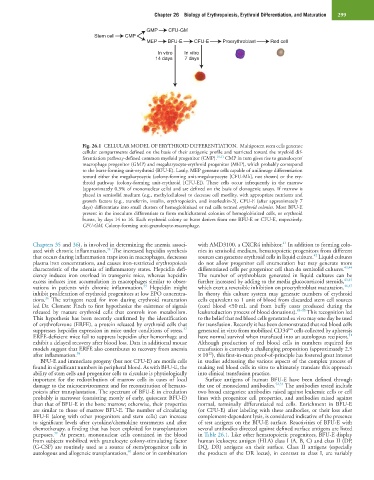
                            Fig. 26.1  CELLULAR MODEL OF ERYTHROID DIFFERENTIATION.  Multipotent stem cells generate
                            cellular compartments defined on the basis of their antigenic profile and restricted toward the myeloid dif-
                            ferentiation pathway-defined common myeloid progenitor (CMP). 10,11  CMP in turn gives rise to granulocyte/
                            macrophage progenitor (GMP) and megakaryocyte-erythroid progenitor (MEP), which probably correspond
                            to the burst-forming unit-erythroid (BFU-E). Lastly, MEP generate cells capable of unilineage differentiation
                            toward either the megakaryocytic (colony-forming unit-megakaryocyte [CFU-Mk], not shown) or the ery-
                            throid  pathway  (colony-forming  unit-erythroid  [CFU-E]).  These  cells  occur  infrequently  in  the  marrow
                            (approximately 0.3% of mononuclear cells) and are defined on the basis of clonogenic assays. If marrow is
                            placed in semisolid medium (e.g., methylcellulose) to decrease cell motility, with appropriate nutrients and
                            growth factors (e.g., transferrin, insulin, erythropoietin, and interleukin-3), CFU-E (after approximately 7
                            days) differentiate into small clusters of hemoglobinized or red cells termed erythroid colonies. Most BFU-E
                            present in the inoculum differentiate to form multiclustered colonies of hemoglobinized cells, or erythroid
                            bursts, by days 14 to 16. Each erythroid colony or burst derives from one BFU-E or CFU-E, respectively.
                            CFU-GM, Colony-forming unit-granulocyte-macrophage.


                                                                                              41
            Chapters 35 and 36), is involved in determining the anemia associ-  with AMD3100, a CXCR4 inhibitor.  In addition to forming colo-
                                    34
            ated with chronic inflammation.  The increased hepcidin synthesis   nies in semisolid medium, hematopoietic progenitors from different
                                                                                                        42
            that occurs during inflammation traps iron in macrophages, decreases   sources can generate erythroid cells in liquid culture.  Liquid cultures
            plasma iron concentrations, and causes iron-restricted erythropoiesis   do  not  allow  progenitor  cell  enumeration  but  may  generate  more
            characteristic of the anemia of inflammatory states. Hepcidin defi-  differentiated cells per progenitor cell than do semisolid cultures. 43,44
            ciency induces iron overload in transgenic mice, whereas hepcidin   The  number  of  erythroblasts  generated  in  liquid  cultures  can  be
            excess induces iron accumulation in macrophages similar to obser-  further increased by adding to the media glucocorticoid steroids, 43,45
                                                35
            vations  in  patients  with  chronic  inflammation.   Hepcidin  might   which exert a reversible inhibition on proerythroblast maturation. 46,47
            inhibit proliferation of erythroid progenitors at low EPO concentra-  In  theory  this  culture  system  may  generate  numbers  of  erythroid
                36
            tions.   The  stringent  need  for  iron  during  erythroid  maturation   cells equivalent to 1 unit of blood from discarded stem cell sources
            led Dr. Clement Finch to first hypothesize the existence of signals   (cord  blood  <50 mL  and  from  buffy  coats  produced  during  the
            released  by  mature  erythroid  cells  that  controls  iron  metabolism.   leukoreduction process of blood donations). 48–50  This recognition led
            This  hypothesis  has  been  recently  confirmed  by  the  identification   to the belief that red blood cells generated ex vivo may one day be used
            of erythroferrone (ERFE), a protein released by erythroid cells that   for transfusion. Recently it has been demonstrated that red blood cells
                                                                                               pos
                                                             37
            suppresses hepcidin expression in mice under conditions of stress.    generated in vitro from mobilized CD34  cells collected by apheresis
                                                                                                                   51
            ERFE-deficient mice fail to suppress hepcidin after hemorrhage and   have normal survival when transfused into an autologous recipient.
            exhibit a delayed recovery after blood loss. Data in additional mouse   Although  production  of  red  blood  cells  in  numbers  required  for
            models suggest that ERFE also contributes to recovery from anemia   transfusion is currently a challenging proposition (approximately 2.5
                                                                     12
            after inflammation. 38                                × 10 ), this first-in-man proof-of-principle has fostered great interest
              BFU-E and immediate progeny (but not CFU-E) are motile cells   in studies addressing the various aspects of the complex process of
            found in significant numbers in peripheral blood. As with BFU-E, the   making red blood cells in vitro to ultimately translate this approach
            ability of stem cells and progenitor cells to circulate is physiologically   into clinical transfusion practice.
            important  for  the  redistribution  of  marrow  cells  in  cases  of  local   Surface  antigens  of  human  BFU-E  have  been  defined  through
            damage to the microenvironment and for reconstitution of hemato-  the use of monoclonal antibodies. 52,53  The antibodies tested include
            poiesis after transplantation. The spectrum of BFU-E in circulation   two broad categories: antibodies raised against leukemic cells or cell
            probably is narrower (consisting mostly of early, quiescent BFU-E)   lines  with  progenitor  cell  properties,  and  antibodies  raised  against
            than that of BFU-E in the bone marrow; otherwise, their properties   normal,  terminally  differentiated  red  cells.  Enrichment  in  BFU-E
            are similar to those of marrow BFU-E. The number of circulating   (or CFU-E) after labeling with these antibodies, or their loss after
            BFU-E (along with  other  progenitors  and stem  cells)  can  increase   complement-dependent lysis, is considered indicative of the presence
            to  significant  levels  after  cytokine/chemokine  treatments  and  after   of test antigens on the BFU-E surface. Reactivities of BFU-E with
            chemotherapy, a finding that has been exploited for transplantation   several antibodies directed against defined surface antigens are listed
                   39
            purposes.   At  present,  mononuclear  cells  contained  in  the  blood   in Table 26.1. Like other hematopoietic progenitors, BFU-E display
            from subjects mobilized with granulocyte colony-stimulating factor   human leukocyte antigen (HLA) class I (A, B, C) and class II (DP,
            (G-CSF) are routinely used as a source of stem/progenitor cells in   DQ,  DR)  antigens  on  their  surface.  Class  II  antigens  (especially
                                           40
            autologous and allogeneic transplantation,  alone or in combination   the  products  of  the  DR  locus),  in  contrast  to  class  I,  are  variably

