


Page 448 - Hematology_ Basic Principles and Practice ( PDFDrive )
P. 448
Chapter 29  Inherited Bone Marrow Failure Syndromes  369


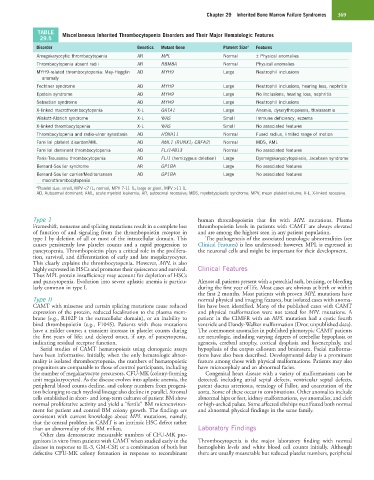
             TABLE   Miscellaneous Inherited Thrombocytopenia Disorders and Their Major Hematologic Features
              29.5
             Disorder                         Genetics  Mutant Gene       Platelet Size a  Features
             Amegakaryocytic thrombocytopenia  AR     MPL                 Normal     ± Physical anomalies
             Thrombocytopenia absent radii    AR      RBM8A               Normal     Physical anomalies
             MYH9-related thrombocytopenia: May-Hegglin   AD  MYH9        Large      Neutrophil inclusions
               anomaly
             Fechtner syndrome                AD      MYH9                Large      Neutrophil inclusions, hearing loss, nephritis
             Epstein syndrome                 AD      MYH9                Large      No inclusions, hearing loss, nephritis
             Sebastian syndrome               AD      MYH9                Large      Neutrophil inclusions
             X-linked macrothrombocytopenia   X-L     GATA1               Large      Anemia, dyserythropoiesis, thalassemia
             Wiskott-Aldrich syndrome         X-L     WAS                 Small      Immune deficiency, eczema
             X-linked thrombocytopenia        X-L     WAS                 Small      No associated features
             Thrombocytopenia and radio-ulnar synostosis  AD  HOXA11      Normal     Fused radius, limited range of motion
             Familial platelet disorder/AML   AD      AML1 (RUNX1; CBFA2)  Normal    MDS, AML
             Familial dominant thrombocytopenia  AD   FLJ14813            Normal     No associated features
             Paris-Trousseau thrombocytopenia  AD     FLI1 (hemizygous deletion)  Large  Dysmegakaryocytopoiesis, Jacobsen syndrome
             Bernard-Soulier syndrome         AR      GP1BA               Large      No associated features
             Bernard-Soulier carrier/Mediterranean   AD  GP1BA            Large      No associated features
               macrothrombocytopenia
             a Platelet size: small, MPV <7 fL; normal, MPV 7-11 fL; large or giant, MPV >11 fL.
             AD, Autosomal dominant; AML, acute myeloid leukemia; AR, autosomal recessive; MDS, myelodysplastic syndrome; MPV, mean platelet volume; X-L, X-linked recessive.


            Type 1                                                human  thrombopoietin  that  fits  with  MPL  mutations.  Plasma
            Frameshift, nonsense and splicing mutations result in a complete loss   thrombopoietin  levels  in  patients  with  CAMT  are  always  elevated
            of  function  of  and  signaling  from  the  thrombopoietin  receptor  in   and are among the highest seen in any patient population.
            type I by deletion of all or most of the intracellular domain. This   The pathogenesis of the associated neurologic abnormalities (see
            causes  persistently  low  platelet  counts  and  a  rapid  progression  to   Clinical Features) is less understood; however, MPL is expressed in
            pancytopenia. Thrombopoietin plays a critical role in the prolifera-  the neuronal cells and might be important for their development.
            tion, survival, and differentiation of early and late megakaryocytes.
            This clearly explains the thrombocytopenia. However, MPL is also
            highly expressed in HSCs and promotes their quiescence and survival.   Clinical Features
            Thus MPL protein insufficiency may account for depletion of HSCs
            and pancytopenia. Evolution into severe aplastic anemia is particu-  Almost all patients present with a petechial rash, bruising, or bleeding
            larly common in type I.                               during the first year of life. Most cases are obvious at birth or within
                                                                  the first 2 months. Most patients with proven MPL mutations have
            Type II                                               normal physical and imaging features, but isolated cases with anoma-
            CAMT with missense and certain splicing mutations cause reduced   lies have been identified. Many of the published cases with CAMT
            expression of the protein, reduced localization to the plasma mem-  and physical malformation were not tested for MPL mutations. A
            brane (e.g., R102P in the extracellular domain), or an inability to   patient in the CIMFR with an MPL mutation had a cystic fourth
            bind  thrombopoietin  (e.g.,  F104S).  Patients  with  these  mutations   ventricle and Dandy-Walker malformation (Dror, unpublished data).
            have a milder course; a transient increase in platelet counts during   The commonest anomalies in published phenotypic CAMT patients
            the  first  years  of  life;  and  delayed  onset,  if  any,  of  pancytopenia,   are neurologic, including varying degrees of cerebellar hypoplasia or
            indicating residual receptor function.                agenesis, cerebral atrophy, cortical dysplasia and lissencephaly, and
              Serial  studies  of  CAMT  hematopoiesis  using  clonogenic  assays   hypoplasia of the corpus callosum and brainstem. Facial malforma-
            have been informative. Initially, when the only hematologic abnor-  tions have also been described. Developmental delay is a prominent
            mality is isolated thrombocytopenia, the numbers of hematopoietic   feature among those with physical malformations. Patients may also
            progenitors are comparable to those of control participants, including   have microcephaly and an abnormal facies.
            the number of megakaryocyte precursors, CFU-MK (colony-forming   Congenital heart disease with a variety of malformations can be
            unit megakaryocytes). As the disease evolves into aplastic anemia, the   detected,  including  atrial  septal  defects,  ventricular  septal  defects,
            peripheral blood counts decline, and colony numbers from progeni-  patent ductus arteriosus, tetralogy of Fallot, and coarctation of the
            tors belonging to each myeloid lineage also decline in parallel. Stromal   aorta. Some of these occur in combinations. Other anomalies include
            cells established in short- and long-term cultures of patient BM show   abnormal hips or feet, kidney malformations, eye anomalies, and cleft
            normal proliferative activity and yield a “fertile” BM microenviron-  or high-arched palate. Some affected sibships manifested both normal
            ment for patient and control BM colony growth. The findings are   and abnormal physical findings in the same family.
            consistent with current knowledge about MPL mutations, namely,
            that the central problem in CAMT is an intrinsic HSC defect rather
            than an abnormality of the BM milieu.                 Laboratory Findings
              Other data demonstrate measurable numbers of CFU-MK pro-
            genitors in vitro from patients with CAMT when studied early in the   Thrombocytopenia  is  the  major  laboratory  finding  with  normal
            disease in response to IL-3, GM-CSF, or a combination of both but   hemoglobin  levels  and  white  blood  cell  counts  initially.  Although
            defective  CFU-MK  colony  formation  in  response  to  recombinant   there are usually measurable but reduced platelet numbers, peripheral

