


Page 453 - Hematology_ Basic Principles and Practice ( PDFDrive )
P. 453
374    Part IV  Disorders of Hematopoietic Cell Development


        previously suspected and that was only unmasked by testing in long-  Clinical Features
        term  cultures.  This  observation,  however,  is  in  keeping  with  the
        clinical observation that in addition to anemia, patients may have   DBA registries with longitudinal data and a summary of published
        neutropenia  and  thrombocytopenia. These  findings  were  extended   cases provide comprehensive information about clinical aspects of the
        with evidence in long-term culture initiating assays for a trilineage   disorder. Aside from findings associated with anemia, about half of
        defect in DBA refractory to treatment. The data broaden the defini-  infants at presentation look healthy and are normal physically. Unless
        tion of DBA and explain generalized BM dysfunction and hypoplasia   the baby develops cardiac failure as a result of anemia, hepatospleno-
        in some cases of DBA that have puzzled investigators for years.  megaly and edema are absent.
           The molecular mechanism that links ribosome protein haploinsuf-  Pregnancy, birth history, or both are often abnormal. In a survey
        ficiency to the erythroid defect is unclear. One hypothesis is that it is   from the French and German DBA registries of 64 pregnancies in 26
        related to translation insufficiency. It is well known that during early   women with DBA, complications were seen in 42 pregnancies (66%)
        stages of erythropoiesis, translation is increased. It is possible that the   and included abortion, preeclampsia, in utero fetal death, in utero
        need for protein synthesis is not met during this critical developmental   growth retardation, retroplacental hematoma, and preterm delivery.
        stage. A second hypothesis is that ribosomal protein gene mutations   Thirteen of 34 children born alive had DBA. Fetal DBA with hydrops
        lead to accumulation of abnormal rRNA precursors as well as dysregu-  fetalis has been reported. In current reports, more than 90% of cases
        lation of multiple ribosomal protein genes and protein expression as   present in the first 12 months of life; however, because of the avail-
        shown  with  RPS19.  This  leads  to  defective  ribosome  biogenesis,   ability of genetic testing, patients with mild to moderate phenotype
        unassembled ribosome proteins, and cellular stress. Indeed, loss of   are diagnosed later on in life. After diagnosis, family screening may
        ribosome proteins have been shown to increase the levels of S6 kinase   identify the parents or older siblings as affected.
        phosphorylation via increased ROS, which in turn results in stimulat-  About 30% to 47% of patients present with one or more con-
        ing erythroid cell autophagy. A third hypothesis and the one consid-  genital anomalies. Most of these phenotypic abnormalities belong to
        ered  most  plausible  is  that  defective  ribosome  biogenesis  leads  to   the  following  categories:  (1)  craniofacial  dysmorphism,  including
        activation of p53, thereby causing apoptosis and cell cycle arrest. A   hypertelorism, microcephaly, microphthalmos, congenital cataract or
        role of p53 is supported by a recent mouse model with mutations in   glaucoma, strabismus, microretrognathism, and a high-arched palate
        RPS19  that  is  characterized  by  RBC  underproduction  and  small   or cleft palate; (2) prenatal or postnatal growth failure independent
        mouse size and by zebrafish models of RPS19 inhibition that manifest   of steroid therapy; (3) neck anomalies, which may consist of a pte-
        impaired erythropoiesis and malformations. Activation of p53 may   rygium  coli  or  the  fusion  of  cervical  vertebrae  with  flaring  of  the
        involve the interactions of MDM2 with specific ribosomal proteins   trapezius muscle (Klippel-Feil syndrome), giving a Turner syndrome
        such as RPL5, RPL11, and RPL23. These interactions may lead to   appearance or there may also be the Sprengel deformity (congenital
        dissociation of p53 from MDM2, impairment of p53 targeting to the   elevation of the scapula) as an isolated anomaly or a combination of
        proteosome,  and  prevention  of  proteosome  degradation.  However,   the  two  anomalies;  and  (4)  thumb  malformations,  such  as  bifid
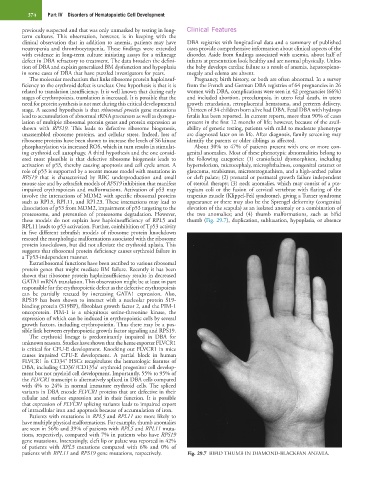
        these  models  do  not  explain  how  haploinsufficiency  of  RPL5  and   thumb (Fig. 29.7), duplication, subluxation, hypoplasia, or absence
        RPL11 leads to p53 activation. Further, coinhibition of Tp53 activity
        in  five  different  zebrafish  models  of  ribosome  protein  knockdown
        rescued the morphologic malformations associated with the ribosome
        protein knockdown, but did not alleviate the erythroid aplasia. This
        suggests that ribosomal protein deficiency causes erythroid failure in
        a Tp53-independent manner.
           Extraribosomal functions have been ascribed to various ribosomal
        protein genes that might mediate BM failure. Recently it has been
        shown that ribosome protein haploinsufficiency results in decreased
        GATA1 mRNA translation. This observation might be at least in part
        responsible for the erythropoietic defect as the defective erythropoiesis
        can  be  partially  rescued  by  increasing  GATA1  expression.  Also,
        RPS19  has  been  shown  to  interact  with  a  nucleolar  protein  S19-
        binding protein (S19BP), fibroblast growth factor 2, and the PIM-1
        oncoprotein.  PIM-1  is  a  ubiquitous  serine-threonine  kinase,  the
        expression of which can be induced in erythropoietic cells by several
        growth factors, including erythropoietin. Thus there may be a pos-
        sible link between erythropoietic growth factor signaling and RPS19.
           The  erythroid  lineage  is  predominantly  impaired  in  DBA  for
        unknown reasons. Studies have shown that the heme exporter FLVCR1
        is critical for CFU-E development. Knocking out FLVCR1 in mice
        causes  impaired  CFU-E  development.  A  partial  block  in  human
                      +
        FLVCR1 in CD34  HSCs recapitulates the hematologic features of
                                 +
                         +
        DBA, including CD36 /CD135a  erythroid progenitor cell develop-
        ment but not myeloid cell development. Importantly, 55% to 95% of
        the FLVCR1 transcript is alternatively spliced in DBA cells compared
        with  4%  to  24%  in  normal  immature  erythroid  cells. The  spliced
        variants in DBA encode FLVCR1 proteins that are defective in their
        cellular  and  surface  expression  and  in  their  function.  It  is  possible
        that expression of FLVCR1 splicing variants leads to impaired export
        of intracellular iron and apoptosis because of accumulation of iron.
           Patients with mutations in RPL5 and RPL11 are more likely to
        have multiple physical malformations. For example, thumb anomalies
        are seen in 56% and 39% of patients with RPL5 and RPL11 muta-
        tions, respectively, compared with 7% in patients who have RPS19
        gene mutations. Interestingly, cleft lip or palate was reported in 42%
        of  patients  with  RPL5  mutations  compared  with  6%  and  0%  of
        patients with RPL11 and RPS19 gene mutations, respectively.  Fig. 29.7  BIFID THUMB IN DIAMOND-BLACKFAN ANEMIA.

