


Page 655 - Hematology_ Basic Principles and Practice ( PDFDrive )
P. 655
Chapter 40  Thalassemia Syndromes  557


            approximately 200 g/mol. It is an orally active bidentate iron chelator
            that requires three molecules to bind one iron atom. Deferiprone is   1.0
            absorbed by the gastrointestinal tract and has a plasma half-life of
            approximately  90  minutes  (2–3  hours).  Chelated  iron  is  excreted   0.9
            predominantly in the urine (90%) and far less in the stool (10%). It   0.8
            was synthesized in the late 1980s and was first tested in uncontrolled
            clinical trials at the Royal Free Hospital in London, hence the eponym   0.7
            L1. 205,206  A large observational study demonstrated improvement in   0.6
                                                   207
            cardiac  iron  deposition  with  deferiprone  treatment.   At  doses  of  Cumulative proportion adverse reaction free  0.5
            75 mg/kg/d,  deferiprone  administered  in  three  divided  doses  with
            meals  reduces  or  maintains  iron  stores,  thereby  achieving  negative   0.4   Complete   Censored
            iron balance or iron balance in many regularly transfused patients for   0.3     Agranulocytosis: 1/187 = 0.5%
            the most part, particularly those with more severe transfusional iron            Neutropenia: 15/187 = 8.0%
            overload. 208–216   However,  some  patients  remain  in  positive  iron   0.2  Arthropathy: 28/187 = 15.0%
            balance and continue to accumulate iron during long-term therapy   0.1           GI symptoms: 62/187 = 33.2%
            with this dose of deferiprone. 209,212,217  Regimens using higher doses
                                                      218
            up to 100 mg/kg/d of deferiprone may be more effective.  Combi-  0.0
            nation regimens with deferoxamine also reduce iron stores or prove   0  4  8  12  16  20  24  28  32  36  40  44  48 52
            effective  in  restoring  negative  iron  balance  in  some  of  these        Time (mo)
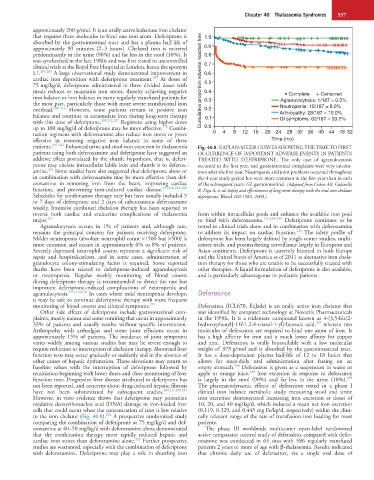
            patients. 219–221  Enhanced urine and stool iron excretion in thalassemia   Fig. 40.8  KAPLAN-MEIER CURVES SHOWING THE TIME TO FIRST
            patients using both deferoxamine and deferiprone have suggested an   OCCURRENCE OF IMPORTANT ADVERSE EVENTS IN PATIENTS
            additive effect postulated by the shuttle hypothesis, that is, deferi-  TREATED  WITH  DEFERIPRONE.  The  only  case  of  agranulocytosis
            prone may chelate intracellular labile iron and shuttle it to deferox-  occurred in the first year, and gastrointestinal complaints were very uncom-
                 222
            amine.  Some studies have also suggested that deferiprone alone or   mon after the first year. Neutropenia and joint problems occurred throughout
            in combination with deferoxamine may be more effective than def-  the 4-year study period but were more common in the first year than in each
            eroxamine  in  removing  iron  from  the  heart,  improving  cardiac   of the subsequent years. GI: gastrointestinal. (Adapted from Cohen AR, Galanello
            function,  and  preventing  iron-induced  cardiac  disease. 133,216,223–226    R, Piga A, et al: Safety and effectiveness of long-term therapy with the oral iron chelator
            Schedules for combination therapy vary but have usually included 5   deferiprone. Blood 102:1583, 2003.)
            to 7 days of deferiprone and 2 days of subcutaneous deferoxamine
            weekly. Intensive combined chelation therapy has been reported to
            reverse  both  cardiac  and  endocrine  complications  of  thalassemia   from within intracellular pools and enhance the available iron pool
            major. 227                                            to  bind  with  deferoxamine. 211,234–236   Deferiprone  continues  to  be
              Agranulocytosis  occurs  in  1%  of  patients  and,  although  rare,   tested in clinical trials alone and in combination with deferoxamine
                                                                                                  226
            remains  the  principal  concern  for  patients  receiving  deferiprone.   to  address  its  impact  on  cardiac  function.  The  safety  profile  of
            Milder neutropenia (absolute neutrophil count <1500 but >500) is   deferiprone has been largely defined by single-center studies, multi-
            more common and occurs in approximately 6% to 8% of patients.   center trials, and postmarketing surveillance largely in European and
            Severely depressed neutrophil counts represent a significant risk of   Asian continents. Deferiprone is currently licensed in both Europe
            sepsis  and  hospitalizations,  and  in  some  cases,  administration  of   and the United States of America as of 2011 as alternative iron chela-
            granulocyte  colony-stimulating  factor  is  required.  Some  reported   tion therapy for those who are unable to be successfully treated with
            deaths  have  been  related  to  deferiprone-induced  agranulocytosis   other therapies. A liquid formulation of deferiprone is also available,
            or  neutropenia.  Regular  weekly  monitoring  of  blood  counts   and is particularly advantageous in pediatric patients.
            during deferiprone therapy is recommended to detect the rare but
            important  deferiprone-induced  complications  of  neutropenia  and
            agranulocytosis. 212–214,228  In cases where mild neutropenia develops,   Deferasirox
            it may be safe to continue deferiprone therapy with more frequent
            monitoring of blood counts and clinical symptoms. 229  Deferasirox (ICL670, ExJade) is an orally active iron chelator that
              Other  side  effects  of  deferiprone  include  gastrointestinal  com-  was identified by computer technology at Novartis Pharmaceuticals
            plaints, mostly nausea and some vomiting that occur in approximately   in  the  1990s.  It  is  a  tridentate  compound  known  as  4-(3,5-bis[2-
                                                                                                        237
            33%  of  patients  and  usually  resolve  without  specific  intervention.   hydroxyphenyl]-1H-1,2,4-triazol-1-yl)-benzoic acid,  wherein two
            Arthropathy  with  arthralgias  and  some  joint  effusions  occur  in   molecules of deferasirox are required to bind one atom of iron. It
            approximately  15%  of  patients. The  incidence  of  joint  symptoms   has  a  high  affinity  for  iron  and  a  much  lower  affinity  for  copper
            varies  widely  among  various  studies  but  may  be  severe  enough  to   and  zinc.  Deferasirox  is  orally  bioavailable  with  a  low  molecular
            require reduction or interruption of chelation therapy. Abnormal liver   weight  of  373 g/mol  and  is  absorbed  by  the  gastrointestinal  tract.
            function tests may occur gradually or suddenly and in the absence of   It  has  a  dose-dependent  plasma  half-life  of  12  to  18  hours  that
            other causes of hepatic dysfunction. These elevations may return to   allows  for  once-daily  oral  administration  after  fasting  on  an
                                                                              238
            baseline  values  with  the  interruption  of  deferiprone  followed  by   empty stomach.  Deferasirox is given as a suspension in water or
                                                                                   239
            reinitiation beginning with lower doses and close monitoring of liver   apple  or  orange  juice.   Iron  excretion  in  response  to  deferasirox
                                                                                                                  239
            function tests. Progressive liver disease attributed to deferiprone has   is  largely  in  the  stool  (90%)  and  far  less  in  the  urine  (10%).
            not been reported, and concerns about drug-induced hepatic fibrosis   The  pharmacodynamic  effects  of  deferasirox  tested  in  a  phase  I
            have  not  been  substantiated  by  subsequent  studies. 209,211,230,231    clinical  iron  balance  metabolic  study  measuring  stool  and  urine
            However, in vitro evidence shows  that  deferiprone may  potentiate   iron  excretion  demonstrated  increasing  iron  excretion  at  doses  of
            oxidative deoxyribonucleic acid (DNA) damage in iron-loaded liver   10, 20, and 40 mg/kg/d, which induced a mean net iron excretion
            cells that could occur when the concentration of iron is low relative   (0.119, 0.329, and 0.445 mg Fe/kg/d, respectively) within the clini-
                                    232
            to the iron chelator (Fig. 40.8).  A prospective randomized study   cally relevant range of the rate of transfusion iron loading for most
            comparing the combination of deferiprone at 75 mg/kg/d and def-  patients.
            eroxamine at 40–50 mg/kg/d with deferoxamine alone demonstrated   The  phase  III  worldwide  multicenter  open-label  randomized
            that  the  combination  therapy  more  rapidly  reduced  hepatic  and   active comparator control study of deferasirox compared with defer-
                                             233
            cardiac iron stores than deferoxamine alone.  Further prospective   oxamine  was  conducted  in  65  sites  with  586  regularly  transfused
            studies are warranted, especially with the combination of deferiprone   patients 2 years or more of age with β-thalassemia. Results indicated
            with  deferoxamine.  Deferiprone  may  play  a  role  in  shuttling  iron   that  chronic  daily  use  of  deferasirox,  via  a  single  oral  dose  of

