


Page 660 - Hematology_ Basic Principles and Practice ( PDFDrive )
P. 660
562    Part V  Red Blood Cells


        transfusions and chelation monitoring. Future efforts should be initi-  to 32% depending on the prophylaxis regimen, and the incidence of
        ated to improve the care of adult patients with thalassemia, including   chronic GVHD is 27% in patients receiving BM hematopoietic stem
        understanding the pathology of the disease and training new genera-  cells  from  a  parental  or  sibling  human  leukocyte  antigen  (HLA)-
                                                                          350
        tions  of  hematologists  with  an  understanding  of  thalassemia   identical donor.  In addition, recent studies suggest HLA-identical
        syndromes.                                            or 1-antigen-mismatched related nonsibling donors can be performed
           Screening tests are also an important component of ongoing care   with high thalassemia-free survival rates. 351
        in thalassemia. Currently, the most common cause of mortality in   In view of the available evidence, stem cell transplantation from
        adults with thalassemia is related to cardiac disease and arrhythmias.   a partially HLA-matched relative is not routinely advisable, although
        These patients also have other chronic illnesses including cardiomy-  it may be considered in extreme situations when transfusion support
        opathy, hepatic disease, endocrinopathies, osteoporosis, hypogonad-  is impossible or life threatening when a patient is completely non-
        ism,  pulmonary  hypertension,  and  ongoing  infectious  risk  from   compliant with any type of iron chelation therapy.
        splenectomies.  Recommended  screening  tests  are  shown  in Tables
        40.1–40.2, based on recommendations from the Thalassemia Inter-
        national  Federation  (www.thalassemia.org.cy).  Regular  follow  up   Experimental Therapies
        with  an  internal  medicine  primary  care  physician  is  also  recom-
        mended  to  make  sure  adults  are  aware  of  current  screening  and   Enhancement of β and γ Gene Expression
        treatment guidelines applicable to the general population, for example
        age-appropriate cancer screening, an area where adult patients may   Active γ-globin genes are hypomethylated in utero but are methylated
        not  have  previously  been  referred  because  of  historically  shorter   and inactive after birth. Hypomethylation of the γ-globin genes can
        lifespans.                                            be induced by the drug 5-azacytidine; indeed, short-term administra-
                                                              tion of this drug produced the predicted effect in vivo. 352–354  Despite
                                                              much subsequent experimental work, it remains unclear whether the
        Hematopoietic Stem Cell Transplantation               effect was attributable to direct stimulation of fetal genes by demeth-
                                                              ylation or to recruitment and accelerated differentiation of primitive
        There  is  now  extensive  experience  with  transplantation,  with  well   burst-forming  unit–erythroid  progenitor  cells,  which  have  greater
                                                346
        over 3000 patients having undergone transplantation.  Risk classi-  potential to produce Hb F. 355–357  Hydroxyurea has an effect on burst-
        fication is based on hepatomegaly, the degree of portal fibrosis, and   forming unit–erythroid similar to that of 5-azacytidine and is a safer
                                          347
        the regularity of prior iron chelation therapy.  In class 1 without   drug for long-term use. 356,358  Short-term as well as longer trials with
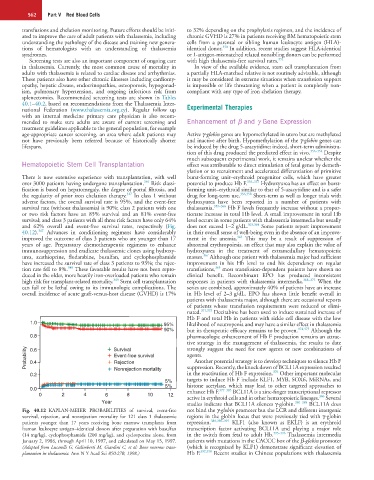
        adverse factors, the overall survival rate is 95%, and the event-free   hydroxyurea  have  been  reported  in  a  number  of  patients  with
        survival rate (without thalassemia) is 90%; class 2 patients with one   thalassemia. 359–366  Hb F levels frequently increase without a propor-
        or  two  risk  factors  have  an  85%  survival  and  an  81%  event-free   tionate increase in total Hb level. A small improvement in total Hb
        survival; and class 3 patients with all three risk factors have only 64%   level occurs in some patients with thalassemia intermedia but usually
        and  62%  overall  and  event-free  survival  rates,  respectively  (Fig.   does not exceed 1–2 g/dL. 363,364  Some patients report improvement
              347
        40.12).   Advances  in  conditioning  regimens  have  considerably   in their overall sense of well-being even in the absence of an improve-
                                                                               363
        improved the outcome of class 3 patients who are younger than 17   ment  in  the  anemia.   This  may  be  a  result  of  suppression  of
        years  of  age.  Preparatory  chemotherapeutic  regimens  to  enhance   abnormal erythropoiesis, an effect that may also explain the value of
        immunosuppression and eradicate thalassemic clones using hydroxy-  hydroxyurea  in  the  treatment  of  extramedullary  hematopoietic
                                                                    367
        urea,  azathioprine,  fludarabine,  busulfan,  and  cyclophosphamide   masses.  Although one patient with thalassemia major had sufficient
        have increased the survival rate of class 3 patients to 93%; the rejec-  improvement  in  his  Hb  level  to  end  his  dependency  on  regular
                                                                       365
                       348
        tion rate fell to 8%.  These favorable results have not been repro-  transfusions,  most transfusion-dependent patients have shown no
        duced in the older, more heavily iron-overloaded patients who remain   clinical  benefit.  Recombinant  EPO  has  produced  inconsistent
                                      349
        high risk for transplant-related mortality.  Stem cell transplantation   responses  in  patients  with  thalassemia  intermedia. 368–372  When  the
        can fail or be lethal owing to its immunologic complications. The   series are combined, approximately 40% of patients have an increase
        overall incidence of acute graft-versus-host disease (GVHD) is 17%   in  Hb  level  of  2–3 g/dL.  EPO  has  shown  little  benefit  overall  in
                                                              patients with thalassemia major, although there are occasional reports
                                                              of patients whose transfusion requirements were reduced or elimi-
                                                              nated. 371,373  Decitabine has been used to induce sustained increase of
                                                              Hb F and total Hb in patients with sickle cell disease with the low
           1.0                                         95%    likelihood of neutropenia and may have a similar effect in thalassemia
                                                       90%    but its therapeutic efficacy remains to be proven. 374,375  Although the
           0.8                                                pharmacologic enhancement of Hb F production remains an attrac-
                                                              tive strategy in the management of thalassemia, the results to date
                                                              strongly  suggest  the  need  for  new  agents  or  new  combinations  of
          Probability  0.4            Event-free survival     agents.
                                      Survival
           0.6
                                                                 Another potential strategy is to develop techniques to silence Hb F
                                      Rejection
                                                                                          376
                                                              in the reactivation of Hb F expression.  Other important molecular
           0.2                        Nonrejection mortality  suppression. Recently, the knock down of BCL11A expression resulted
                                                       5%     targets to induce Hb F include KLF1, MYB, SOX6, MiRNAs, and
                                                       5%     histone  acetylase,  which  may  lead  to  other  targeted  approaches  to
           0.0                                                enhance Hb F. 377–385  BCL11A is a zinc-finger transcriptional repressor
              0      2      4      6       8     10     12    active in erythroid cells and in other hematopoietic lineages.  Several
                                                                                                         386
                                  Year                        studies indicate that BCL11A silences γ-globin. 386–388  BCL11A does
        Fig.  40.12  KAPLAN-MEIER  PROBABILITIES  of  survival,  event-free   not bind the γ-globin promoter but the LCR and different intergenic
        survival,  rejection,  and  nonrejection  mortality  for  121  class  1  thalassemic   regions in the globin locus that were previously tied with γ-globin
        patients  younger  than  17  years  receiving  bone  marrow  transplants  from   repression. 386,389–392   KLF1  (also  known  as  EKLF)  is  an  erythroid
        human leukocyte antigen–identical donors after preparation with busulfan   transcription  factor  activating  BCL11A  and  playing  a  major  role
        (14 mg/kg), cyclophosphamide (200 mg/kg), and cyclosporine alone, from   in the switch from fetal to adult Hb. 393–396  Thalassemia intermedia
        January 2, 1986, through April 10, 1997, and calculated on May 15, 1997.   patients with mutations in the CACCC box of the β-globin promoter
        (Adapted from Lucarelli G, Galimberti M, Giardini C, et al: Bone marrow trans-  (which is recognized by KLF1) demonstrate significant elevation of
        plantation in thalassemia. Ann N Y Acad Sci 850:270, 1998.)  Hb F. 397,398  Recent studies in Chinese populations with thalassemia

