


Page 659 - Hematology_ Basic Principles and Practice ( PDFDrive )
P. 659
Chapter 40  Thalassemia Syndromes  561


            requirement of more than 180–200 mL/kg/y of packed RBCs usually   TABLE   Survival by Birth Cohort at Different Ages of Patients
            represents  excessive  RBC  requirements. 330,331   For  such  patients,  a   40.2  With Transfusion-Dependent Thalassemia
            25% to 60% reduction in transfusion requirements after splenectomy
            is  generally  predictable.  Before  attributing  increased  transfusion   Patient Age   Cohort (%)
            requirements  to  hypersplenism,  it  is  important  to  look  for  other   (Years)  1970–1974  1975–1979  1980–1984
            causes, such as RBC alloimmunization or a change in the hematocrit
                                                     52
            of the units of donor blood. RBC survival studies using  Cr-labeling   10  98 (96–99)  98 (96–99)  99 (95–100)
            are  not  usually  of  value  for  predicting  response  to  splenectomy.   15  95 (92–97)  97 (94–98)  98 (93–100)
            Because  of  the  greater  risk  of  postsplenectomy  sepsis  in  younger   20  89 (85–92)  96 (93–98)
            patients, surgery should be deferred until after 5 years of age whenever
            possible, so the humoral immune system has developed. For well-  25  82 (77–86)
            transfused  and  well-chelated  patients,  splenectomy  may  have  little   Data from Borgna Pignatti C, Rugolotto S, De Stefano X, et al: Survival and
            benefit,  and  some  centers  have  noted  a  significant  decline  in  the   disease complications in thalassemia major. Ann N Y Acad Sci 850:227, 1998.
            number of patients undergoing splenectomy in recent years.
              Laparoscopic splenectomy has proved safe for patients with thalas-
            semia and has dramatically shortened the recovery time compared
                            332
            with open procedures.  Partial splenectomy and partial dearterializa-  1.00
            tion of the spleen have been suggested as alternative approaches to
            reducing blood requirements without incurring the risk of sepsis. 333–335
            The long-term benefits of this approach remain uncertain. Therapeu-  0.75
            tic embolization of the spleen avoids the need for surgery, 336–338  but
            this approach is frequently associated with postprocedure pain and
            fever and does not permit the removal of accessory spleens.  Proportion without   cardiac disease  0.50
              After splenectomy, striking thrombocytosis may occur, which may
                                                            339
            require  thrombosis  prophylaxis  or  platelet  deaggregating  agents.
            Increased numbers of nucleated RBCs appear in the blood, and the   0.25
            presence  of  many  RBCs  containing  inclusion  bodies  composed  of
            precipitated α-globin chains can be demonstrated by staining with
            supravital staining.
              Patients  with  thalassemia  major  are  at  significant  risk  for  the   0.00
            development  of  overwhelming,  often  fatal,  infection  after  splenec-  0  2  4  6  8  10  12  14   16
                                           340
            tomy  (postsplenectomy  sepsis  syndrome).  The  problem  is  most        Years of chelation therapy
            common  in  young  children.  Streptococcus  pneumoniae  causes  two-
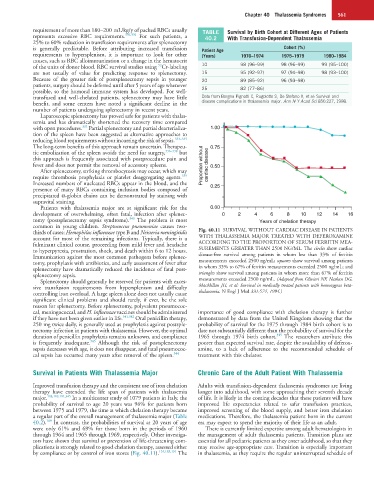
            thirds of cases; Hemophilus influenzae type B and Neisseria meningitidis   Fig. 40.11  SURVIVAL WITHOUT CARDIAC DISEASE IN PATIENTS
            account  for  most  of  the  remaining  infections. Typically,  there  is  a   WITH THALASSEMIA MAJOR TREATED WITH DEFEROXAMINE
            fulminant clinical course, proceeding from mild fever and headache   ACCORDING TO THE PROPORTION OF SERUM FERRITIN MEA-
            to hyperpyrexia, prostration, shock, and death within 6 to 12 hours.   SUREMENTS GREATER THAN 2500 NG/ML. The circles show cardiac
            Immunization against the most common pathogens before splenec-  disease-free  survival  among  patients  in  whom  less  than  33%  of  ferritin
            tomy, prophylaxis with antibiotics, and early assessment of fever after   measurements exceeded 2500 ng/mL; squares show survival among patients
            splenectomy have dramatically reduced the incidence of fatal post-  in whom 33% to 67% of ferritin measurements exceeded 2500 ng/mL; and
            splenectomy sepsis.                                   triangles show survival among patients in whom more than 67% of ferritin
              Splenectomy should generally be reserved for patients with exces-  measurements exceeded 2500 ng/mL. (Adapted from Olivieri NF, Nathan DG,
            sive  transfusion  requirements  from  hypersplenism  and  difficulty   MacMillan JH, et al: Survival in medically treated patients with homozygous beta-
            controlling iron overload. A large spleen alone does not usually cause   thalassemia. N Engl J Med 331:574, 1994.)
            significant  clinical  problems  and  should  rarely,  if  ever,  be  the  sole
            reason for splenectomy. Before splenectomy, polyvalent pneumococ-
            cal, meningococcal, and H. influenzae vaccines should be administered   importance  of  good  compliance  with  chelation  therapy  is  further
            if they have not been given earlier in life. 341,342  Oral penicillin therapy,   demonstrated by data from the United Kingdom showing that the
            250 mg twice daily, is generally used as prophylaxis against postsple-  probability of survival for the 1975 through 1984 birth cohort is to
            nectomy infection in patients with thalassemia. However, the optimal   date not substantially different than the probability of survival for the
                                                                                            345
            duration of penicillin prophylaxis remains unknown, and compliance   1965  through  1974  birth  cohort.  The  researchers  attribute  this
                               343
            is  frequently  inadequate.   Although  the  risk  of  postsplenectomy   poorer than expected survival rate, despite the availability of deferox-
            sepsis decreases with age, it does not disappear, and fatal pneumococ-  amine,  to  a  lack  of  adherence  to  the  recommended  schedule  of
            cal sepsis has occurred many years after removal of the spleen. 344  treatment with this chelator.
            Survival in Patients With Thalassemia Major           Chronic Care of the Adult Patient With Thalassemia

            Improved transfusion therapy and the consistent use of iron chelation   Adults with transfusion-dependent thalassemia syndromes are living
            therapy  have  extended  the  life  span  of  patients  with  thalassemia   longer into adulthood, with some approaching their seventh decade
            major. 103,189,191,345  In a multicenter study of 1079 patients in Italy, the   of life. It is likely in the coming decades that these patients will have
            probability  of  survival  to  age  20  years  was  96%  for  patients  born   improved  life  expectancies  related  to  safer  transfusion  practices,
            between 1975 and 1979, the time at which chelation therapy became   improved screening of the blood supply, and better iron chelation
            a regular part of the overall management of thalassemia major (Table   medications. Therefore, the thalassemia patient born in the current
                189
            40.2).  In contrast, the probabilities of survival at 20 years of age   era may expect to spend the majority of their life as an adult.
            were  only  61%  and  69%  for  those  born  in  the  periods  of  1960   There is currently limited expertise among adult hematologists in
            through 1964 and 1965 through 1969, respectively. Other investiga-  the management of adult thalassemia patients. Transition plans are
            tors have shown that survival or prevention of life-threatening com-  essential for all pediatric patients as they enter adulthood, so that they
            plications is strongly related to good chelation therapy, assessed either   may receive age-appropriate care. Transition is especially important
            by compliance or by control of iron stores (Fig. 40.11). 134,183,191  The   in thalassemia, as they require the regular uninterrupted schedule of

