


Page 800 - Hematology_ Basic Principles and Practice ( PDFDrive )
P. 800
686    Part VI  Non-Malignant Leukocytes


        maintain normal serum levels. Aside from chemotherapeutic agents,   well-defined  genetic  basis,  present  with  severe  bacterial  infections,
        a  number  of  medications  can  produce  hypogammaglobulinemia;   most commonly in the respiratory tract (pneumonia, sinusitis, and
        these  include  captopril,  antiseizure  medications  (carbamazepine,   otitis media), as well as diarrhea caused by bacteria, parasites, and
        phenytoin),  gold  salts,  antimalarials,  fenoclofenac,  penicillamine,   viruses. The prototypic member of this group is X-linked agamma-
        and sulfasalazine, as well as glucocorticoids. Infection with HIV and   globulinemia  (XLA)  caused  by  a  mutation  in  the  Bruton  tyrosine
        EBV, and congenital infection with rubella, CMV, and T. gondii can   kinase  (Btk)  gene,  which  produces  a  block  in  B-cell  maturation.
        produce very low immunoglobulin levels and should be ruled out   Female carriers of a Btk mutation are generally asymptomatic, but
        as appropriate. A host of lymphoid malignancies produce hypogam-  most boys with XLA come to clinical attention by the age of 1 year.
        maglobulinemia, but the defect is most profound in CLL, in which   In addition to low-serum immunoglobulins, a clue to the diagnosis
        up to 85% of patients are said to possess hypogammaglobulinemia   is the absence of lymphoid tissue, including tonsils. Autosomal reces-
        even in the absence of treatment. 23                  sive mutations in the µ heavy chain as well as defects in λ5, Igα, Igβ,
                                                              and  BLNK  produce  a  similar  phenotype.  Phosphatidylinositol
                                                              3-kinase deficiency (PIK3R1) and heterozygous mutation of the E47
        Primary Immunodeficiencies                            transcription factor deficiency (TCF3) can cause severe reduction in
                                                              all serum immunoglobulin isotypes. In a small percentage of patients,
        The International Union  of  Immunological  Societies  has  classified   no  clear  molecular  defect  can  be  identified.  Also  included  in  this
        the primary immunodeficiency diseases into nine groups, including   group are thymoma with immunodeficiency (Good syndrome) and
                                              9
        one class called predominantly antibody deficiencies.  These disorders   myelodysplasia. Good syndrome is a poorly understood disorder that
        present  in  both  adults  and  children,  although  some  are  very  rare.   presents  primarily  in  middle-aged  adults.  Immunodeficiency  can
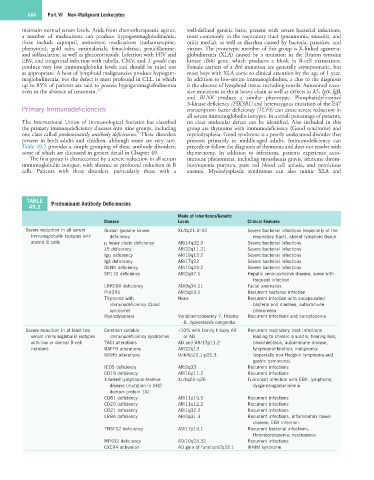
        Table 49.2 provides a simple grouping of these antibody disorders,   precede or follow the diagnosis of thymoma and does not resolve with
        some of which are discussed in greater detail in Chapter 49.  thymectomy.  In  addition  to  infections,  patients  experience  auto-
           The first group is characterized by a severe reduction in all serum   immune phenomena, including myasthenia gravis, immune throm-
        immunoglobulin isotypes, with absence or profound reduction in B   bocytopenia  purpura,  pure  red  blood  cell  aplasia,  and  pernicious
        cells.  Patients  with  these  disorders,  particularly  those  with  a   anemia.  Myelodysplastic  syndromes  can  also  mimic  XLA  and


          TABLE   Predominant Antibody Deficiencies
          49.2
                                                           Mode of Inheritance/Genetic
                                   Disease                 Locus                  Clinical Features
         Severe reduction in all serum   Bruton tyrosine kinase   XL/Xq21.3–22    Severe bacterial infections (especially of the
           immunoglobulin isotypes with   deficiency                                respiratory tract), absent lymphoid tissue
           absent B cells          µ heavy chain deficiency  AR/14q32.3           Severe bacterial infections
                                   λ5 deficiency           AR/22q11.21            Severe bacterial infections
                                   Igα deficiency          AR/19q13.2             Severe bacterial infections
                                   Igβ deficiency          AR/17q23               Severe bacterial infections
                                   BLNK deficiency         AR/10q23.2             Severe bacterial infections
                                   SP110 deficiency        AR/2q37.1              Hepatic veno-occlusive disease, some with
                                                                                    frequent infection
                                   LRRC8A deficiency       AD/9q34.11             Facial anomalies
                                   PIK3R1                  AR/5q13.1              Recurrent bacterial infection
                                   Thymoma with            None                   Recurrent infection with encapsulated
                                     immunodeficiency (Good                         bacteria and diarrhea, autoimmune
                                     syndrome)                                      phenomena
                                   Myelodysplasia          Variable/monosomy 7, trisomy   Recurrent infections and pancytopenia
                                                             8, dyskeratosis congenita
         Severe reduction in at least two   Common variable   ≈10% with family history AR   Recurrent respiratory tract infections
           serum immunoglobulin isotypes   immunodeficiency syndromes  or AD        leading to chronic sinusitis, hearing loss,
           with low or normal B-cell   TACI alterations    AD and AR/17p11.2        bronchiectasis, autoimmune disease,
           numbers                 BAFFR alterations       AR/22q13                 lymphoproliferation, malignancy
                                   MSH5 alterations        Unk/6p22.1-p21.3         (especially non-Hodgkin lymphoma and
                                                                                    gastric carcinoma)
                                   ICOS deficiency         AR/2q33                Recurrent infections
                                   CD19 deficiency         AR/16p11.2             Recurrent infections
                                   X-linked lymphoproliferative   XL/Xq25–q26     Fulminant infection with EBV, lymphoma,
                                     disease (mutation in SH2                       dysgammaglobulinemia
                                     domain protein 1A)
                                   CD81 deficiency         AR/11p15.5             Recurrent infections
                                   CD20 deficiency         AR/11q12.2             Recurrent infections
                                   CD21 deficiency         AR/1q32.2              Recurrent infections
                                   LRBA deficiency         AR/4q31.3              Recurrent infections, inflammatory bowel
                                                                                    disease, EBV infection
                                   TNSF12 deficiency       AD/17p13.1             Recurrent bacterial infections,
                                                                                    thrombocytopenia, neutropenia
                                   NFKB2 deficiency        AD/10q24.32            Recurrent infections
                                   CXCR4 activation        AD gain of function/2q22.1  WHIM syndrome

