


Page 803 - Hematology_ Basic Principles and Practice ( PDFDrive )
P. 803
Chapter 49  Lymphocytosis, Lymphocytopenia, Hypergammaglobulinemia, and Hypogammaglobulinemia  689


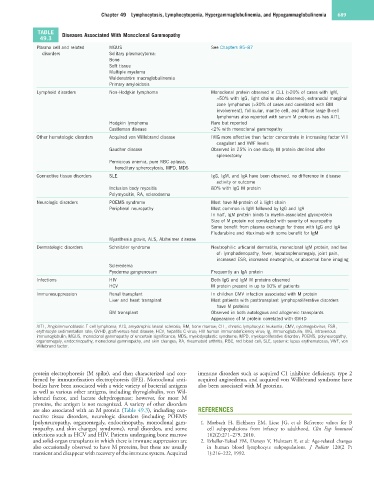
             TABLE   Diseases Associated With Monoclonal Gammopathy
              49.3
             Plasma cell and related   MGUS                           See Chapters 85–87
               disorders             Solitary plasmacytoma:
                                     Bone
                                     Soft tissue
                                     Multiple myeloma
                                     Waldenström macroglobulinemia
                                     Primary amyloidosis
             Lymphoid disorders      Non-Hodgkin lymphoma             Monoclonal protein observed in CLL (>20% of cases with IgM,
                                                                        ≈50% with IgG, light chains also observed), extranodal marginal
                                                                        zone lymphomas (>30% of cases and correlated with BM
                                                                        involvement), follicular, mantle cell, and diffuse large B-cell
                                                                        lymphomas also reported with serum M proteins as has AITL
                                     Hodgkin lymphoma                 Rare but reported
                                     Castleman disease                <2% with monoclonal gammopathy
             Other hematologic disorders  Acquired von Willebrand disease  IVIG more effective than factor concentrate in increasing factor VIII
                                                                        coagulant and VWF levels
                                     Gaucher disease                  Observed in 25% in one study; M protein declined after
                                                                        splenectomy
                                     Pernicious anemia, pure RBC aplasia,
                                       hereditary spherocytosis, MPD, MDS
             Connective tissue disorders  SLE                         IgG, IgM, and IgA have been observed, no difference in disease
                                                                        activity or outcome
                                     Inclusion body myositis          80% with IgG M protein
                                     Polymyositis, RA, scleroderma
             Neurologic disorders    POEMS syndrome                   Most have M-protein of λ light chain
                                     Peripheral neuropathy            Most common is IgM followed by IgG and IgA
                                                                      In half, IgM protein binds to myelin-associated glycoprotein
                                                                      Size of M protein not correlated with severity of neuropathy
                                                                      Some benefit from plasma exchange for those with IgG and IgA
                                                                      Fludarabine and rituximab with some benefit for IgM
                                     Myasthenia gravis, ALS, Alzheimer disease
             Dermatologic disorders  Schnitzler syndrome              Neutrophilic urticarial dermatitis, monoclonal IgM protein, and two
                                                                        of: lymphadenopathy, fever, hepatosplenomegaly, joint pain,
                                                                        increased ESR, increased neutrophils, or abnormal bone imaging
                                     Scleredema
                                     Pyoderma gangrenosum             Frequently an IgA protein
             Infections              HIV                              Both IgG and IgM M proteins observed
                                     HCV                              M protein present in up to 10% of patients
             Immunosuppression       Renal transplant                 In children CMV infection associated with M protein
                                     Liver and heart transplant       Most patients with posttransplant lymphoproliferative disorders
                                                                        have M proteins
                                     BM transplant                    Observed in both autologous and allogeneic transplants
                                                                      Appearance of M protein correlated with GVHD
             AITL, Angioimmunoblastic T-cell lymphoma; ALS, amyotrophic lateral sclerosis; BM, bone marrow; CLL, chronic lymphocytic leukemia; CMV, cytomegalovirus; ESR,
             erythrocyte sedimentation rate; GVHD, graft-versus-host disease; HCV, hepatitis C virus; HIV human immunodeficiency virus; Ig, immunoglobulin; IVIG, intravenous
             immunoglobulin; MGUS, monoclonal gammopathy of uncertain significance; MDS, myelodysplastic syndrome; MPD, myeloproliferative disorder; POEMS, polyneuropathy,
             organomegaly, endocrinopathy, monoclonal gammopathy, and skin changes; RA, rheumatoid arthritis; RBC, red blood cell; SLE, systemic lupus erythematosus; VWF, von
             Willebrand factor.


            protein electrophoresis (M spike), and then characterized and con-  immune disorders such as acquired C1 inhibitor deficiency, type 2
            firmed by immunofixation electrophoresis (IFE). Monoclonal anti-  acquired angioedema, and acquired von Willebrand syndrome have
            bodies have been associated with a wide variety of bacterial antigens   also been associated with M proteins.
            as well as various other antigens, including thyroglobulin, von Wil-
            lebrand  factor,  and  lactate  dehydrogenase;  however,  for  most  M
            proteins, the antigen is not recognized. A variety of other disorders
            are also associated with an M protein (Table 49.3), including con-  REFERENCES
            nective  tissue  disorders,  neurologic  disorders  (including  POEMS
            [polyneuropathy, organomegaly, endocrinopathy, monoclonal gam-  1.  Morbach  H,  Eichhorn  EM,  Liese  JG,  et al:  Reference  values  for  B
            mopathy, and skin changes] syndrome), renal disorders, and some   cell  subpopulations  from  infancy  to  adulthood.  Clin  Exp  Immunol
            infections such as HCV and HIV. Patients undergoing bone marrow   162(2):271–279, 2010.
            and solid-organ transplants in which there is immune suppression are   2.  Erkeller-Yuksel  FM,  Deneys V,  Hulstaert  F,  et al:  Age-related  changes
            also occasionally observed to have M proteins, but these are usually   in  human  blood  lymphocyte  subpopulations.  J  Pediatr  120(2  Pt
            transient and disappear with recovery of the immune system. Acquired   1):216–222, 1992.

