


Page 858 - Hematology_ Basic Principles and Practice ( PDFDrive )
P. 858
Chapter 53  Lysosomal Storage Diseases: Perspectives and Principles  741


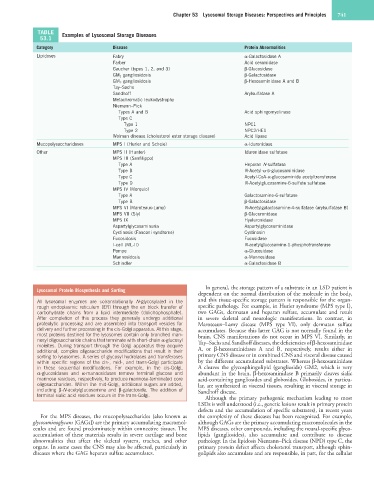
             TABLE   Examples of Lysosomal Storage Diseases
              53.1
             Category                 Disease                                    Protein Abnormalities
             Lipidoses                Fabry                                      α-Galactosidase A
                                      Farber                                     Acid ceramidase
                                      Gaucher (types 1, 2, and 3)                β-Glucosidase
                                      GM 1  gangliosidosis                       β-Galactosidase
                                      GM 2  gangliosidosis                       β-Hexosaminidase A and B
                                      Tay–Sachs
                                      Sandhoff                                   Arylsulfatase A
                                      Metachromatic leukodystrophy
                                      Niemann–Pick
                                        Types A and B                            Acid sphingomyelinase
                                        Type C
                                           Type 1                                NPC1
                                           Type 2                                NPC2/HE1
                                      Wolman disease (cholesterol ester storage disease)  Acid lipase
             Mucopolysaccharidoses    MPS I (Hurler and Scheie)                  α-Iduronidase
             Other                    MPS II (Hunter)                            Iduronidase sulfatase
                                      MPS III (Sanfilippo)
                                        Type A                                   Heparan N-sulfatase
                                        Type B                                   N-Acetyl-α-D-glucosaminidase
                                        Type C                                   Acetyl-CoA-α-glucosaminide acetyltransferase
                                        Type D                                   N-Acetylglucosamine-6-sulfate sulfatase
                                      MPS IV (Morquio)
                                        Type A                                   Galactosamine-6-sulfatase
                                        Type B                                   β-Galactosidase
                                      MPS VI (Maroteaux-Lamy)                    N-Acetylgalactosamine-4-sulfatase (arylsulfatase B)
                                      MPS VII (Sly)                              β-Glucuronidase
                                      MPS IX                                     Hyaluronidase
                                      Aspartylglycosaminuria                     Aspartylglycosaminidase
                                      Cystinosis (Fanconi syndrome)              Cystinosin
                                      Fucosidosis                                Fucosidase
                                      I-cell (ML-II)                             N-acetylglucosamine-1-phosphotransferase
                                      Pompe                                      α-Glucosidase
                                      Mannosidosis                               α-Mannosidase
                                      Schindler                                  α-Galactosidase B


                                                                    In general, the storage pattern of a substrate in an LSD patient is
             Lysosomal Protein Biosynthesis and Sorting
                                                                  dependent on the normal distribution of the molecule in the body,
             All  lysosomal  enzymes  are  cotranslationally  N-glycosylated  in  the   and this tissue-specific storage pattern is responsible for the organ-
             rough  endoplasmic  reticulum  (ER)  through  the  en  block  transfer  of   specific pathology. For example, in Hurler syndrome (MPS type I),
             carbohydrate  chains  from  a  lipid  intermediate  (dolichophosphate).   two  GAGs,  dermatan  and  heparan  sulfate,  accumulate  and  result
             After  completion  of  this  process  they  generally  undergo  additional   in  severe  skeletal  and  neurologic  manifestations.  In  contrast,  in
             proteolytic  processing  and  are  assembled  into  transport  vesicles  for   Maroteaux–Lamy  disease  (MPS  type  VI),  only  dermatan  sulfate
             delivery and further processing in the cis-Golgi apparatus. At this stage,   accumulates. Because this latter GAG is not normally found in the
             most proteins destined for the lysosomes contain only branched man-  brain, CNS manifestations do not occur in MPS VI. Similarly, in
             nosyl oligosaccharide chains that terminate with short-chain α-glucosyl   Tay–Sachs and Sandhoff diseases, the deficiencies of β-hexosaminidase
             moieites.  During  transport  through  the  Golgi  apparatus  they  acquire
             additional,  complex  oligosaccharide  modifications  that  result  in  their   A,  or  β-hexosaminidases  A  and  B,  respectively,  results  either  in
             sorting to lysosomes. A series of glycosyl hydrolases and transferases   primary CNS disease or in combined CNS and visceral disease caused
             within  specific  regions  of  the  cis-,  mid-,  and  trans-Golgi  participate   by the different accumulated substrates. Whereas β-hexosaminidase
             in  these  sequential  modifications.  For  example,  in  the  cis-Golgi,   A  cleaves  the  glycosphingolipid  (ganglioside)  GM2,  which  is  very
             α-glucosidases  and  α-mannosidases  remove  terminal  glucose  and   abundant in the brain, β-hexosaminidase B primarily cleaves sialic
             mannose residues, respectively, to produce mannose-terminated core   acid-containing gangliosides and globosides. Globosides, in particu-
             oligosaccharides. Within the mid-Golgi, additional sugars are added,   lar, are synthesized in visceral tissues, resulting in visceral storage in
             including  β-N-acetylglucosamine  and  β-galactoside.  The  addition  of   Sandhoff disease.
             terminal sialic acid residues occurs in the trans-Golgi.  Although  the  primary  pathogenic  mechanism  leading  to  most
                                                                  LSDs is well understood (i.e., genetic lesions result in primary protein
                                                                  defects and the accumulation of specific substrates), in recent years
              For the MPS diseases, the mucopolysaccharides (also known as   the complexity of these diseases has been recognized. For example,
            glycosaminoglycans [GAGs]) are the primary accumulating macromol-  although GAGs are the primary accumulating macromolecules in the
            ecules and are found predominately within connective tissues. The   MPS diseases, other compounds, including the neural-specific glyco-
            accumulation of these materials results in severe cartilage and bone   lipids  (gangliosides),  also  accumulate  and  contribute  to  disease
            abnormalities  that  affect  the  skeletal  system,  trachea,  and  other   pathology. In the lipidosis Niemann–Pick disease (NPD) type C, the
            organs. In some cases the CNS may also be affected, particularly in   primary protein defect affects cholesterol transport, although sphin-
            diseases where the GAG heparan sulfate accumulates.   golipids also accumulate and are responsible, in part, for the cellular

