


Page 862 - Hematology_ Basic Principles and Practice ( PDFDrive )
P. 862
Chapter 53  Lysosomal Storage Diseases: Perspectives and Principles  745


                                                                       Sea-blue histiocyte
                                                                       Sea-blue histiocyte
                                                                                           NPD foam cell
                                                                                           NPD foam cell


                          A                                      B


                          C                                         D

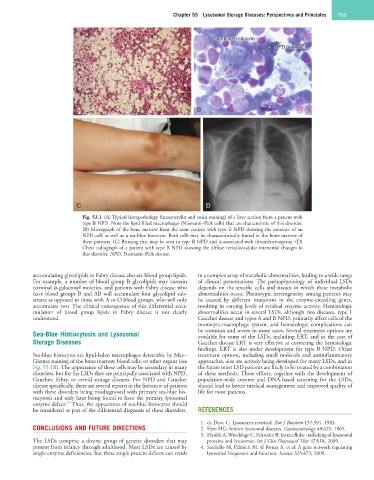
                            Fig. 53.1  (A) Typical histopathology (hematoxylin and eosin staining) of a liver section from a patient with
                            type B NPD. Note the lipid-filled macrophages (Niemann–Pick cells) that are characteristic of this disorder.
                            (B) Micrograph of the bone marrow from the same patient with type B NPD showing the presence of an
                            NPD cell, as well as a sea-blue histocyte. Both cells may be characteristically found in the bone marrow of
                            these patients. (C) Bruising that may be seen in type B NPD and is associated with thrombocytopenia. (D)
                            Chest radiograph of a patient with type B NPD showing the diffuse reticulonodular interstitial changes in
                            this disorder. NPD, Niemann–Pick disease.


            accumulating glycolipids in Fabry disease also are blood group lipids.   in a complex array of metabolic abnormalities, leading to a wide range
            For example, a number of blood group B glycolipids may contain   of  clinical  presentations. The  pathophysiology  of  individual  LSDs
            terminal α-galactosyl moieties, and patients with Fabry disease who   depends on the specific cells and tissues in which these metabolic
            have blood groups B and AB will accumulate four glycolipid sub-  abnormalities occur. Phenotypic heterogeneity among patients may
            strates as opposed to those with A or O blood groups, who will only   be  caused  by  different  mutations  in  the  enzyme-encoding  genes,
            accumulate two. The clinical consequence of this differential accu-  resulting in varying levels of residual enzyme activity. Hematologic
            mulation  of  blood  group  lipids  in  Fabry  disease  is  not  clearly   abnormalities occur in several LSDs, although two diseases, type 1
            understood.                                           Gaucher disease and types A and B NPD, primarily affect cells of the
                                                                  monocyte-macrophage  system,  and  hematologic  complications can
            Sea-Blue Histiocytosis and Lysosomal                  be common and severe in some cases. Several treatment options are
                                                                  available for some of the LSDs, including ERT, and in the case of
            Storage Diseases                                      Gaucher disease ERT is very effective at correcting the hematologic
                                                                  findings. ERT is also under development for type B NPD. Other
            Sea-blue histocytes are lipid-laden macrophages detectable by May–  treatment options, including small molecule and antiinflammatory
            Giemsa staining of the bone marrow, blood cells, or other organs (see   approaches, also are actively being developed for many LSDs, and in
            Fig. 53.1B). The appearance of these cells may be secondary in many   the future most LSD patients are likely to be treated by a combination
            disorders, but for the LSDs they are principally associated with NPD,   of these methods. These efforts, together with the development of
            Gaucher, Fabry, or ceroid storage diseases. For NPD and Gaucher   population-wide  enzyme  and  DNA-based  screening  for  the  LSDs,
            disease specifically, there are several reports in the literature of patients   should lead to better medical management and improved quality of
            with these disorders being misdiagnosed with primary sea-blue his-  life for most patients.
            tocytosis and only later being found to have the primary lysosomal
                       34
            enzyme defect.  Thus, the appearance of sea-blue histocytes should
            be considered as part of the differential diagnosis of these disorders.  REFERENCES
                                                                   1.  de Duve C: Lysosomes revisited. Eur J Biochem 137:391, 1983.
            CONCLUSIONS AND FUTURE DIRECTIONS                      2.  Hers HG: Inborn lysosomal diseases. Gastroenterology 48:625, 1965.
                                                                   3.  Hasilik A, Wrocklage C, Schroder B: Intracellular trafficking of lysosomal
            The LSDs comprise a diverse group of genetic disorders that may   proteins and lysosomes. Int J Clin Pharmacol Ther 47:S18, 2009.
            present from infancy through adulthood. Most LSDs are caused by   4.  Sardiello M, Palmieri M, di Ronza A, et al: A gene network regulating
            single enzyme deficiencies, but these single protein defects can result   lysosomal biogenesis and function. Science 325:473, 2009.

