


Page 987 - Hematology_ Basic Principles and Practice ( PDFDrive )
P. 987
870    Part VII  Hematologic Malignancies


        or DNA damage, they do not directly interact with the intracellular   metabolic stimuli. A number of current anticancer agents in develop-
        machinery involved in apoptosis. Tumor selectivity of conventional   ment target these pathways and are designed to be effective alone or
        agents is largely caused by the increased sensitivity to apoptosis of   in combination with other agents that disrupt the cell cycle, DNA
        tumor  cells  after  DNA  damage  or  cell  cycle  perturbation.  Novel   synthesis, invoke DNA damage, and so on.
        therapeutic agents or strategies that target critical regulators or effec-
        tors  of  apoptosis  are  under  development  and  clinical  testing,  and
        these agents or strategies have the potential to exert selective cytotox-  Death Receptor–Initiated Apoptotic Signaling
        icity against cancer cells.
           Caspases are the “executioners” for apoptosis. They are proteases   Several TNF  family  receptors  are  known  to  transduce  signals  that
        that exist as inactive zymogens and are activated by proteolytic cleav-  result  in  apoptosis.  These  include  TNFRSF1A  (also  known  as
        age of their proforms in response to a variety of death stimuli. This   CD120a and previously designated tumor necrosis factor receptor-1
        processing occurs at conserved aspartic acid residues, thus generating   [TNFR1]),  TNFRSF6  (also  known  as  CD95,  APO-1,  or  FAS),
        the enzymatically active caspases. Caspase activation is organized as   TNFRSF25 (also designated TRAMP and known as DR3 or APO3),
        a  cascade,  with  an  upstream  initiator  and  downstream  effector   TNFRSF10A (also known as DR4 or TRAIL-R1), and TNFRSF10B
        caspase. Upstream initiator caspases contain large prodomains that   (also known as DR5 or TRAIL-R2). These receptors, also called death
        interact with specific proteins involved in triggering the cascade. The   receptors, are characterized by the presence of a death domain within
        downstream  caspases,  which  function  as  the  ultimate  effectors  of   their cytoplasmic region, and have been shown to trigger apoptosis
        apoptosis, possess small prodomains and are activated predominantly   upon binding to their cognate ligands or specific agonist antibody.
        by proteolytic cleavage by upstream caspases. The irreversible cleavage   The activating ligands for these death receptors are structurally related
        of specific protein death substrates by the downstream effector cas-  molecules  that  also  belong  to  the  TNF  gene  superfamily  such  as
        pases directly or indirectly accounts for the biochemical and morpho-  TNFSF6 (also known as Fas ligand), TNF, and TRAIL.
        logic changes that are recognized as apoptosis.          Ligation of death receptors produces receptor trimerization and
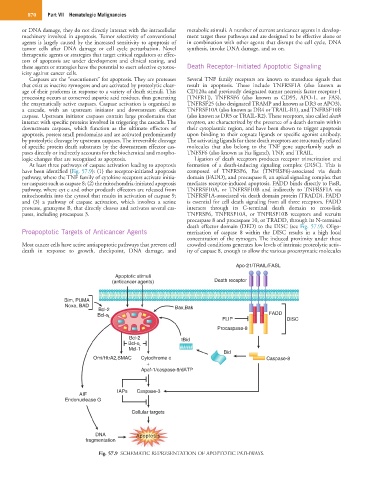
           At least three pathways of caspase activation leading to apoptosis   formation  of  a  death-inducing  signaling  complex  (DISC). This  is
        have been identified (Fig. 57.9): (1) the receptor-initiated apoptosis   composed  of  TNFRSF6,  Fas  (TNFRSF6)-associated  via  death
        pathway, where the TNF family of cytokine receptors activate initia-  domain (FADD), and procaspase 8, an apical signaling complex that
        tor caspases such as caspase 8; (2) the mitochondria-initiated apoptosis   mediates receptor-induced apoptosis. FADD binds directly to FasR,
        pathway, where cyt c and other prodeath effectors are released from   TNFRSF10A,  or  TNFRSF10B  and  indirectly  to  TNFRSF1A  via
        mitochondria into the cytosol that results in activation of caspase 9;   TNFRSF1A-associated via death domain protein (TRADD). FADD
        and  (3)  a  pathway  of  caspase  activation,  which  involves  a  serine   is essential for cell death signaling from all three receptors. FADD
        protease, granzyme B, that directly cleaves and activates several cas-  interacts  through  its  C-terminal  death  domain  to  cross-link
        pases, including procaspase 3.                        TNFRSF6,  TNFRSF10A,  or  TNFRSF10B  receptors  and  recruits
                                                              procaspase 8 and procaspase 10, or TRADD, through its N-terminal
                                                              death effector domain (DED) to the DISC (see Fig. 57.9). Oligo-
        Proapoptotic Targets of Anticancer Agents             merization  of  caspase  8  within  the  DISC  results  in  a  high  local
                                                              concentration of the zymogen. The induced proximity under these
        Most cancer cells have active antiapoptotic pathways that prevent cell   crowded conditions generates low levels of intrinsic proteolytic activ-
        death  in  response  to  growth,  checkpoint,  DNA  damage,  and    ity of caspase 8, enough to allow the various proenzymatic molecules


                                                                              Apo-21/TRAIL/FASL
                                       Apoptotic stimuli
                                      (anticancer agents)              Death receptor


                      Bim, PUMA
                      Noxa, BAD                           Bax,Bak
                                 Bcl-2
                                 Bcl-x L                                                 FADD
                                                                          FLIP                 DISC
                                                                        Procaspase-8
                                           Bcl-2            tBid
                                           Bcl-x L
                                           Mcl-1
                                                                          Bid
                                Omi/HtrA2,SMAC  Cytochrome c                            Caspase-8
                                                 +
                                               Apaf-1/caspase-9/dATP


                                       IAPs   Caspase-3
                           AIF
                      Endonuclease G
                                            Cellular targets


                                DNA           Apoptosis
                             fragmentation

                                 Fig. 57.9  SCHEMATIC REPRESENTATION OF APOPTOTIC PATHWAYS.

