


Page 984 - Hematology_ Basic Principles and Practice ( PDFDrive )
P. 984
Chapter 57  Pharmacology and Molecular Mechanisms of Antineoplastic Agents for Hematologic Malignancies  867


            the  degradation  of  intracellular  proteins.  Numerous  studies  have   least three distinct proteolytic activities are associated with the protea-
            demonstrated that the ubiquitin–proteasome system controls basic   some: chymotryptic, tryptic, and peptidylglutamyl. After release from
            cellular  functions  such  as  cell  cycle  progression,  signal  transduc-  the  substrate,  the  polyubiquitin  chain  is  hydrolyzed  into  single
            tion, and programmed cell death, hence the interest in therapeutic   ubiquitin moieties, and tagged proteins are degraded to small pep-
            interventions  that  manipulate  proteasomal  activity  and  potentially   tides. Both the assembly of the 26S proteasome and the degradation
            restore cellular homeostasis into transformed cells (see Chapter 4).  of protein substrates are ATP dependent. The mechanism leading to
              Ubiquitin is a highly conserved 76-amino–acid polypeptide that   cell death after proteasome inhibition are not fully understood, but
            is expressed in all eukaryotic cells. Under the sequential action of E1   it  is  hypothesized  that  accumulation  of  incompatible  regulatory
            (ubiquitin-activating  enzyme),  E2  (ubiquitin-conjugating  enzyme),   proteins within the cell, accumulation of mis-folded proteins from
            and E3 (ubiquitin ligase), ubiquitin is activated and covalently con-  the ER (“ER stress”) leading to suspension of protein synthesis, and
            jugated  to  potential  proteasome  substrates  via  an  isopeptide  bond   interference with degradation of proteins that inhibit NFκB, leading
            between the C-terminal glycine residue of ubiquitin and the ε-amino   to  inhibition  of  NFκB,  are  the  major  contributors  to  cell  death
            group of internal lysine residues in target proteins. The same set of   induced  by  proteasome  inhibitors.  Synergism  between  proteasome
            enzymes also catalyzes the formation of the isopeptide bond between   inhibition and cytotoxic chemotherapy is an area of active research.
            G76 and the lysine residue (K48) of previously conjugated ubiquitin,   The activated B-cell subtype of DLBCL (ABC-DLBCL), which has
            leading  to  formation  of  a  polyubiquitin  chain.  Polyubiquitinated   inferior survival after anthracycline-based chemotherapy, is character-
            substrates are usually targeted for proteasomal degradation.  ized  by  constitutive  activation  of  the  NFκB  pathway,  leading  to
              The  26S  proteasome  is  a  large  (2000-kDa)  threonine  protease   resistance  to  apoptosis  via  the  mitochondrial  pathway  through
            present  in  the  nucleus  and  cytoplasm  of  all  eukaryotic  cells. This   upregulation  of  NFκB-regulated  genes  (including  bcl-2,  bcl-XL,
            ATP-dependent, multicatalytic protease eliminates damaged or mis-  X-linked inhibitor of apoptosis [XIAP], and survivin). This explains
            folded proteins and regulates cyclins and CDK inhibitor cell cycle   the clinical benefit seen with the addition of bortezomib, the first-in-
            regulatory proteins as well as other proteins that govern the transcrip-  class proteasome inhibitor to anthracycline-based chemotherapy in
            tion  factor  activation,  apoptosis,  and  cell  trafficking.  Its  structure   ABC-DLBCL.
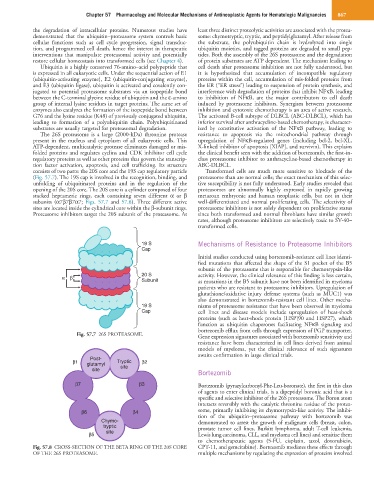
            consists of two parts: the 20S core and the 19S cap regulatory particle   Transformed  cells  are  much  more  sensitive  to  blockade  of  the
            (Fig. 57.7). The 19S cap is involved in the recognition, binding, and   proteasome than are normal cells; the exact mechanism of this selec-
            unfolding  of  ubiquitinated  proteins  and  in  the  regulation  of  the   tive susceptibility is not fully understood. Early studies revealed that
            opening of the 20S core. The 20S core is a cylinder composed of four   proteasomes  are  abnormally  highly  expressed  in  rapidly  growing
            stacked  heptameric  rings,  each  containing  seven  different  α  or  β   metazoan embryonic and human neoplastic cells, but not in their
            subunits  (α7β7β7α7;  Figs.  57.7  and  57.8). Three  different  active   well-differentiated and normal proliferating cells. The selectivity of
            sites are located inside the cylindrical core within the β-subunit rings.   proteasome inhibitors is not solely dependent on proliferative status
            Proteasome inhibitors target the 20S subunit of the proteasome. At   since both transformed and normal fibroblasts have similar growth
                                                                  rates, although proteasome inhibitors are selectively toxic to SV-40–
                                                                  transformed cells.

                                               19 S               Mechanisms of Resistance to Proteasome Inhibitors
                                               Cap
                                                                  Initial studies conducted using bortezomib-resistant cell lines identi-
                                                                  fied mutations that affected the shape of the S1 pocket of the B5
                                                                  subunit of the proteasome that is responsible for chemotrypsin-like
                                               20 S               activity. However, the clinical relevance of this finding is less certain,
                     α  β                      Subunit            as mutations in the B5 subunit have not been identified in myeloma
                                                                  patients who are resistant to proteasome inhibitors. Upregulation of
                                                                  glutathione/oxidative  injury  defense  systems  (such  as  MUC1)  was
                                                                  also demonstrated in bortezomib-resistant cell lines. Other mecha-
                                               19 S               nisms of proteasome resistance that have been observed in myeloma
                                               Cap                cell  lines  and  disease  models  include  upregulation  of  heat-shock
                                                                  proteins (such as heat-shock protein [HSP]90 and HSP27), which
                                                                  function  as  ubiquitin  chaperones  facilitating  NFκB  signaling  and
                                                                  bortezomib efflux from cells through expression of PGP transporter.
                          Fig. 57.7  26S PROTEASOME.              Gene expression signatures associated with bortezomib sensitivity and
                                                                  resistance have been characterized in cell lines derived from animal
                                                                  models  of  myeloma,  yet  the  clinical  relevance  of  such  signatures
                                                                  awaits confirmation in large clinical trials.
                               Post-
                         β1  glutamyl  Tryptic  β2
                               site     site
                                                                  Bortezomib
                          β7                   β3                 Bortezomib (pyrazylcarbonyl-Phe-Leu-boronate), the first in this class
                                                                  of agents to enter clinical trials, is a dipeptidyl boronic acid that is a
                                                                  specific and selective inhibitor of the 26S proteasome. The Boron atom
                                                                  interacts reversibly with the catalytic threonine residue of the protea-
                            β6              β4                    some, primarily inhibiting its chymotrypsin-like activity. The inhibi-
                                                                  tion  of  the  ubiquitin–proteasome  pathway  with  bortezomib  was
                                  Chymo-                          demonstrated to arrest the growth of malignant cells (breast, colon,
                                   tryptic                        prostate  tumor  cell  lines,  Burkitt  lymphoma,  adult T-cell  leukemia,
                                    site
                              β5                                  Lewis lung carcinoma, CLL, and myeloma cell lines) and sensitize them
                                                                  to  chemotherapeutic  agents  (5-FU,  cisplatin,  taxol,  doxorubicin,
            Fig. 57.8  CROSS-SECTION OF THE BETA RING OF THE 20S CORE   CPT-11, and gemcitabine). Bortezomib mediates these effects through
            OF THE 26S PROTEASOME.                                multiple mechanisms by regulating the expression of proteins involved

