


Page 991 - Hematology_ Basic Principles and Practice ( PDFDrive )
P. 991
874    Part VII  Hematologic Malignancies


        increased SMAD1 mRNA, in DLBCL cells obtained from patients.   HATs and HDACs are two classes of enzymes that mediate the
        SMAD1 is the major downstream effector of TGF-β. TGF-β exerts an   acetylation and deacetylation, respectively, at evolutionarily-conserved
        antiproliferative  effect  in  most  NHL,  and  loss  of  antiproliferative   N-terminal lysine residues. Acetylated histones are negatively charged
        response to TGF-β has been demonstrated in the majority of NHLs.   and  do  not  bind  as  tightly  to  negatively  charged  DNA,  thereby
        SMAD1 hypomethylation has been associated with an abundance of   facilitating gene transcription. In contrast, deacetylated histones bind
        SMAD1 mRNA and restoration of chemosensitivity in DLBCL cells   closely  to  DNA,  preventing  transcription.  Acetylation  status  of
        after azacitidine “priming.”                          chromatin and hence gene transcription is dictated by balanced activ-
                                                              ity of HATs and HDACs. Acetylation of core histone bases has also
                                                              been implicated in chromatin assembly, DNA repair, and replication
        Histone Deacetylase Inhibitors                        timing  of  specific  genomic  regions.  Cross-talk  also  exists  between
                                                              acetylation and ubiquitination. Thus, HDACs can decrease the half-
        Histone acetyl transferases (HATs) control gene expression through the   lives of substrates by exposing the lysine residue for ubiquitination.
        modification of chromatin structure through acetylation of chromatin-  Other  crucial  functions  affected  by  the  delicate  balance  between
        bound histones. Regulation of acetylation is through histone deacety-  HATs and HDACs include activation of the apoptotic program via
        lation. Without the ability to fine tune histone binding to chromatin   interaction between Ku70 and Bax; protein localization (nuclear vs.
        regions, gene expression is perturbed. Inhibition of this process by a   cytoplasm); and DNA binding of transcription factors such as p53,
        group  of  agents  termed  histone  deacetylation  inhibitors  alters  gene   E2F1,  GATA1,  RelA,  YY1,  and  hormone  receptors.  There  is  a
        expression  in  both  normal  and  malignant  cells.  Often  the  result  is   growing list of nonhistone proteins that are modulated by HATs or
        differentiation of malignant cells or induction of apoptosis. Given the   HDACs.  These  include  hypoxia-inducible  factor-1α  (HIF-1α),
        long history of the use of differentiating agents in leukemias, for APL   β-catenin,  α-tubulin,  Ku70,  importin-α  7,  cortactin,  and,  most
        (retinoids), low-dose ara-C and azacytidine, it is not surprising that   recently, HSP90. HATs and HDACs can be classified into subfamilies
        newer HDIs have undergone extensive evaluation in leukemias.  according to the presence of highly conserved structural motifs. Please
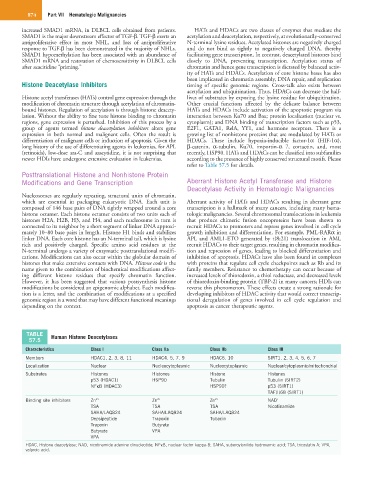
                                                              refer to Table 57.5 for details.
        Posttranslational Histone and Nonhistone Protein
        Modifications and Gene Transcription                  Aberrant Histone Acetyl Transferase and Histone
                                                              Deacetylase Activity in Hematologic Malignancies
        Nucleosomes are regularly repeating, structural units of chromatin,
        which  are  essential  in  packaging  eukaryotic  DNA.  Each  unit  is   Aberrant activity of HATs and HDACs resulting in aberrant gene
        composed of 146 base pairs of DNA tightly wrapped around a core   transcription is a hallmark of many cancers, including many hema-
        histone octamer. Each histone octamer consists of two units each of   tologic malignancies. Several chromosomal translocations in leukemia
        histones H2A, H2B, H3, and H4, and each nucleosome in turn is   that  produce  chimeric  fusion  oncoproteins  have  been  shown  to
        connected to its neighbor by a short segment of linker DNA approxi-  recruit HDACs to promoters and repress genes involved in cell cycle
        mately 10–80 base pairs in length. Histone H1 binds and stabilizes   growth inhibition and differentiation. For example, PML-RARα in
        linker DNA. Each core histone has an N-terminal tail, which is lysine   APL  and  AML1-ETO  generated  by  t(8;21)  translocation  in  AML
        rich  and  positively  charged.  Specific  amino  acid  residues  at  the   recruit HDACs to their target genes, resulting in chromatin modifica-
        N-terminal undergo a variety of enzymatic posttranslational modifi-  tion and repression of genes, leading to blocked differentiation and
        cations. Modifications can also occur within the globular domain of   inhibition of apoptosis. HDACs have also been found in complexes
        histones that make extensive contacts with DNA. Histone code is the   with proteins that regulate cell cycle checkpoints such as Rb and its
        name given to the combination of biochemical modifications affect-  family members. Resistance to chemotherapy can occur because of
        ing  different  histone  residues  that  specify  chromatin  function.   increased levels of thioredoxin, a thiol reductase, and decreased levels
        However,  it  has  been  suggested  that  various  postsynthesis  histone   of thioredoxin-binding protein (TBP-2) in many cancers; HDIs can
        modifications be considered an epigenomic alphabet. Each modifica-  reverse this phenomenon. These effects create a strong rationale for
        tion is a letter, and the combination of modifications at a specified   developing inhibitors of HDAC activity that would correct transcrip-
        genomic region is a word that may have different functional meanings   tional  deregulation  of  genes  involved  in  cell  cycle  regulation  and
        depending on the context.                             apoptosis as cancer therapeutic agents.


          TABLE   Human Histone Deacetylases
          57.5
         Characteristics       Class I             Class IIa          Class IIb          Class III
         Members               HDAC1, 2, 3, 8, 11  HDAC4, 5, 7, 9     HDAC6, 10          SIRT1, 2, 3, 4, 5, 6, 7
         Localization          Nuclear             Nucleocytoplasmic  Nucleocytoplasmic  Nuclear/cytoplasmic/mitochondrial
         Substrates            Histones            Histones           Histone            Histones
                               p53 (HDAC1)         HSP90              Tubulin            Tubulin (SIRT2)
                               NFκB (HDAC3)                           HSP90?             p53 (SIRT1)
                                                                                         TAF(I)68 (SIRT1)
         Binding site inhibitors  Zn 2+            Zn 2+              Zn 2+              NAD +
                               TSA                 TSA                TSA                Nicotinamide
                               SAHA/LAQ824         SAHA/LAQ824        SAHA/LAQ824
                               Depsipeptide        Trapoxin           Tubacin
                               Trapoxin            Butyrate
                               Butyrate            VPA
                               VPA
         HDAC, Histone deacetylase; NAD, nicotinamide adenine dinucleotide; NFκB, nuclear factor kappa-B; SAHA, suberoylanilide hydroxamic acid; TSA, tricostatin A; VPA,
         valproic acid.

