


Page 1017 - Williams Hematology ( PDFDrive )
P. 1017
992            Part VII:  Neutrophils, Eosinophils, Basophils, and Mast Cells                                                                                                Chapter 65:  Neutropenia and Neutrophilia             993


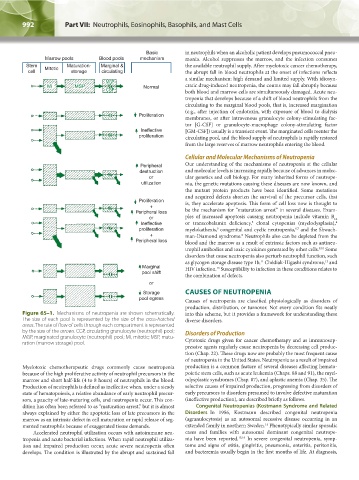
                                                         Basic        in neutrophils when an alcoholic patient develops pneumococcal pneu-
                       Marrow pools      Blood pools   mechanism      monia. Alcohol suppresses the marrow, and the infection consumes
                 Stem  Mitotic  Maturation-  Marginal &               the available neutrophil supply. After myelotoxic cancer chemotherapy,
                 cell           storage   circulating                 the abrupt fall in blood neutrophils at the onset of infections reflects
                                                                      a similar mechanism: high demand and limited supply. With idiosyn-
                                           MGP
                        Mi       MSP                    Normal        cratic drug-induced neutropenia, the counts may fall abruptly because
                                           CGP                        both blood and marrow cells are simultaneously damaged. Acute neu-
                                                                      tropenia that develops because of a shift of blood neutrophils from the
                                                                      circulating to the marginal blood pools, that is, increased margination
                                                                      (e.g., after injection of endotoxin, with exposure of blood to dialysis
                                                      Proliferation
                                                                      membranes, or after intravenous granulocyte colony-stimulating fac-
                                                                      tor [G-CSF] or granulocyte-macrophage colony-stimulating factor
                                                       Ineffective    [GM-CSF]) usually is a transient event. The marginated cells reenter the
                                                      proliferation   circulating pool, and the blood supply of neutrophils is rapidly restored
                                                                      from the large reserves of marrow neutrophils entering the blood.
                                                                      Cellular and Molecular Mechanisms of Neutropenia
                                                       Peripheral     Our understanding of the mechanisms of neutropenia at the cellular
                                                       destruction    and molecular levels is increasing rapidly because of advances in molec-
                                                          or          ular genetics and cell biology. For many inherited forms of neutrope-
                                                       utilization    nia, the genetic mutations causing these diseases are now known, and
                                                                      the mutant protein products have been identified. Some mutations
                                                                      and acquired defects shorten the survival of the precursor cells, that
                                                      Proliferation   is, they accelerate apoptosis. This form of cell loss now is thought to
                                                          +
                                                     Peripheral loss  be the mechanism for “maturation arrest” in several diseases. Exam-
                                                          or          ples of increased apoptosis causing neutropenia include vitamin B
                                                                                                                        12
                                                                                                                        4
                                                                                            3
                                                       Ineffective    or transcobalamin deficiency,  clonal cytopenias (myelodysplasia),
                                                                                                           6,7
                                                                                 5
                                                      proliferation   myelokathexis,  congenital and cyclic neutropenia,  and the Shwach-
                                                          +           man-Diamond syndrome.  Neutrophils also can be depleted from the
                                                                                         8
                                                     Peripheral loss  blood and the marrow as a result of extrinsic factors such as antineu-
                                                                      trophil antibodies and toxic cytokines generated by other cells.  Some
                                                                                                                   9,10
                                                                      disorders that cause neutropenia also perturb neutrophil function, such
                                                                      as glycogen storage disease type 1b,  Chédiak-Higashi syndrome,  and
                                                                                                                     12
                                                                                               11
                                                        Marginal      HIV infection.  Susceptibility to infection in these conditions relates to
                                                                                 13
                                                       pool shift
                                                                      the combination of defects.
                                                          or
                                                        Storage       CAUSES OF NEUTROPENIA
                                                       pool egress    Causes of neutropenia are classified physiologically as disorders of
                                                                      production, distribution, or turnover. Not every condition fits neatly
               Figure 65–1.  Mechanisms of neutropenia are shown schematically.   into this scheme, but it provides a framework for understanding these
               The size of each pool is represented by the size of the cross-hatched   diverse disorders.
               areas. The rate of flow of cells through each compartment is represented
               by the size of the arrows. CGP, circulating granulocyte (neutrophil) pool;   Disorders of Production
               MGP, marginated granulocyte (neutrophil) pool; Mi, mitotic; MSP, matu-  Cytotoxic drugs given for cancer chemotherapy and as immunosup-
               ration (marrow storage) pool.
                                                                      pressive agents regularly cause neutropenia by decreasing cell produc-
                                                                      tion (Chap. 22). These drugs now are probably the most frequent cause
                                                                      of neutropenia in the United States. Neutropenia as a result of impaired
               Myelotoxic chemotherapeutic drugs commonly cause neutropenia   production is a common feature of several diseases affecting hemato-
               because of the high proliferative activity of neutrophil precursors in the   poietic stem cells, such as acute leukemia (Chaps. 88 and 91), the myel-
               marrow and short half-life (4 to 8 hours) of neutrophils in the blood.   odysplastic syndromes (Chap. 87), and aplastic anemia (Chap. 35). The
               Production of neutrophils is defined as ineffective when, under a steady   selective causes of impaired production, progressing from disorders of
               state of hematopoiesis, a relative abundance of early neutrophil precur-  early precursors to disorders presumed to involve defective maturation
               sors, a paucity of late-maturing cells, and neutropenia occur. This con-  (ineffective production), are described briefly as follows.
               dition has often been referred to as “maturation arrest,” but it is almost   Congenital Neutropenias (Kostmann Syndrome and Related
               always explained by either the apoptotic loss of late precursors in the   Disorders  In 1956, Kostmann described congenital neutropenia
               marrow as an intrinsic defect in cell maturation or rapid release of seg-  (agranulocytosis) as an autosomal recessive disease occurring in  an
                                                                                                 14
               mented neutrophils because of exaggerated tissue demands.  extended family in northern Sweden.  Phenotypically similar sporadic
                   Accelerated neutrophil utilization occurs with autoimmune neu-  cases and families with autosomal dominant congenital neutrope-
               tropenia and acute bacterial infections. When rapid neutrophil utiliza-  nia have been reported. 15,16  In severe congenital neutropenia, symp-
               tion and impaired production occur, acute severe neutropenia often   toms and signs of otitis, gingivitis, pneumonia, enteritis, peritonitis,
               develops. The condition is illustrated by the abrupt and sustained fall   and bacteremia usually begin in the first months of life. At diagnosis,


          Kaushansky_chapter 65_p0991-1004.indd   992                                                                   9/17/15   6:44 PM

