


Page 1018 - Williams Hematology ( PDFDrive )
P. 1018
992  Part VII:  Neutrophils, Eosinophils, Basophils, and Mast Cells  Chapter 65:  Neutropenia and Neutrophilia        993


                                                                        rare cases of biallelic mutations within the extracellular domain of the
                                                                        G-CSF receptor which lead to nonresponse to treatment with G-CSF. 36
                                                                            G-CSF is a very effective therapy for all of the recognized subtypes
                                                                        of severe congenital neutropenia, increasing the neutrophil counts and
                                                                                                      37
                                                                        reducing recurrent fevers and infections.  G-CSF acts to increase the
                                                                        neutrophil counts by enhancing expression of a critical transcription
                                                                        factor for granulopoiesis, C/EBPβ (CCAAT/enhancer binding protein
                                                                        β), and the “emergency” pathway of myelopoiesis (as during steady state
                                                                                            38
                                                                        C/EBPα is not functional).  Approximately 5 percent of patients do
                                                                        not respond to G-CSF. Hematopoietic transplantation is the only other
                                                                        therapy  known  to  improve  the  clinical  course  for  these  patients. 39,40
                                                                        Untreated  patients  and  patients  treated  with  G-CSF  are  at  risk  for
                                                                        developing acute myelogenous leukemia. The risk increases with time
                                                                                                                          41
                                                                        on treatment with G-CSF, particularly in poorly responsive patients.
                                                                        A novel molecular pathway of leukemogenesis was recently identified:
                                                                        mutations in the hematopoietic cytokine receptor (G-CSFR) in com-
                                                                        bination with the second mutations in the downstream hematopoietic
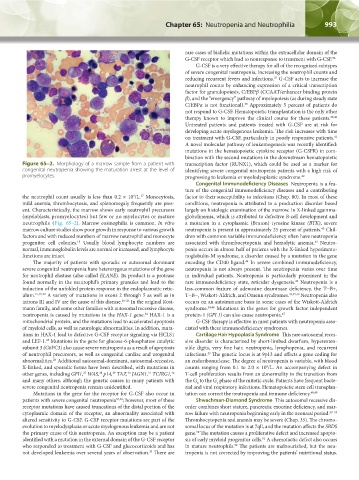
                  Figure 65–2.  Morphology of a marrow sample from a patient with   transcription factor (RUNX1),  which  could be  used  as  a marker  for
                  congenital neutropenia showing the maturation arrest at the level of   identifying severe congenital neutropenia patients with a high risk of
                  promyelocytes.                                        progressing to leukemia or myelodysplastic syndrome. 42
                                                                            Congenital Immunodeficiency Diseases  Neutropenia is a fea-
                                                                        ture of the congenital immunodeficiency diseases and a contributing
                  the neutrophil count usually is less than 0.2 × 10 /L.  Monocytosis,   factor to their susceptibility to infections (Chap. 80). In most of these
                                                         17
                                                       9
                  mild anemia, thrombocytosis, and splenomegaly frequently are pres-  conditions,  neutropenia  is attributed to  a production  disorder based
                  ent. Characteristically, the marrow shows early neutrophil precursors     largely on histologic examination of the marrow. In X-linked agamma-
                  (myeloblasts, promyelocytes) but few or no myelocytes or mature   globulinemia, which is attributed to defective B-cell development and
                  neutrophils (Fig. 65–2). Marrow eosinophilia is common.  In vitro   a  mutation  in  a  cytoplasmic  (Bruton)  tyrosine  kinase  (BTK),  severe
                                                                                                                      43
                  marrow culture studies show poor growth in response to various growth   neutropenia is present in approximately 25 percent of patients.  Chil-
                  factors and with reduced numbers of marrow neutrophil and monocyte     dren with common variable immunodeficiency often have neutropenia
                                    18
                                                                                                                    43
                  progenitor cell colonies.  Usually blood lymphocyte numbers are    associated with thrombocytopenia and hemolytic anemia.  Neutro-
                  normal, immunoglobulin levels are normal or increased, and lymphocyte   penia occurs in almost half of patients with the X-linked hyperimmu-
                  functions are intact.                                 noglobulin-M syndrome, a disorder caused by a mutation in the gene
                     The majority of patients with sporadic or autosomal dominant   encoding  the  CD40  ligand.  In severe combined immunodeficiency,
                                                                                             44
                  severe congenital neutropenia have heterozygous mutations of the gene   neutropenia is not always present. The neutropenia varies over time
                  for neutrophil elastase (also called ELANE). Its product is a protease   in individual patients. Neutropenia is particularly prominent in the
                  found normally in the neutrophil’s primary granules and lead to the   rare immunodeficiency state, reticular dysgenesis.  Neutropenia is a
                                                                                                             43
                  induction of the unfolded protein response in the endoplasmatic retic-  less-common feature of adenosine deaminase deficiency, the T−B+,
                  ulum. 15,19,20  A variety of mutations in exons 2 through 5 as well as in   T−B−, Wiskott-Aldrich, and Omenn syndromes. 43,45,46  Neutropenia also
                  introns III and IV are the cause of this disease. 20–23  In the original Kost-  occurs on an autoimmune basis in some cases of the Wiskott-Aldrich
                  mann family, and some other families with autosomal recessive disease,   syndrome. 34,46  Mutations in the genes for growth factor independent
                                                           24
                  neutropenia is caused by mutations in the HAX-1 gene.  HAX-1 is a   protein-1 (GFI 1) can also cause neutropenia. 47
                  mitochondrial protein, and the mutations lead to accelerated apoptosis   G-CSF therapy is effective in most patients with neutropenia asso-
                  of myeloid cells, as well as neurologic abnormalities. In addition, muta-  ciated with these immunodeficiency syndromes.
                  tions in HAX-1 lead to defective G-CSF receptor signaling via HCLS1   Cartilage Hair Hypoplasia Syndrome  This rare autosomal reces-
                          25
                  and LEF-1.  Mutations in the gene for glucose-6-phosphatase catalytic   sive disorder is characterized by short-limbed dwarfism, hyperexten-
                  subunit 3 (G6PC3) also cause severe neutropenia as a result of apoptosis   sible digits, very fine hair, neutropenia, lymphopenia, and recurrent
                  of neutrophil precursors, as well as congenital cardiac and urogenital   infections.  The genetic locus is at 9p13 and affects a gene coding for
                                                                                43
                            26
                  abnormalities.  Additional autosomal-dominant, autosomal-recessive,   an endoribonuclease. The degree of neutropenia is variable, with blood
                                                                                                    9
                  X-linked, and sporadic forms have been described, with mutations in   counts  ranging  from  0.1  to  2.0  ×  10 /L.  An  accompanying  defect  in
                                      27
                                                            31
                                                     30
                  other genes, including GFI1,  WAS,  p14,  TAZ,  JAGN1,  TCIRG1,    T-cell proliferation results from an abnormality in the transition from
                                                                    32
                                            28
                                                29
                  and many others, although the genetic causes in many patients with   the G  to the G  phase of the mitotic cycle. Patients have frequent bacte-
                                                                            0
                                                                                   1
                  severe congenital neutropenia remain unidentified.    rial and viral respiratory infections. Hematopoietic stem cell transplan-
                     Mutations in the gene for the receptor for G-CSF also occur in   tation can correct the neutropenia and immune deficiency. 48,49
                  patients with severe congenital neutropenia 33,34 ; however, most of these   Shwachman-Diamond Syndrome  This autosomal recessive dis-
                  receptor mutations have caused truncations of the distal portion of the   order combines short stature, pancreatic exocrine deficiency, and mar-
                  cytoplasmic  domain of the receptor,  an abnormality  associated  with   row failure with neutropenia beginning early in the neonatal period. 50–53
                  altered sensitivity to G-CSF. G-CSF receptor mutations are part of the   Thrombocytopenia and anemia may be severe (Chap. 35). The chromo-
                  evolution to myelodysplasia or acute myelogenous leukemia and are not   somal locus of the mutation is at 7qll, and the mutation affects the SBDS
                                                                            50
                  the primary cause of this neutropenia. An exception may be a patient   gene.  The mutation causes a proliferative defect and increased apopto-
                  identified with a mutation in the external domain of the G-CSF receptor   sis of early myeloid progenitor cells.  A chemotactic defect also occurs
                                                                                                  51
                  who responded to treatment with G-CSF and glucocorticoids and has   in mature neutrophils.  The patients are malnourished, but the neu-
                                                                                         52
                                                            35
                  not developed leukemia over several years of observation.  There are   tropenia is not corrected by improving the patients’ nutritional status.
          Kaushansky_chapter 65_p0991-1004.indd   993                                                                   9/17/15   6:44 PM

