


Page 1021 - Williams Hematology ( PDFDrive )
P. 1021
996            Part VII:  Neutrophils, Eosinophils, Basophils, and Mast Cells                                                                                                Chapter 65:  Neutropenia and Neutrophilia             997


                                                                      tocilizumab. 116,117  Results with these therapies are unpredictable. 122,127
                                                                      Many specialists prefer weekly methotrexate because of its ease of
                                                                      administration, efficacy, and low toxicity.  G-CSF or GM-CSF can
                                                                                                     118
                                                                      increase neutrophils but may exacerbate arthralgias.  Combinations
                                                                                                             119
                                                                      of these agents is another good alternative. Splenectomy is followed
                                                                      by a rapid increase in counts in approximately two-thirds of cases, but
                                                                      approximately two-thirds of patients who respond to splenectomy have
                                                                                         120
                                                                      recurrence of neutropenia.  A subset of patients with Felty syndrome
                                                                      have a high blood concentration of large granular lymphocytes with
                                                                                                                   121
                                                                      a phenotype characteristic of immature natural killer cells.  These
                                                                      patients tend to respond poorly to therapies directed toward increas-
                                                                      ing neutrophil levels but may respond to combinations of methotrexate
                                                                      and G-CSF. Several factors in addition to neutropenia predispose these
                                                                      patients to  infections,  including  monocytopenia, hypocomplemen-
                                                                      temia, circulating immune complexes, and treatment with glucocorti-
                                                                      coids or cytotoxic drugs. In general, treatments to correct neutropenia
                                                                      should be reserved for patients with documented infections.
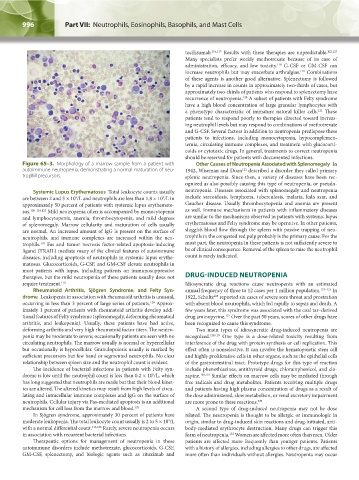
               Figure 65–3.  Morphology of a marrow sample from a patient with   Other Causes of Neutropenia Associated with Splenomegaly  In
               autoimmune neutropenia, demonstrating a normal maturation of neu-  1942, Wiseman and Doan  described a disorder they called primary
                                                                                         122
               trophil precursors.                                    splenic neutropenia. Since then, a variety of diseases have been rec-
                                                                      ognized as also possibly causing this type of neutropenia, or pseudo-
                   Systemic Lupus Erythematosus  Total leukocyte counts usually   neutropenia. Diseases associated with splenomegaly and neutropenia
               are between 2 and 5 × 10 /L and neutrophils are less than 1.8 × 10 /L in   include  sarcoidosis, lymphoma, tuberculosis,  malaria,  kala  azar,  and
                                 9
                                                              9
               approximately 50 percent of patients with systemic lupus erythemato-  Gaucher disease. Usually thrombocytopenia and anemia are present
               sus. 108–110,123  Mild neutropenia often is accompanied by monocytopenia   as well. Immune mechanisms in patients with inflammatory diseases
               and lymphocytopenia, anemia, thrombocytopenia, and mild degrees   are similar to the mechanisms observed in patients with systemic lupus
               of splenomegaly. Marrow cellularity and maturation of cells usually   erythematosus and Felty syndrome may be operative. In other patients,
               are normal. An increased amount of IgG is present on the surface of   sluggish blood flow through the spleen with passive trapping of neu-
               neutrophils, and immune complexes are increased within the neu-  trophils in the congested red pulp probably is the primary cause. For the
               trophils.  Fas and tumor necrosis factor-related apoptosis-inducing   most part, the neutropenia in these patients is not sufficiently severe to
                     110
               ligand (TRAIL) mediate many of the clinical features of autoimmune   be of clinical consequence. Removal of the spleen to raise the neutrophil
               diseases, including apoptosis of neutrophils in systemic lupus erythe-  count is rarely indicated.
               matosus. Glucocorticoids, G-CSF, and GM-CSF elevate neutrophils in
               most patients with lupus, including patients on immunosuppressive
               therapies, but the mild neutropenia of these patients usually does not   DRUG-INDUCED NEUTROPENIA
               require treatment. 110                                 Idiosyncratic  drug  reactions  cause  neutropenia  with an  estimated
                   Rheumatoid Arthritis, Sjögren Syndrome, and Felty Syn-  annual frequency of three to 12 cases per 1 million population. 123–125  In
               drome  Leukopenia in association with rheumatoid arthritis is unusual,   1922, Schultz  reported six cases of severe sore throat and prostration
                                                                                128
               occurring in less than 3 percent of large series of patients.  Approx-  with absent blood neutrophils, which led rapidly to sepsis and death. A
                                                          124
               imately 1 percent of patients with rheumatoid arthritis develop addi-  few years later, this syndrome was associated with the coal tar–derived
               tional features of Felty syndrome (splenomegaly, deforming rheumatoid   drug aminopyrine.  Over the past 50 years, scores of other drugs have
                                                                                    127
               arthritis, and leukopenia). Usually, these patients have had active,   been recognized to cause this syndrome.
               deforming arthritis and very high rheumatoid factor titers. The neutro-  Two main types of idiosyncratic drug-induced neutropenia are
               penia may be moderate to severe; occasionally patients are seen with no   recognized. 128,129  One type is a dose-related toxicity resulting from
               circulating neutrophils. The marrow usually is normal or hypercellular   interference of the drug with protein synthesis or cell replication. This
               but occasionally is hypocellular. Granulopoiesis usually is marked by   effect often is nonselective. It can involve the hematopoietic stem cell
               sufficient precursors but few band or segmented neutrophils. No clear   and highly proliferative cells in other organs, such as the epithelial cells
               relationship between spleen size and the neutrophil count is evident.  of the gastrointestinal tract. Prototype drugs for this type of reaction
                   The incidence of bacterial infections in patients with Felty syn-  include phenothiazines, antithyroid drugs, chloramphenicol, and clo-
               drome is low until the neutrophil count is less than 0.2 × 10 /L, which   zapine. 130,131  Similar effects on marrow cells may be mediated through
                                                           9
               has long suggested that neutrophils are made but that their blood kinet-  free  radicals  and  drug  metabolites.  Patients  receiving  multiple  drugs
               ics are altered. The altered kinetics may result from high levels of circu-  and patients having high plasma concentration of drugs as a result of
               lating and intracellular immune complexes and IgG on the surface of   the dose administered, slow metabolism, or renal excretory impairment
               neutrophils. Cellular injury via Fas-mediated apoptosis is an additional   are more prone to these reactions. 130
               mechanism for cell loss from the marrow and blood. 125     A second type of drug-induced neutropenia may not be dose
                   In Sjögren syndrome, approximately 30 percent of patients have   related. The neutropenia is thought to be allergic or immunologic in
               moderate leukopenia. The total leukocyte count usually is 2 to 5 × 10 /L   origin, similar to drug-induced skin reactions and drug-initiated, anti-
                                                                9
               with a normal differential count. 115,126  Rarely, severe neutropenia occurs   body-mediated erythrocyte destruction. Many drugs can trigger this
               in association with recurrent bacterial infections.    form of neutropenia.  Women are affected more often than men. Older
                                                                                     132
                   Therapeutic options for management of neutropenia in these   patients are affected more frequently than younger patients. Patients
               autoimmune disorders include methotrexate, glucocorticoids, G-CSF,   with a history of allergies, including allergies to other drugs, are affected
               GM-CSF, splenectomy, and biologic agents such as rituximab and   more often than individuals without allergies. Neutropenia may occur


          Kaushansky_chapter 65_p0991-1004.indd   996                                                                   9/17/15   6:44 PM

