


Page 1055 - Williams Hematology ( PDFDrive )
P. 1055
1030           Part VII:  Neutrophils, Eosinophils, Basophils, and Mast Cells                                                                                              Chapter 66:  Disorders of Neutrophil Function         1031


                                                    H O 2   catalase  O + H O         H O 2
                                                     2
                                                                        2
                                                                           2
                                                                                       2
                                                    E. coli                          Strep.
                                         H 2 O 2  H 2 O 2                               H 2 O 2  H 2 O 2
                                        H 2 O 2  E. coli  H 2 O 2  E. coli             H 2 O 2  Strep.  H 2 O 2

                                                                                           H 2 O 2
                                            H 2 O 2  H 2 O 2                                  H 2 O 2


                                          Normal                               CGD
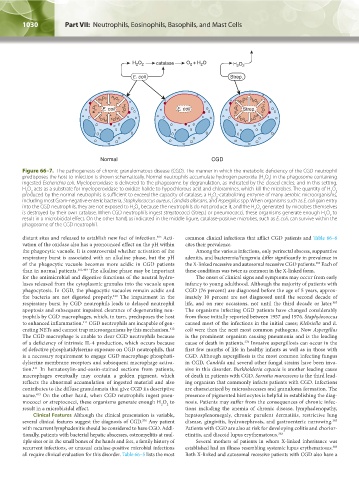
               Figure 66–7.  The pathogenesis of chronic granulomatous disease (CGD). The manner in which the metabolic deficiency of the CGD neutrophil
               predisposes the host to infection is shown schematically. Normal neutrophils accumulate hydrogen peroxide (H O ) in the phagosome containing
                                                                                                2
                                                                                                  2
               ingested Escherichia coli. Myeloperoxidase is delivered to the phagosome by degranulation, as indicated by the closed circles, and in this setting,
               H O  acts as a substrate for myeloperoxidase to oxidize halide to hypochlorous acid and chloramines, which kill the microbes. The quantity of H O
                  2
                                                                                                                       2
                 2
                                                                                                                        2
               produced by the normal neutrophils is sufficient to exceed the capacity of catalase, a H O -catabolizing enzyme of many aerobic microorganisms,
                                                                               2
                                                                                2
               including most Gram-negative enteric bacteria, Staphylococcus aureus, Candida albicans, and Aspergillus spp. When organisms such as E. coli gain entry
               into the CGD neutrophils, they are not exposed to H O  because the neutrophils do not produce it, and the H O  generated by microbes themselves
                                                     2
                                                      2
                                                                                             2
                                                                                               2
               is destroyed by their own catalase. When CGD neutrophils ingest streptococci (Strep.) or pneumococci, these organisms generate enough H O  to
                                                                                                                       2
                                                                                                                     2
               result in a microbicidal effect. On the other hand, as indicated in the middle figure, catalase-positive microbes, such as E. coli, can survive within the
               phagosome of the CGD neutrophil.
               distant sites and released to establish new foci of infection.  Acti-  common clinical infections that afflict CGD patients and Table 66–6
                                                            405
               vation of the oxidase also has a pronounced effect on the pH within   cites their prevalence.
               the phagocytic vacuole. It is controversial whether activation of the   Among the various infections, only perirectal abscess, suppurative
               respiratory burst is associated with an alkaline phase, but the pH   adenitis, and bacteremia/fungemia differ significantly in prevalence in
                                                                                                                  383
               of the phagocytic vacuole becomes more acidic in CGD patients   the X-linked recessive and autosomal recessive CGD patients.  Each of
               than in normal patients. 161,409  The alkaline phase may be important   these conditions was twice as common in the X-linked form.
               for the antimicrobial and digestive functions of the neutral hydro-  The onset of clinical signs and symptoms may occur from early
               lases released from the cytoplasmic granules into the vacuole upon   infancy to young adulthood. Although the majority of patients with
               phagocytosis. In CGD, the phagocytic vacuoles remain acidic and   CGD (76 percent) are diagnosed before the age of 5 years, approx-
               the bacteria are not digested properly.  The impairment in the   imately 10 percent are not diagnosed until the second decade of
                                              410
                                                                                                                       383
               respiratory  burst  by  CGD  neutrophils  leads  to  delayed  neutrophil   life, and on rare occasions, not until the third decade or later.
               apoptosis and subsequent impaired clearance of degenerating neu-  The organisms infecting CGD patients have changed considerably
               trophils by CGD macrophages, which, in turn, predisposes the host   from those initially reported between 1957 and 1976. Staphylococcus
               to enhanced inflammation.  CGD neutrophils are incapable of gen-  caused most of the infections in the initial cases; Klebsiella and E.
                                    411
                                                                 412
               erating NETs and cannot trap microorganisms by this mechanism.    coli were then the next most common pathogens. Now Aspergillus
               The CGD macrophage is unable to clear CGD neutrophils because   is  the  prominent  organism  causing  pneumonia and  is  the  leading
                                                                                          376
               of a deficiency of intrinsic IL-4 production, which occurs because   cause of death in patients.  Invasive aspergillosis can occur in the
               of defective phosphatidylserine exposure on CGD neutrophils, that   first few months of life in healthy infants as well as in those with
               is a necessary requirement to engage CGD macrophage phosphati-  CGD. Although aspergillosis is the most common infecting fungus
               dylserine membrane receptors and subsequent macrophage activa-  in CGD, Candida and several other fungal strains have been inva-
               tion.  In hematoxylin-and-eosin-stained sections from patients,   sive in this disorder. Burkholderia cepacia is another leading cause
                   411
               macrophages eventually may contain a golden pigment, which   of death in patients with CGD. Serratia marcescens is the third lead-
               reflects the abnormal accumulation of ingested material and also   ing organism that commonly infects patients with CGD. Infections
               contributes to the diffuse granulomata that give CGD its descriptive   are characterized by microabscesses and granuloma formation. The
                    413
               name.  On the other hand, when CGD neutrophils ingest pneu-  presence of pigmented histiocytes is helpful in establishing the diag-
               mococci or streptococci, these organisms generate enough H O  to   nosis. Patients may suffer from the consequences of chronic infec-
                                                              2
                                                                2
               result in a microbicidal effect.                       tions including the anemia of chronic disease, lymphadenopathy,
                   Clinical Features Although the clinical presentation is variable,   hepatosplenomegaly, chronic purulent dermatitis, restrictive lung
               several clinical features suggest the diagnosis of CGD.  Any patient   disease, gingivitis, hydronephrosis, and gastroenteric narrowing.
                                                                                                                       383
                                                        376
               with recurrent lymphadenitis should be considered to have CGD. Addi-  Patients with CGD are also at risk for developing colitis and chorior-
               tionally, patients with bacterial hepatic abscesses, osteomyelitis at mul-  etinitis, and discoid lupus erythematosus. 383
               tiple sites or in the small bones of the hands and feet, a family history of   Several mothers of patients in whom X-linked inheritance was
                                                                                                                       383
               recurrent infections, or unusual catalase-positive microbial infections   established had an illness resembling systemic lupus erythematosus.
               all require clinical evaluation for this disorder. Table 66–5 lists the most   Both X-linked and autosomal recessive patients with CGD also have a
          Kaushansky_chapter 66_p1005-1042.indd   1030                                                                  9/21/15   10:48 AM

