Page 1053 - Williams Hematology ( PDFDrive )
P. 1053
1028           Part VII:  Neutrophils, Eosinophils, Basophils, and Mast Cells                                                                                              Chapter 66:  Disorders of Neutrophil Function         1029


                TABLE 66–4.  Diagnostic Classification of Chronic Granulomatous Disease
                Affected Component  Inheritance  Subtype  Membrane-Bound Cytochrome b * Cytosol p47 phox*  Cytosol p67 phox*
                                                                                  558
                gp91 phox          X           X91 0     Not detectable                Normal           Normal
                                               X91 +     Normal quantity, but nonfunctional  Normal     Normal
                                               X91 –     Defective gp91 phox , which is poorly   Normal  Normal
                                                         functional or expressed in a small
                                                         fraction of phagocytes
                p22 phox           A           A22 0     Not detectable                Normal           Normal
                                               A22 +     Normal quantity, but nonfunctional  Normal     Normal
                p47 phox           A           A47 0     Normal quantity               Not detectable   Normal
                p67 phox                       A67 0     Normal                        Normal           Not detectable

               *Detected by spectral analysis or immunoblotting. In this nomenclature, the first letter represents the mode of inheritance (-linked [X] or auto-
               somal recessive [A]). The number indicates the phox component, which is genetically affected. The superscript symbols indicate whether the
               level of protein of the affected component is undetectable (0), diminished (–), or normal (+) as measured by immunoblot or spectral analysis.


                                                                   Cytoplasm

                                              Fungus


                                    Bacteria
                                               HOCl
                Plasma
                membrane
                                            MPO
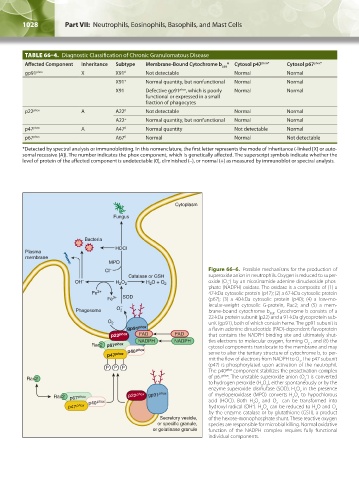
                                           Cl –                               Figure 66–6.  Possible mechanisms for the production of
                                                   Catalase or GSH            superoxide anion in neutrophils. Oxygen is reduced to super-
                                                                                    –
                                 OH –          H 2 O 2   H O + O              oxide (O ) by an nicotinamide adenine dinucleotide phos-
                                                               2
                                                          2
                                                                                    2
                                                                              phate (NADPH) oxidase. The oxidase is a composite of (1) a
                                       Fe 2+                                  47-kDa cytosolic protein (p47); (2) a 67-kDa cytosolic protein
                                            Fe 3+  SOD                        (p67); (3) a 40-kDa cytosolic protein (p40); (4) a low-mo-
                                 Phagosome     O 2 –                          lecular-weight cytosolic G-protein, Rac2; and (5) a mem-
                                                                              brane-bound cytochrome b . Cytochrome b consists of a
                                                                                                  558
                                                                              22-kDa protein subunit (p22) and a 91-kDa glycoprotein sub-
                                            O 2                               unit (gp91), both of which contain heme. The gp91 subunit is
                                                   gp91 phox                  a flavin adenine dinucleotide (FAD)-dependent flavoprotein
                                             p22 phox  FAD         FAD        that contains the NADPH binding site and ultimately shut-
                                                                                                                –
                                                      NADPH       NADPH       tles electrons to molecular oxygen, forming O , and (6) the
                                                                                                               2
                                       Rac2 p67 phox                          cytosol components translocate to the membrane and may
                                                   p40 phox                   serve to alter the tertiary structure of cytochrome b, to per-
                                            p47 phox
                                                                              mit the flow of electrons from NADPH to O . The p47 subunit
                                                                                                            2
                                                                              (p47) is phosphorylated upon activation of the neutrophil.
                                           P  P P
                                                                              The p40 phox  component stabilizes the preactivation complex
                                                                                                               –
                 Rac2                                                         of p67 phox . The unstable superoxide anion (O ) is converted
                                                                                                              2
                                                                              to hydrogen peroxide (H O ), either spontaneously or by the
                                                                                                 2
                                                                                               2
                                                                              enzyme superoxide dismutase (SOD). H O  in the presence
                                                                                                           2
                                                                                                            2
                          Rac2  p67 phox           p22 phox gp91 phox         of  myeloperoxidase  (MPO)  converts  H O   to hypochlorous
                                                                                                            2
                                                                                                          2
                                                                                                     –
                                      p40 phox                                acid (HOCl). Both H O  and O  can be transformed into
                                                                                                     2
                                                                                             2
                                                                                              2
                               p47 phox                                       hydroxyl radical (OH ). H O  can be reduced to H O and O
                                                                                             –
                                                                                                2
                                                                                                                  2
                                                                                                                        2
                                                                                                 2
                                                                              by the enzyme catalase or by glutathione (GSH), a product
                                                             Secretory vesicle,  of the hexose-monophosphate shunt. These reactive oxygen
                                                             or specific granule,  species are responsible for microbial killing. Normal oxidative
                                                           or gelatinase granule  function  of  the  NADPH  complex  requires  fully  functional
                                                                              individual components.
          Kaushansky_chapter 66_p1005-1042.indd   1028                                                                  9/21/15   10:48 AM
   1048   1049   1050   1051   1052   1053   1054   1055   1056   1057   1058