


Page 1175 - Williams Hematology ( PDFDrive )
P. 1175
1150           Part IX:  Lymphocytes and Plasma Cells                                                                                                                                       Chapter 74:  Lymphopoiesis           1151


                                   Human
                                                                                      T cells
                                                                                 Thymus
                                                                                Fetal Marrow
                                          Fetal liver
                                                 PAS/AGM                             B cells
                                                                  Placenta
                                    Yolk sac
                                        18  20  22  24  26  28  30  32  34  36  38  40  10  20  30  Birth
                                           Circulation
                                                          Days                           Weeks
                                   A
                                 Mouse

                                                               T cells
                                                          B cells
                                                             Thymus              Fetal Marrow
                                                     Fetal liver
                                  PAS/AGM
                                        Placenta
                                 Yolk sac
                                         8.0    9.0    10.0    11.0   12.0    13.0   14.0    15.0   Birth
                                          Circulation
                                                                    Days
                                 B
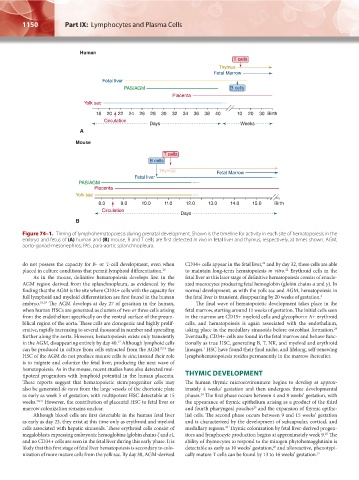
               Figure 74–1.  Timing of lymphohematopoiesis during prenatal development. Shown is the timeline for activity in each site of hematopoiesis in the
               embryo and fetus of (A) human and (B) mouse. B and T cells are first detected in vivo in fetal liver and thymus, respectively, at times shown. AGM,
               aorto-gonad-mesonephros; PAS, para-aortic splanchnopleura.


                                                                                                22
               do not possess the capacity for B- or T-cell development, even when   CD34+ cells appear in the fetal liver,  and by day 32, these cells are able
               placed in culture conditions that permit lymphoid differentiation. 18  to maintain long-term hematopoiesis in vitro.  Erythroid cells in the
                                                                                                        22
                   As in the mouse, definitive hematopoiesis develops first in the   fetal liver at this later stage of definitive hematopoiesis consist of enucle-
               AGM region derived from the splanchnopleura, as evidenced by the   ated macrocytes producing fetal hemoglobin (globin chains α and γ). In
               finding that the AGM is the site where CD34+ cells with the capacity for   normal development, as with the yolk sac and AGM, hematopoiesis in
               full lymphoid and myeloid differentiation are first found in the human   the fetal liver is transient, disappearing by 20 weeks of gestation. 1
               embryo. 18,19  The AGM develops at day 27 of gestation in the human,   The final wave of hematopoietic development takes place in the
               when human HSCs are generated as clusters of two or three cells arising   fetal marrow, starting around 11 weeks of gestation. The initial cells seen
               from the endothelium specifically on the ventral surface of the preum-  in the marrow are CD15+ myeloid cells and glycophorin A+ erythroid
               bilical region of the aorta. These cells are clonogenic and highly prolif-  cells,  and hematopoiesis  is again associated with  the endothelium,
                                                                                                                        23
               erative, rapidly increasing to several thousand in number and spreading   taking place in the medullary sinusoids before osteoblast formation.
               further along the aorta. However, hematopoiesis exists only transiently   Eventually, CD34+ cells are found in the fetal marrow and behave func-
                                               17
               in the AGM, disappearing entirely by day 40.  Although lymphoid cells   tionally as true HSC, generating B, T, NK, and myeloid and erythroid
                                                                            1
               can be produced in culture from cells extracted from the AGM 17,18  the   lineages.  HSC have found their final niche, and lifelong, self-renewing
               HSC of the AGM do not produce mature cells in situ; instead their role   lymphohematopoiesis resides permanently in the marrow thereafter.
               is to migrate and colonize the fetal liver, producing the next wave of
               hematopoiesis. As in the mouse, recent studies have also detected mul-
               tipotent progenitors with lymphoid potential in the human placenta.   THYMIC DEVELOPMENT
               These reports suggest that hematopoietic stem/progenitor cells may   The human thymic microenvironment begins to develop at approx-
               also be generated de novo from the large vessels of the chorionic plate   imately 4 weeks’ gestation and then undergoes three developmental
                                                                           24
               as early as week 5 of gestation, with multipotent HSC detectable at 15   phases.  The first phase occurs between 4 and 8 weeks’ gestation, with
               weeks. 20,21  However, the contribution of placental HSC to fetal liver or   the appearance of thymic epithelium arising as a product of the third
                                                                                             25
               marrow colonization remains unclear.                   and fourth pharyngeal pouches  and the expansion of thymic epithe-
                   Although blood cells are first detectable in the human fetal liver   lial cells. The second phase occurs between 9 and 15 weeks’ gestation
               as early as day 23, they exist at this time only as erythroid and myeloid   and is characterized by the development of subcapsular, cortical, and
               cells associated with hepatic sinusoids. These erythroid cells consist of   medullary regions.  Thymic colonization by fetal liver-derived progen-
                                                                                   24
                                                                                                                     25
               megaloblasts expressing embryonic hemoglobins (globin chains ζ and ε),   itors and lymphocyte production begins at approximately week 9.  The
               and no CD34+ cells are seen in the fetal liver during this early phase. It is   ability of thymocytes to respond to the mitogen phytohemagglutinin is
               likely that this first stage of fetal liver hematopoiesis is secondary to colo-  detectable as early as 10 weeks’ gestation,  and alloreactive, phenotypi-
                                                                                                   26
               nization of more mature cells from the yolk sac. By day 30, AGM-derived   cally mature T cells can be found by 13 to 16 weeks’ gestation. 27


          Kaushansky_chapter 74_p1149-p1158.indd   1150                                                                 9/18/15   2:25 PM

