


Page 1177 - Williams Hematology ( PDFDrive )
P. 1177
1152           Part IX:  Lymphocytes and Plasma Cells                                                                                                                                       Chapter 74:  Lymphopoiesis           1153


                           Mouse
                                                 LT-HSC                                     CD34 neg Flt3 neg
                                                                                                hi
                                                                                             hi
                                                                                      (Lin neg Sca Kit CD150+CD48–)

                                                   MPP                                     CD34+Flt3 neg IL7R neg
                                                                                                       hi
                                                                                                    hi
                                                                                            (Lin neg Sca Kit )
                                        CMP     Myeloid       Lymphoid
                                                                                                   hi
                                                                                           CD34+Flt3 IL7R neg
                                                                                LMPP           neg
                                                                                            (Lin  Kit+Sca+)
                                                                                              CD34+IL7R+
                                                                                                 Io
                                                                                                     Io
                                                                          CLP             (Lin neg Kit Sca thy1 neg )
                            MEP                     GMP


                                                                DC      B     NK         T
                                                                   Bone marrow        Thymus
                           A
                           Human
                                              HSC/MPP
                                                                                      HSC/MPP
                                                                                  CD34+Lin neg CD38 neg
                                                            LMPP                        BM “LMPP”    neg
                                                                                               neg
                                                                                         neg
                                                                                  CD34+Lin  CD38  CD10
                                                                                      CD45RA+CD62L hi
                                         Myeloid                                          UCB/BM “MLP”
                                                       Lymphoid                   CD34+Iin neg CD38 neg CD45RA+CD10+
                                                                   CLP
                                   CMP                                                   UCB “MLP”
                                                                                           neg
                                                                                  CD34+CD38  CD45RA+CD7+
                                                                                          BM CLP
                                                                                   CD34+Iin neg CD45RA+CD10+


                            MEP           GMP

                                                         DC      B   NK        T
                                                           Bone marrow       Thymus
                           B
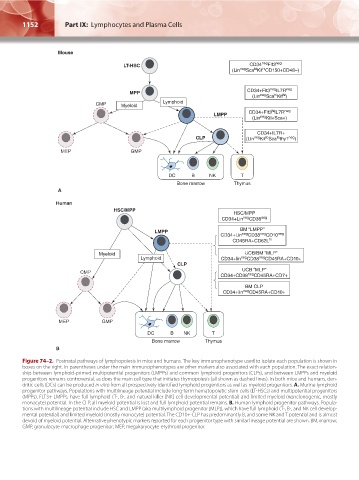
               Figure 74–2.  Postnatal pathways of lymphopoiesis in mice and humans. The key immunophenotype used to isolate each population is shown in
               boxes on the right. In parentheses under the main immunophenotypes are other markers also associated with each population. The exact relation-
               ship between lymphoid-primed multipotential progenitors (LMPPs) and common lymphoid progenitors (CLPs), and between LMPPs and myeloid
               progenitors remains controversial, as does the main cell type that initiates thymopoiesis (all shown as dashed lines). In both mice and humans, den-
               dritic cells (DCs) can be produced in vitro from all prospectively identified lymphoid progenitors as well as myeloid progenitors. A. Murine lymphoid
               progenitor pathways. Populations with multilineage potential include long-term hematopoietic stem cells (LT-HSCs) and multipotential progenitors
               (MPPs). FLT3+ LMPPs, have full lymphoid (T-, B-, and natural killer [NK] cell developmental potential) and limited myeloid (nonclonogenic, mostly
               monocyte) potential. In the CLP, all myeloid potential is lost and full lymphoid potential remains. B. Human lymphoid progenitor pathways. Popula-
               tions with multilineage potential include HSC and LMPP (aka multilymphoid progenitor [MLP]), which have full lymphoid (T-, B-, and NK cell develop-
               mental potential) and limited myeloid (mostly monocyte) potential. The CD10+ CLP has predominantly B, and some NK and T potential and is almost
               devoid of myeloid potential. Alternative phenotypic markers reported for each progenitor type with similar lineage potential are shown. BM, marrow;
               GMP, granulocyte-macrophage progenitor; MEP, megakaryocyte-erythroid progenitor.


          Kaushansky_chapter 74_p1149-p1158.indd   1152                                                                 9/18/15   2:26 PM

