


Page 1301 - Williams Hematology ( PDFDrive )
P. 1301
1276           Part X:  Malignant Myeloid Diseases                                                                                 Chapter 83:  Classification and Clinical Manifestations of the Clonal Myeloid Disorders       1277


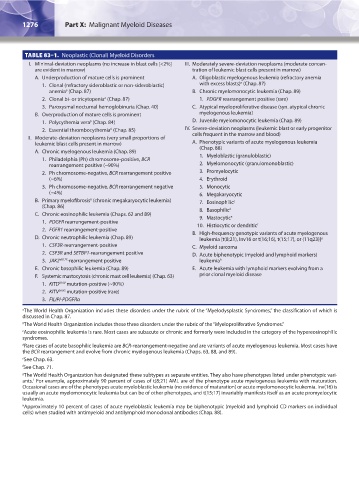
                TABLE 83–1.  Neoplastic (Clonal) Myeloid Disorders
                  I.  Minimal-deviation neoplasms (no increase in blast cells [<2%]   III.  Moderately severe-deviation neoplasms (moderate concen-
                    are evident in marrow)                              tration of leukemic blast cells present in marrow)
                    A.  Underproduction of mature cells is prominent    A.  Oligoblastic myelogenous leukemia (refractory anemia
                                                                                         a
                      1.  Clonal (refractory sideroblastic or non-sideroblastic)   with excess blasts)  (Chap. 87)
                        anemia  (Chap. 87)                              B.  Chronic myelomonocytic leukemia (Chap. 89)
                              a
                      2.  Clonal bi- or tricytopenia  (Chap. 87)           1.  PDGFR rearrangement positive (rare)
                                           a
                      3.  Paroxysmal nocturnal hemoglobinuria (Chap. 40)  C.  Atypical myeloproliferative disease (syn. atypical chronic
                    B.  Overproduction of mature cells is prominent        myelogenous leukemia)
                      1.  Polycythemia vera  (Chap. 84)                 D.  Juvenile myelomonocytic leukemia (Chap. 89)
                                      b
                      2.  Essential thrombocythemia  (Chap. 85)       IV.  Severe-deviation neoplasms (leukemic blast or early progenitor
                                             b
                 II.  Moderate-deviation neoplasms (very small proportions of   cells frequent in the marrow and blood)
                    leukemic blast cells present in marrow)             A.  Phenotypic variants of acute myelogenous leukemia
                    A.  Chronic myelogenous leukemia (Chap. 89)            (Chap. 88)
                      1.  Philadelphia (Ph) chromosome-positive, BCR       1.  Myeloblastic (granuloblastic)
                        rearrangement positive (~90%)                      2.  Myelomonocytic (granulomonoblastic)
                      2.  Ph chromosome-negative, BCR rearrangement positive   3.  Promyelocytic
                        (~6%)                                              4.  Erythroid
                      3.  Ph chromosome-negative, BCR rearrangement negative   5.  Monocytic
                        (~4%)                                              6.  Megakaryocytic
                    B.  Primary myelofibrosis  (chronic megakaryocytic leukemia)   7.  Eosinophilic c
                                      b
                      (Chap. 86)                                           8.  Basophilic d
                    C.  Chronic eosinophilic leukemia (Chaps. 62 and 89)   9.  Mastocytic e
                      1.  PDGFR rearrangement-positive                    10.  Histiocytic or dendritic f
                      2.  FGFR1 rearrangement-positive                  B.  High-frequency genotypic variants of acute myelogenous
                    D.  Chronic neutrophilic leukemia (Chap. 89)           leukemia [t(8;21), Inv16 or t(16;16), t(15;17), or (11q23)] g
                      1.  CSF3R-rearrangement-positive                  C.  Myeloid sarcoma
                      2.  CSF3R and SETBP1-rearrangement positive       D.  Acute biphenotypic (myeloid and lymphoid markers)
                      3.  JAK2 V617F -rearrangement positive               leukemia h
                    E.  Chronic basophilic leukemia (Chap. 89)          E.  Acute leukemia with lymphoid markers evolving from a
                    F.  Systemic mastocytosis (chronic mast cell leukemia) (Chap. 63)  prior clonal myeloid disease
                      1.  KITD 816V  mutation-positive (~90%)
                      2.  KITV 560G  mutation-positive (rare)
                      3.  FILIPI-PDGFRα

               a The World Health Organization includes these disorders under the rubric of the “Myelodysplastic Syndromes,” the classification of which is
               discussed in Chap. 87.
               b The World Health Organization includes these three disorders under the rubric of the “Myeloproliferative Syndromes.”
               c Acute eosinophilic leukemia is rare. Most cases are subacute or chronic and formerly were included in the category of the hypereosinophilic
               syndromes.
               d Rare cases of acute basophilic leukemia are BCR-rearrangement-negative and are variants of acute myelogenous leukemia. Most cases have
               the BCR rearrangement and evolve from chronic myelogenous leukemia (Chaps. 63, 88, and 89).
               e See Chap. 63.
               f See Chap. 71.
               g The World Health Organization has designated these subtypes as separate entities. They also have phenotypes listed under phenotypic vari-
                   1
               ants.  For example, approximately 90 percent of cases of t(8;21) AML are of the phenotype acute myelogenous leukemia with maturation.
               Occasional cases are of the phenotypes acute myeloblastic leukemia (no evidence of maturation) or acute myelomonocytic leukemia. Inv(16) is
               usually an acute myelomonocytic leukemia but can be of other phenotypes, and t(15;17) invariably manifests itself as an acute promyelocytic
               leukemia.
               h Approximately 10 percent of cases of acute myeloblastic leukemia may be biphenotypic (myeloid and lymphoid CD markers on individual
               cells) when studied with antimyeloid and antilymphoid monoclonal antibodies (Chap. 88).


          Kaushansky_chapter 83_p1273-1290.indd   1276                                                                  9/21/15   11:12 AM

