


Page 1306 - Williams Hematology ( PDFDrive )
P. 1306
1280  Part X:  Malignant Myeloid Diseases  Chapter 83:  Classification and Clinical Manifestations of the Clonal Myeloid Disorders  1281


                  thrombocytopenia, among other changes (Chap. 89). The progression      PATHOGENESIS OF CLONAL
                  from chronic to accelerated phase or blast phase of CML, however, has
                  been delayed in the majority of patients by the application of tyrosine   MYELOID DISEASES
                  kinase inhibitor therapy during the chronic phase of the disease. Deter-
                  mining the frequency of evolution to AML in those patients with CML   In AML, a sequence of mutations in a single multipotential cell results
                  who enter a complete molecular remission with tyrosine kinase inhibi-  in a clone that is severely defective and contains precursor cells that are
                                                                                           42,43
                  tors must await observations over the next decade.    largely unable to mature.   Proliferation of primitive progenitors is
                     This process of clonal evolution is an intrinsic feature of the   excessive when considered in absolute terms, that is, the total number
                  genomic instability of clonal myeloid diseases. The practice of calling   of blast cells proliferating. AML is a clinical disease with many forms of
                  the result of this process “secondary AML” is obfuscating. This choice of   morphologic expression. This variation of phenotype is consistent with
                  terms is notable in the case of myelodysplastic syndrome, which is “leu-  the large number of genetic lesions identified and the behavior of the
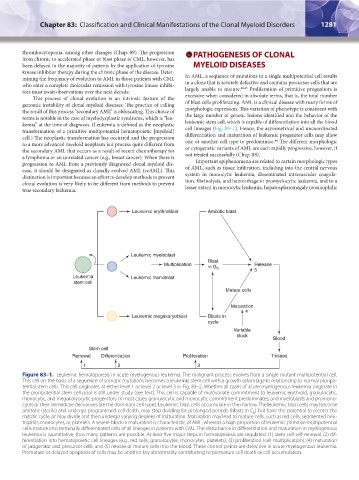
                  kemia” at the time of diagnosis. (Leukemia is defined as the neoplastic   leukemic stem cell, which is capable of differentiation into all the blood
                  transformation of a primitive multipotential hematopoietic [myeloid]   cell lineages (Fig. 83–1). Hence, the asymmetrical and uncoordinated
                  cell.) The neoplastic transformation has occurred and the progression   differentiation and maturation of leukemic progenitor cells may allow
                                                                                                      44
                  to a more advanced myeloid neoplasm is a process quite different from   one or another cell type to predominate.  The different morphologic
                  the secondary AML that occurs as a result of recent chemotherapy for   or cytogenetic variants of AML are each rapidly progressive, however, if
                  a lymphoma or an unrelated cancer (e.g., breast cancer). When there is   not treated successfully (Chap. 88).
                  progression to AML from a previously diagnosed clonal myeloid dis-  Important epiphenomena are related to certain morphologic types
                  ease, it should be designated as clonally evolved AML (ceAML). This   of AML, such as tissue infiltration, including into the central nervous
                  distinction is important because an effort to develop methods to prevent   system in monocytic leukemia, disseminated intravascular coagula-
                  clonal evolution is very likely to be different from methods to prevent   tion, fibrinolysis, and hemorrhage in promyelocytic leukemia, and to a
                  true secondary leukemia.                              lesser extent in monocytic leukemia, hepatosplenomegaly (eosinophilic


                                                       Leukemic erythroblast    Amitotic blast


                                                      Leukemic myeloblast
                                                                                Blast
                                                                 Multiplication  in G 0         Release
                                                                                                5
                                   Leukemia           Leukemic monoblast
                                   stem cell
                                                                                      Mature cells


                                                                                        Maturation
                                                                                             4
                                                       Leukemic megakaryoblast  Blasts in
                                                                                cycle
                                                                                         Variable
                                                                                          block
                                                                                                      Blood
                                        Stem cell
                                   Renewal  Differentiation             Proliferation                Tissues
                                      1           2                          3
                  Figure 83–1.  Leukemic hematopoiesis in acute myelogenous leukemia. The malignant process evolves from a single mutant multipotential cell.
                  This cell on the basis of a sequence of somatic mutations becomes a leukemia stem cell with a growth advantage in relationship to normal pluripo-
                  tential stem cells. This cell originates at either level 1 or level 2 or level 3 in Fig. 83–2. Whether all cases of acute myelogenous leukemia originate in
                  the pluripotential stem cell pool is still under study (see text). This cell is capable of multivariate commitment to leukemic erythroid, granulocytic,
                  monocytic, and megakaryocytic progenitors. In most cases, granulocytic and monocytic commitment predominates, and myeloblasts and promono-
                  cytes or their immediate derivatives are the dominant cell types. Leukemic blast cells accumulate in the marrow. The leukemic blast cells may become
                  amitotic (sterile) and undergo programmed cell death, may stop dividing for prolonged periods (blasts in G ) but have the potential to reenter the
                                                                                               0
                  mitotic cycle, or may divide and then undergo varying degrees of maturation. Maturation may lead to mature cells, such as red cells, segmented neu-
                  trophils, monocytes, or platelets. A severe block in maturation is characteristic of AML, whereas a high proportion of leukemic primitive multipotential
                  cells mature into terminally differentiated cells of all lineages in patients with CML. The disturbance in differentiation and maturation in myelogenous
                  leukemia is quantitative, thus many patterns are possible. At least five major steps in hematopoiesis are regulated: (1) stem cell self-renewal, (2) dif-
                  ferentiation into hematopoietic cell lineages (e.g., red cells, granulocytes, monocytes, platelets), (3) proliferation (cell multiplication), (4) maturation
                  of progenitor and precursor cells, and (5) release of mature cells into the blood. These control points are defective in acute myelogenous leukemia.
                  Premature or delayed apoptosis of cells may be another key abnormality contributing to premature cell death or cell accumulation.


          Kaushansky_chapter 83_p1273-1290.indd   1281                                                                  9/21/15   11:13 AM

