


Page 1303 - Williams Hematology ( PDFDrive )
P. 1303
1278           Part X:  Malignant Myeloid Diseases                                                                                 Chapter 83:  Classification and Clinical Manifestations of the Clonal Myeloid Disorders       1279


               aneuploid or pseudodiploid cells in the clone, are the result of the expan-  MODERATE-DEVIATION CLONAL
               sion of a somatically mutated cell, and can be associated with significant   MYELOID DISORDERS
               morbidity and premature death; thus, they are neoplasias not dysplasias.
               They demonstrate clonal (genomic) instability, and each has a propen-  Primary myelofibrosis (Chap. 86) and CML (Chap. 89) classically
               sity to evolve into AML at a rate that far exceeds the incidence of the dis-  share the features of overproduction of granulocytes and platelets and
               ease in the general population. The term myelodysplasia was proposed   impaired production of red cells. In contrast to the minimally devi-
               at a conference in Paris in 1976 at a time when prominent dysmorpho-  ated clonal myeloid neoplasms, CML and primary myelofibrosis may
               genesis and cytopenias were thought to be the singular abnormalities   have a small to moderate proportion of leukemic blast cells in marrow
               and arguments existed as to whether some of these syndromes without   and blood. The most constant feature in primary myelofibrosis is the
               increased blast cell percentages represented a preneoplastic (preleuke-  abundance of neoplastic, dysmorphic megakaryocytes and the resul-
               mic) condition.  They have long been established as neoplastic (a spec-  tant predisposition to marrow reticulin and collagen fibrosis, osteo-
                           11
               trum of minimal-deviation to severe-deviation leukemias)—indeed,   sclerosis,  extramedullary  fibrohematopoietic  tumors,  splenomegaly,
               those with overt leukemic hematopoiesis (quantitatively increased leu-  and teardrop-shaped red cells (dacryocytes) in every oil immersion
               kemic blast cell counts), which made up approximately 50 percent of   field on the blood film. The megakaryocytic abnormalities are so domi-
               cases, were known at the time to be neoplasms—but the terminology   nant and consistent in this disorder that it could be considered chronic
                                                                                         19
               has not been rectified.                                megakaryocytic leukemia.  The cells in this disorder have no specific
                                                                      cytogenetic change, but approximately 50 percent of cases carry a muta-
               OVERPRODUCTION OF CELLS PROMINENT                      tion in the JAK2 gene and approximately one-third have wild-type JAK2
                                                                      but a mutation in the CALR gene (Chap. 86).
                                                                                                       13,14
                                                                                                          These two mutations
               Polycythemia vera (Chap. 84) and essential thrombocythemia (Chap. 85)   give primary myelofibrosis a genetic kinship with polycythemia vera
               are clonal myeloid disorders so named because of the overaccumulation   and essential thrombocytosis. They are often referred to as “the mye-
               of red cells, and often neutrophils, and platelets in the blood in poly-  loproliferative neoplasms,” but virtually all clonal myeloid diseases are
               cythemia, and of platelets, and to a lesser extent neutrophils, in throm-  fundamentally myeloproliferative as the term refers, principally, to mar-
               bocythemia.  Each cell lineage is affected in each disorder, reflecting a   row hematopoiesis. The clinical behavior of primary myelofibrosis is,
                        12
               multipotential hematopoietic cell origin, but the magnitude of the effect   in most cases of a progressive neoplasm with morphologic evidence,
               on each lineage differs. The decrease in red cell production in essential   of lower-level leukemic hematopoiesis and with a median survival sig-
               thrombocythemia usually is slight to mild. Polycythemia vera and essen-  nificantly less than polycythemia vera or essential thrombocythemia.
               tial thrombocythemia do not show morphologic evidence of leuke-  Primary myelofibrosis is another misnomer perpetuated in the WHO
               mic hematopoiesis; the proportion of blast cells in the marrow is never   classification. The fibrosis is secondary to cytokines released by neoplas-
               increased above normal, and blast cells are never present in the blood.   tic (leukemic) megakaryocytes (an epiphenomenon) and it is the only
               Hematopoietic differentiation and maturation are maintained. These are   cancer in the medical lexicon named after connective tissue fibers and
               minimal-deviation neoplasms. These disorders do not have a specific   not the cells in which the cancer arises. 19
               cytogenetic abnormality, but approximately 95 percent of cases of poly-  In contrast to primary myelofibrosis, CML has a rearrangement of
               cythemia and approximately 50 percent of cases of essential thrombo-  the breakpoint cluster (BCR) gene on chromosome 22. The shortening
               cythemia have an acquired mutation in the Janus kinase 2 (JAK2) gene. In   of the long arm of chromosome 22 gives it the designation of the Phil-
               thrombocythemia, 25 percent of patients have wild-type JAK2 genes and   adelphia chromosome, now called the Ph chromosome. It can be iden-
               mutations in the calreticulin (CALR) gene. A few percent of patients with   tified by Giemsa (G)-banding cytogenetic studies in approximately 90
               thrombocythemia have nonmutated JAK2 and CALR but a mutation in   percent of patients with CML. This mutation is caused by and is a reflec-
               the myeloproliferative leukemia virus gene (MPL; Chaps. 84 and 85). 13,14    tion of the translocation t(9;22)(q34;q11)(BCR-ABL1 [Abelson murine
               Several studies of comparative survival of the chronic myeloproliferative   leukemia viral oncogene homologue 1]). The BCR-ABL1 fusion in CML
               neoplasms have been reported. 4,15–18,18a  In the most comprehensive study   cells can be found in virtually all cases studied by fluorescence in situ
               of survival as of this writing, patients with essential thrombocythemia   hybridization or the polymerase chain reaction. Only approximately 4
               have only slightly decreased survival than expected over 10 years of obser-  percent of patients with a phenotype indistinguishable from BCR-re-
               vation, but this widens somewhat over longer periods. The difference in   arrangement–positive CML do not have the rearrangement (see Table
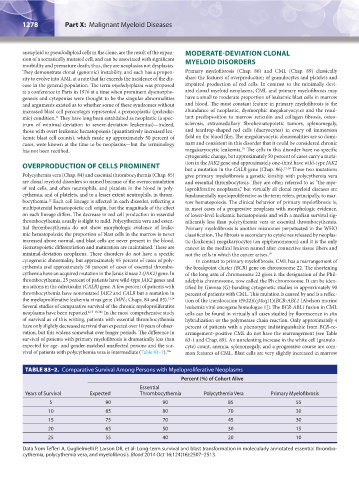
               survival of patients with primary myelofibrosis is dramatically less than   83-1 and Chap. 89). An unrelenting increase in the white cell (granulo-
               expected for age- and gender-matched unaffected persons and the sur-  cyte) count, anemia, splenomegaly, and a progressive course are com-
               vival of patients with polycythemia vera is intermediate (Table 83–2). 18a  mon features of CML. Blast cells are very slightly increased in marrow


                TABLE 83–2.  Comparative Survival Among Persons with Myeloproliferative Neoplasms
                                                                     Percent (%) of Cohort Alive
                                                       Essential
                Years of Survival     Expected         Thrombocythemia      Polycythemia Vera      Primary Myelofibrosis
                        5                  90                 90                    85                     55
                        10                 85                 80                    70                     30
                        15                 75                 70                    45                     30
                        20                 65                 50                    30                     15
                        25                 55                 40                    20                     10

               Data from Tefferi A, Guglielmelli P, Larson DR, et al: Long-term survival and blast transformation in molecularly annotated essential thrombo-
               cythemia, polycythemia vera, and myelofibrosis. Blood 2014 Oct 16;124(16):2507–2513.


          Kaushansky_chapter 83_p1273-1290.indd   1278                                                                  9/21/15   11:12 AM

