


Page 1326 - Williams Hematology ( PDFDrive )
P. 1326
1300  Part X:  Malignant Myeloid Diseases                                   Chapter 84:  Polycythemia Vera           1301


                  THE SPENT PHASE                                            1.0
                  Sometimes after only a few years and usually after 15 years or more,   0.9
                  erythrocytosis in patients with PV gradually abates in the absence of   0.8
                  iron deficiency, phlebotomy requirements decrease and cease, and ane-  0.7                      N=503
                  mia develops. During this “spent” phase of the disease, marrow fibrosis   0.6                Medain survival 27.8 years
                  becomes more marked and the spleen often becomes greatly enlarged   Survival  0.5
                  (see Fig. 84–2A). Instead of phlebotomies, transfusions or erythropoi-  0.4
                  etin may be required in such patients.  The platelet count may remain   0.3
                                             255
                  high  or may decline, even to  pronounced thrombocytopenic  levels.
                                                                                          N=568
                  Marked leukopenia or leukocytosis may occur, and immature granulo-  0.2  Median survival 10.9 years  N=474
                                                                                       HR 10.7; 95% CI 7.7-15.0
                  cytes may appear in the blood. At this point, the disease closely mimics   0.1               Median survival 18.9 years
                                                                                                               HR 3.7; 95% CI 2.6-5.2
                  PMF (Chap. 86) and is termed post-PV MF. Treatment of this phase   0.0
                  of the disease is difficult and requires the judicious use of a combina-  0  10   20        30        40
                  tion of therapeutic approaches, including HU, erythropoiesis-stimu-              Years
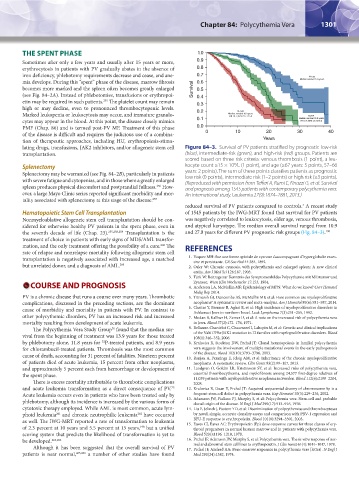
                  lating drugs, transfusions, JAK2 inhibitors, and/or allogeneic stem cell   Figure 84–3.  Survival of PV patients stratified by prognostic low-risk
                  transplantation.                                      (blue), intermediate-risk (green), and high-risk (red) groups. Patients are
                                                                        scored based on three risk criteria: venous thrombosis (1 point), a leu-
                                                                                         9
                  Splenectomy                                           kocyte count ≥15 × 10 /L (1 point), and age (≥67 years: 5 points, 57–66
                  Splenectomy may be warranted (see Fig. 84–2B), particularly in patients   years: 2 points). The sum of these points classifies patients as prognostic
                  with severe fatigue and cytopenias, and in those where a greatly enlarged   low risk (0 points), intermediate risk (1–2 points) or high risk (≥3 points).
                  spleen produces physical discomfort and postprandial fullness.  How-  (Reproduced with permission from Tefferi A, Rumi E, Finazzi G, et al: Survival
                                                               256
                                                                        and prognosis among 1545 patients with contemporary polycythemia vera:
                  ever, a large Mayo Clinic series reported significant morbidity and mor-  An international study. Leukemia 27(9):1874–1881, 2013.)
                  tality associated with splenectomy at this stage of the disease. 257
                                                                        reduced survival of PV patients compared to controls.  A recent study
                                                                                                                4
                  Hematopoietic Stem Cell Transplantation               of 1545 patients by the IWG-MRT found that survival for PV patients
                  Nonmyeloablative allogeneic stem cell transplantation should be con-  was negatively correlated to leukocytosis, older age, venous thrombosis,
                  sidered for otherwise healthy PV patients in the spent phase, even in   and atypical karyotype. The median overall survival ranged from 10.9
                  the seventh decade of life (Chap. 23). 255,258,259  Transplantation is the   and 27.8 years for different PV prognostic risk groups (Fig. 84–3). 190
                  treatment of choice in patients with early signs of MDS/AML transfor-
                  mation, and the only treatment offering the possibility of a cure.  The   REFERENCES
                                                                260
                  rate of relapse and nonrelapse mortality following allogeneic stem cell
                  transplantation is negatively associated with increased age, a matched     1.  Vaquez MH: Sue une forme spéciale de cyanose s’accompagnant d’hyperglobulie exces-
                                                                           sive et persistante. CR Soc Biol 44:384, 1892.
                  but unrelated donor, and a diagnosis of AML. 260        2.  Osler W: Chronic cyanosis, with polycythemia and enlarged spleen: A new clinical
                                                                           entity. Am J Med Sci 126:187, 1903.
                                                                          3.  Türk W: Beitrage zur Kenntnis des Symptomenbildes Polycythamie mit Milztumor und
                                                                           Zyanose. Wien Klin Wochenschr 17:153, 1904.
                        COURSE AND PROGNOSIS                              4.  Anderson LA, McMullin MF: Epidemiology of MPN: What do we know? Curr Hematol
                                                                           Malig Rep 2014.
                  PV is a chronic disease that runs a course over many years. Thrombotic     5.  Titmarsh GJ, Duncombe AS, McMullin MF, et al: How common are myeloproliferative
                  complications, discussed in the preceding sections, are the dominant   neoplasms? A systematic review and meta-analysis. Am J Hematol 89(6):581–587, 2014.
                  cause of morbidity and mortality in patients with PV. In contrast to     6.  Chaiter Y, Brenner B, Aghai E, et al: High incidence of myeloproliferative disorders in
                                                                           Ashkenazi Jews in northern Israel. Leuk Lymphoma 7(3):251–255, 1992.
                  other polycythemic disorders, PV has an increased risk and increased     7.  Modan B, Kallner H, Zemer D, et al: A note on the increased risk of polycythemia vera
                  mortality resulting from development of acute leukemia.  in Jews. Blood 37(2):172–176, 1971.
                     The Polycythemia Vera Study Group  found that the median sur-    8.  Bellanne-Chantelot C, Chaumarel I, Labopin M, et al: Genetic and clinical implications
                                                76
                  vival from the beginning of treatment was 13.9 years for those treated   of the Val617Phe JAK2 mutation in 72 families with myeloproliferative disorders. Blood
                                                                           108(1):346–352, 2006.
                  by phlebotomy alone, 11.8 years for  P-treated patients, and 8.9 years     9.  Kralovics R, Stockton DW, Prchal JT: Clonal hematopoiesis in familial polycythemia
                                            32
                  for chlorambucil-treated patients. Thrombosis was the most common   vera suggests the involvement of multiple mutational events in the early pathogenesis
                                                                           of the disease. Blood 102(10):3793–3796, 2003.
                  cause of death, accounting for 31 percent of fatalities. Nineteen percent     10.  Ranjan A, Penninga E, Jelsig AM, et al: Inheritance of the chronic myeloproliferative
                  of patients died of acute leukemia, 15 percent from other neoplasms,   neoplasms. A systematic review. Clin Genet 83(2):99–107, 2013.
                  and approximately 5 percent each from hemorrhage or development of     11.  Landgren O, Goldin LR, Kristinsson SY, et al: Increased risks of polycythemia vera,
                  the spent phase.                                         essential thrombocythemia, and myelofibrosis among 24,577 first-degree relatives of
                     There is excess mortality attributable to thrombotic complications   11,039 patients with myeloproliferative neoplasms in Sweden. Blood 112(6):2199–2204,
                                                                           2008.
                  and acute leukemia transformation  as a  direct consequence  of PV.      12.  Kralovics R, Guan Y, Prchal JT: Acquired uniparental disomy of chromosome 9p is a
                                                                    75
                  Acute leukemia occurs even in patients who have been treated only by   frequent stem cell defect in polycythemia vera. Exp Hematol 30(3):229–236, 2002.
                  phlebotomy, although its incidence is increased by the various forms of     13.  Adamson JW, Fialkow PJ, Murphy S, et al: Polycythemia vera: Stem-cell and probable
                                                                           clonal origin of the disease. N Engl J Med 295(17):913–916, 1976.
                  cytotoxic therapy employed. While AML is most common, acute lym-    14.  Liu E, Jelinek J, Pastore YD, et al: Discrimination of polycythemias and thrombocytoses
                  phoid leukemia  and chronic neutrophilic leukemia  have occurred   by novel, simple, accurate clonality assays and comparison with PRV-1 expression and
                             261
                                                        262
                  as well. The IWG-MRT reported a rate of transformation to leukemia   BFU-E response to erythropoietin. Blood 101(8):3294–3301, 2003.
                  of 2.3 percent at 10 years and 5.5 percent at 15 years,  but a unified     15.  Eaves CJ, Eaves AC: Erythropoietin (Ep) dose-response curves for three classes of ery-
                                                         190
                                                                           throid progenitors in normal human marrow and in patients with polycythemia vera.
                  scoring system that predicts the likelihood of transformation is yet to   Blood 52(6):1196–1210, 1978.
                  be developed. 263,264                                   16.  Prchal JF, Adamson JW, Murphy S, et al: Polycythemia vera. The in vitro response of nor-
                                                                           mal and abnormal stem cell lines to erythropoietin. J Clin Invest 61(4):1044–1047, 1978.
                     Although it has been suggested that the overall survival of PV     17.  Prchal JF, Axelrad AA: Bone-marrow responses in polycythemia vera [letter]. N Engl J
                  patients is near normal, 265,266  a number of other studies have found   Med 290(24):1382, 1974.


          Kaushansky_chapter 84_p1291-1306.indd   1301                                                                  9/21/15   11:11 AM

