


Page 1323 - Williams Hematology ( PDFDrive )
P. 1323
1298           Part X:  Malignant Myeloid Diseases                                                                                                                                       Chapter 84:  Polycythemia Vera          1299


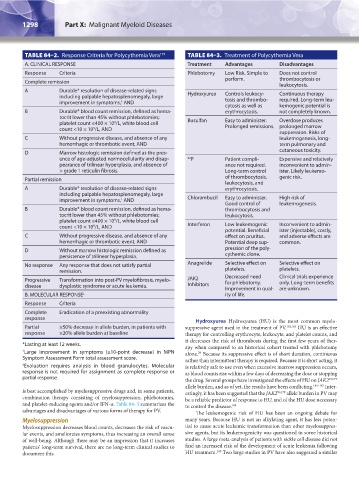
                TABLE 84–2.  Response Criteria for Polycythemia Vera 179  TABLE 84–3.  Treatment of Polycythemia Vera
                A. CLINICAL RESPONSE                                   Treatment   Advantages         Disadvantages
                Response    Criteria                                   Phlebotomy  Low Risk. Simple to   Does not control
                                                                                   perform.           thrombocytosis or
                Complete remission
                                                                                                      leukocytosis.
                A           Durable* resolution of disease-related signs   Hydroxyurea  Controls leukocy-  Continuous therapy
                            including palpable hepatosplenomegaly, large           tosis and thrombo-  required. Long-term leu-
                            improvement in symptoms,  AND
                                                †
                                                                                   cytosis as well as   kemogenic potential is
                B           Durable* blood count remission, defined as hema-       erythrocytosis.    not completely known.
                            tocrit lower than 45% without phlebotomies;   Busulfan  Easy to administer.   Overdose produces
                            platelet count ≤400 × 10 /L, white blood cell          Prolonged remissions. prolonged marrow
                                              9
                                       9
                            count <10 × 10 /L, AND
                                                                                                      suppression. Risks of
                C           Without progressive disease, and absence of any                           leukemogenesis, long-
                            hemorrhagic or thrombotic event, AND                                      term pulmonary and
                D           Marrow histologic remission defined as the pres-                          cutaneous toxicity.
                            ence of age-adjusted normocellularity and disap-  32 P  Patient compli-   Expensive and relatively
                            pearance of trilinear hyperplasia, and absence of      ance not required.   inconvenient to admin-
                            > grade 1 reticulin fibrosis.                          Long-term control   ister. Likely leukemo-
                Partial remission                                                  of thrombocytosis,   genic risk.
                                                                                   leukocytosis, and
                A           Durable* resolution of disease-related signs           erythrocytosis.
                            including palpable hepatosplenomegaly, large   Chlorambucil  Easy to administer.   High risk of
                            improvement in symptoms,  AND
                                                †
                                                                                   Good control of    leukemogenesis.
                B           Durable* blood count remission, defined as hema-       thrombocytosis and
                            tocrit lower than 45% without phlebotomies;            leukocytosis.
                            platelet count ≤400 × 10 /L, white blood cell
                                              9
                            count <10 × 10 /L, AND                     Interferon  Low leukemogenic   Inconvenient to admin-
                                       9
                                                                                   potential. Beneficial   ister (injectable), costly,
                C           Without progressive disease, and absence of any        effect on pruritus.   and adverse effects are
                            hemorrhagic or thrombotic event, AND                   Potential deep sup-  common.
                D           Without marrow histologic remission defined as         pression of the poly-
                            persistence of trilinear hyperplasia.                  cythemic clone.
                No response  Any response that does not satisfy partial   Anagrelide  Selective effect on   Selective effect on
                            remission.                                             platelets.         platelets.
                Progressive   Transformation into post-PV myelofibrosis, myelo-  JAK2   Decreased need   Clinical trials experience
                                                                                   for phlebotomy.
                                                                                                      only. Long-term benefits
                disease     dysplastic syndrome or acute leukemia.     Inhibitors  Improvement in qual-  are unknown.
                B. MOLECULAR RESPONSE ‡                                            ity of life.
                Response    Criteria
                Complete    Eradication of a preexisting abnormality
                response
                                                                          Hydroxyurea  Hydroxyurea (HU) is the most common myelo-
                Partial     ≥50% decrease in allele burden, in patients with   suppressive agent used in the treatment of PV. 182,183  HU is an effective
                response    ≥20% allele burden at baseline            therapy for controlling erythrocyte, leukocyte, and platelet counts, and
                                                                      it decreases the risk of thrombosis during the first few years of ther-
               *Lasting at least 12 weeks.                            apy when compared to an historical cohort treated with phlebotomy
               † Large  improvement in symptoms (≥10-point  decrease) in MPN   alone.  Because its suppressive effect is of short duration, continuous
                                                                          78
               Symptom Assessment Form total assessment score.        rather than intermittent therapy is required. Because it is short acting, it
               ‡ Evaluation requires analysis in blood granulocytes. Molecular     is relatively safe to use even when excessive marrow suppression occurs,
               response is not required for assignment as complete response or     as blood counts rise within a few days of decreasing the dose or stopping
               partial response.                                      the drug. Several groups have investigated the effects of HU on JAK2 V617F
                                                                      allele burden, and as of yet, the results have been conflicting. 184–187  Inter-
               is best accomplished by myelosuppressive drugs and, in some patients,   estingly, it has been suggested that the JAK2 V617F  allele burden in PV may
               combination therapy consisting of myelosuppression, phlebotomies,   be a reliable predictor of response to HU, and of the HU dose necessary
               and platelet-reducing agents and/or IFN-α. Table 84–3 summarizes the   to control the disease. 188
               advantages and disadvantages of various forms of therapy for PV.  The leukemogenic risk of HU has been an ongoing debate for
               Myelosuppression                                       many years. Because HU is not an alkylating agent, it has less poten-
               Myelosuppression decreases blood counts, decreases the risk of vascu-  tial to cause acute leukemic transformation than other myelosuppres-
               lar events, and ameliorates symptoms, thus increasing an overall sense   sive agents, but its leukemogenicity was questioned in some historical
               of well-being. Although there may be an impression that it increases   studies. A large meta-analysis of patients with sickle cell disease did not
               patients’ long-term survival, there are no long-term clinical studies to   find an increased risk of the development of acute leukemia following
                                                                                 189
               document this.                                         HU treatment.  Two large studies in PV have also suggested a similar


          Kaushansky_chapter 84_p1291-1306.indd   1298                                                                  9/21/15   11:11 AM

