


Page 1322 - Williams Hematology ( PDFDrive )
P. 1322
1296  Part X:  Malignant Myeloid Diseases                                   Chapter 84:  Polycythemia Vera           1297


                        DIFFERENTIAL DIAGNOSIS                          out congenital polycythemia should always be undertaken in patients
                                                                        with atypical presentations; however, the presence of polycythemia in
                  Also refer to Chap. 34, Table  34–2, and Chap. 57, Fig. 57–6.  other relatives does not rule out PV.
                     PV has to be differentiated from spurious polycythemia, second-
                  ary polycythemias, congenital disorders of hypoxia sensing, and pri-
                  mary congenital polycythemias. The differential diagnostic task has      TREATMENT
                  been facilitated by the discovery of the JAK2 V617F  mutation that is pres-  The major causes of morbidity and mortality in PV are an increased
                  ent in 95 percent or more of all PV patients. 165,166  Thus, the majority of   incidence of vascular complications (i.e., thrombosis and/or hemor-
                  PV patients can be diagnosed with a complete blood count repeated   rhage), and progression to MF or acute leukemia/myelodysplasia. In the
                  twice and molecular studies to confirm the presence of the JAK2 V617F    first randomized trial of PV patients, a history of previous thrombosis,
                  mutation.                                             age, treatment with phlebotomies, and rate of phlebotomies contributed
                     For the remainder of polycythemic patients, additional diagnostic   to the increased risk of thrombosis.  Presently, the age of the patient
                                                                                                   76
                  measures need to be undertaken. These may include measuring serum   (>60 years) and previous thrombotic events are universally acknowl-
                  erythropoietin level, measuring venous oxygen saturation to calcu-  edged major risk factors for major vascular complications in PV. 71
                  late hemoglobin P50, measuring arterial oxygen saturation (less than   Thus, PV patients are classified as low risk or high risk, with age
                  92 percent suggests cardiac or pulmonary etiologies), abdominal CT   greater than 60 years and previous thrombotic events (including tran-
                  scan (to exclude renal, hepatic, and cerebral tumors), brain magnetic   sient ischemic attacks) defining the high-risk category. The assigned risk
                  resonance imaging (to rule out a cerebellar hemangioblastoma), and   classification has a major impact on therapeutic decisions, as high-risk
                  detailed family studies.                              patients are treated with cytoreductive therapies. Other risk factors may
                     If a diagnosis at this point has not yet been made, the patient could   also play a role in the pathogenesis of thrombosis, such as hypertension,
                  be referred to a specialized center for further testing. These studies may   diabetes, or smoking,  as well as leukocytosis 172–176  and JAK2 V617F  muta-
                                                                                        171
                  include measuring changes in serum erythropoietin levels after phle-  tional allele burden. 80,177  There is a need for prospective clinical studies
                  botomies, red blood cell and plasma volume studies (to diagnose spuri-  with stratification of patients according to these criteria, but until such
                  ous polycythemia or masked PV), genomic sequencing studies, testing   evidence is available, patients with high leukocyte levels and/or high
                  for JAK2 exon 12 mutations, and in vitro studies for EECs. The latter   JAK2 V617F  mutational allele burden should be managed according to
                  two are used to diagnose JAK2 V617F -negative PV patients (<5 percent of   conventional criteria.
                  all PVs).                                                 An elevated platelet count does not increase the risk of thrombosis,
                     Distinguishing between PV and other polycythemic disorders   but it may increase the risk of hemorrhage.  Bleeding is more frequent
                                                                                                       128
                  may, at times, be challenging. Although the diagnosis of PV may be   in patients with platelet counts in excess of 1500 × 10 /L, thought to be
                                                                                                               9
                  straightforward if patients have the classic features of PV as defined   the result of an acquired type 2 von Willebrand disease.
                  by the most recent WHO guidelines,  patients often present with an   Treatment of PV depends on risk evaluation at diagnosis and evo-
                                             154
                  incomplete phenotype. Some of the clinical and laboratory features   lution of the disease over time. Treatment should be given both to alle-
                  that can be helpful for differential diagnosis are summarized in Chap.   viate symptoms and prevent complications. Updated consensus-based
                  34, Table  34–2 and Chap. 57, Fig. 57–6. While the current WHO diag-  guidelines for the management of PV and other major MPNs were pub-
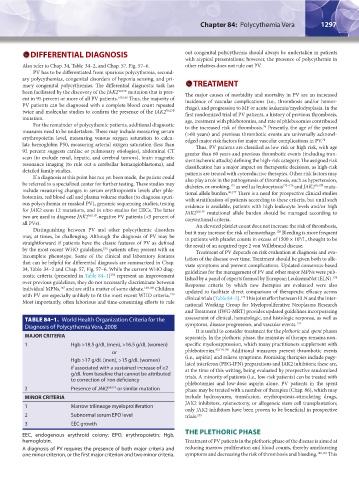
                  nostic criteria (presented in Table 84–1)  represent an improvement   lished by a panel of experts formed by European LeukemiaNet (ELN).
                                               154
                                                                                                                          178
                  over previous guidelines, they do not necessarily discriminate between   Response criteria by which new therapies are evaluated were also
                  individual MPNs,  and are still a matter of some debate. 168,169  Children   updated to facilitate direct comparison of therapeutic efficacy across
                               167
                  with PV are especially unlikely to fit the most recent WHO criteria.    clinical trials (Table 84–2).  This joint effort between ELN and the Inter-
                                                                   170
                                                                                           179
                  Most importantly, often laborious and time-consuming efforts to rule
                                                                        national Working Group for Myeloproliferative Neoplasms Research
                                                                        and Treatment (IWG-MRT) provides updated guidelines incorporating
                   TABLE 84–1.  World Health Organization Criteria for the   assessment of clinical, hematologic, and histologic response, as well as
                   Diagnosis of Polycythemia Vera, 2008                 symptoms, disease progression, and vascular events. 179
                                                                            It is useful to consider treatment for the plethoric and spent phases
                   MAJOR CRITERIA                                       separately. In the plethoric phase, the mainstay of therapy remains non-
                   1              Hgb >18.5 g/dL (men), >16.5 g/dL (women)  specific myelosuppression, which many practitioners supplement with
                                                or                      phlebotomies. 82,178,180  Additional measures prevent thrombotic events
                                  Hgb >17 g/dL (men), >15 g/dL (women)  (i.e., aspirin) and relieve symptoms. Promising therapies include pegy-
                                                                        lated interferon (PEG-IFN) preparations and JAK2 inhibitors; these are,
                                  if associated with a sustained increase of ≥2   at the time of this writing, being evaluated by prospective randomized
                                  g/dL from baseline that cannot be attributed   trials. A minority of patients (i.e., low-risk patients) can be treated with
                                  to correction of iron deficiency
                                                                        phlebotomies and low-dose aspirin alone. PV patients in the spent
                   2              Presence of JAK2 V617F  or similar mutation  phase may be treated with a number of therapies (Chap. 86), which may
                   MINOR CRITERIA                                       include hydroxyurea, transfusion, erythropoiesis-stimulating drugs,
                                                                        JAK2 inhibitors, splenectomy, or allogeneic stem cell transplantation;
                   1              Marrow trilineage myeloproliferation
                                                                        only JAK2 inhibitors have been proven to be beneficial in prospective
                   2              Subnormal serum EPO level             trials. 235
                   3              EEC growth
                                                                        THE PLETHORIC PHASE
                  EEC, endogenous erythroid colony; EPO, erythropoietin; Hgb,
                  hemoglobin.                                           Treatment of PV patients in the plethoric phase of the disease is aimed at
                  A diagnosis of PV requires the presence of both major criteria and   reducing marrow proliferation and blood counts, thereby ameliorating
                  one minor criterion, or the first major criterion and two minor criteria.  symptoms and decreasing the risk of thrombosis and bleeding. 180,181  This


          Kaushansky_chapter 84_p1291-1306.indd   1297                                                                  9/21/15   11:11 AM

