


Page 1347 - Williams Hematology ( PDFDrive )
P. 1347
1322           Part X:  Malignant Myeloid Diseases                                                                                                                                    Chapter 86:  Primary Myelofibrosis         1323


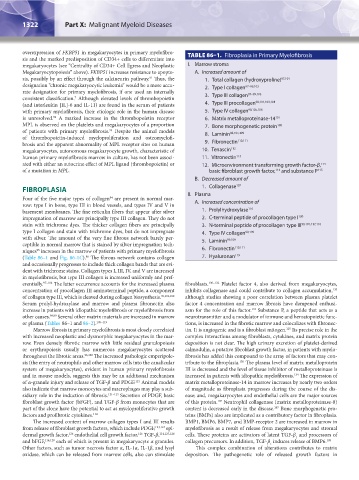
               overexpression of FKBP51 in megakaryocytes in primary myelofibro-  TABLE 86–1.  Fibroplasia in Primary Myelofibrosis
               sis and the marked predisposition of CD34+ cells to differentiate into
               megakaryocytes (see “Centrality of CD34+ Cell Egress and Neoplastic   I.  Marrow stroma
               Megakaryocytopoiesis” above). FKBP51 increases resistance to apopto-  A.  Increased amount of
               sis, possibly by an effect through the calcineurin pathway.  Thus, the   1.  Total collagen (hydroxyproline) 97,101
                                                          91
               designation “chronic megakaryocytic leukemia” would be a more accu-  2.  Type I collagen 97–99,103
               rate designation for primary myelofibrosis, if one used an internally       97–99,103
                                 7
               consistent  classification.   Although  elevated  levels  of  thrombopoietin   3.  Type III collagen
               (and interleukin [IL]-6 and IL-11) are found in the serum of patients   4.  Type III procollagen 98,101,103,104
               with primary myelofibrosis, their etiologic role in the human disease   5.  Type IV collagen 98,105,106
                          92
               is unresolved.  A marked increase in the thrombopoietin receptor   6.  Matrix metalloproteinase-14 107
               MPL is observed on the platelets and megakaryocytes of a proportion   7.  Bone morphogenetic protein 108
                                             93
               of  patients  with  primary  myelofibrosis.   Despite  the  animal  models   8.  Laminin 98,105,109
               of thrombopoietin-induced myeloproliferation and osteomyelofi-           110,111
               brosis and the apparent abnormality of MPL receptor sites on human   9.  Fibronectin
               megakaryocytes, autonomous megakaryocyte growth, characteristic of   10.   Tenascin 112
               human primary myelofibrosis marrow in culture, has not been associ-  11.   Vitronectin 113
               ated with either an autocrine effect of MPL ligand (thrombopoietin) or   12.   Microenvironment transforming growth factor-β,
                                                                                                                    114
               of a mutation in MPL.                                          basic fibroblast growth factor,  and substance P 115
                                                                                                    114
                                                                         B.  Decreased amount of
               FIBROPLASIA                                                  1.  Collagenase 107
               Four of the five major types of collagen  are present in normal mar-  II.  Plasma
                                             94
               row: type I in bone, type III in blood vessels, and types IV and V in   A.  Increased concentration of
               basement membranes. The fine reticulin fibers that appear after silver   1.  Prolylhydroxylase 116
               impregnation of marrow are principally type III collagen. They do not   2.  C-terminal peptide of procollagen type I 100
               stain with trichrome dyes. The thicker collagen fibers are principally   3.  N-terminal peptide of procollagen type III 99,101,117,118
               type I collagen and stain with trichrome dyes, but do not impregnate   4.  Type IV collagen 99,109
               with silver. The amount of the very fine fibrous network barely per-  5.  Laminin 99,109
               ceptible in normal marrow that is stained by silver impregnation tech-  110,111
               niques  increases in the marrow of patients with primary myelofibrosis    6.  Fibronectin
                    95
               (Table 86–1 and Fig. 86-1C).  The fibrous network contains collagen   7.  Hyaluronan 119
                                     96
               and occasionally progresses to include thick collagen bands that are evi-
               dent with trichrome stains. Collagen types I, III, IV, and V are increased
               in myelofibrosis, but type III collagen is increased uniformly and pref-
               erentially. 97–104  The latter occurrence accounts for the increased plasma   fibroblasts. 130–132  Platelet factor 4, also derived from megakaryocytes,
                                                                                                                       120
               concentration of procollagen III aminoterminal peptide, a component   inhibits collagenase and could contribute to collagen accumulation,
               of collagen type III, which is cleaved during collagen biosynthesis. 96,101,102    although studies showing a poor correlation between plasma platelet
               Serum prolyl-hydroxylase and marrow and plasma fibronectin also   factor  4  concentration  and  marrow  fibrosis  have  dampened  enthusi-
               increase in patients with idiopathic myelofibrosis or myelofibrosis from   asm for the role of this factor.  Substance P, a peptide that acts as a
                                                                                            133
               other causes. 98,99  Several other matrix materials are increased in marrow   neurotransmitter and a modulator of immune and hematopoietic func-
               or plasma (Tables  86–1 and 86–2). 105–119             tions, is increased in the fibrotic marrow and colocalizes with fibronec-
                   Marrow fibrosis in primary myelofibrosis is most closely correlated   tin. It is angiogenic and is a fibroblast mitogen.  Its precise role in the
                                                                                                        115
               with increased neoplastic and dysmorphic megakaryocytes in the mar-  complex interactions among fibroblasts, cytokines, and matrix protein
               row. Even densely fibrotic marrow  with little  residual granulopoiesis   deposition is not clear. The high urinary excretion of platelet-derived
               or erythropoiesis usually has numerous megakaryocytes scattered   calmodulin, a putative fibroblast growth factor, in patients with myelo-
               throughout the fibrotic areas. 96,120  The increased pathologic emperipole-  fibrosis has added this compound to the array of factors that may con-
               sis (the entry of neutrophils and other marrow cells into the canalicular   tribute to the fibroplasia.  The plasma level of matrix metalloprotein
                                                                                        130
               system of megakaryocytes), evident in human primary myelofibrosis   III is decreased and the level of tissue inhibitor of metalloproteinase is
               and in mouse models, suggests this may be an additional mechanism   increased in patients with idiopathic myelofibrosis.  The expression of
                                                                                                           134
                                                     121
               of α-granule injury and release of TGF-β and PDGF.  Animal models   matrix metalloproteinase-14 in marrow increases by nearly two orders
               also indicate that marrow monocytes and macrophages may play a sub-  of magnitude as fibroplasia progresses during the course of the dis-
               sidiary role in the induction of fibrosis. 121–123  Secretion of PDGF, basic   ease; and, megakaryocytes and endothelial cells are the major sources
                                                                                 107
               fibroblast growth factor (bFGF), and TGF-β from monocytes that are   of this protein.  Neutrophil collagenase (matrix metalloproteinase-8)
               part of the clone have the potential to act as myeloproliferative growth   content is decreased early in the disease.  Bone morphogenetic pro-
                                                                                                    107
               factors and profibrotic cytokines. 114                 teins (BMPs) also are implicated as a contributory factor in fibroplasia.
                   The increased content of marrow collagen types I and III results   BMP1, BMP6, BMP7, and BMP-receptor 2 are increased in marrow in
               from release of fibroblast growth factors, which include PDGF, 123,124  epi-  myelofibrosis as a result of release from megakaryocytes and stromal
                                                      126
                               126
               dermal growth factor,  endothelial cell growth factor,  TGF-β, 114,127,128    cells. These proteins are activators of latent TGF-β  and processors of
                                                                                                           1
               and bFGF, 114,129  each of which is present in megakaryocyte α granules.   collagen precursors. In addition, TGF-β  induces release of BMP6. 108
                                                                                                   1
               Other factors, such as tumor necrosis factor α, IL-1α, IL-1β, and lysyl   This complex combination of alterations contributes to matrix
               oxidase, which can be released from marrow cells, also can stimulate   deposition. The pathogenetic role of released growth factors in


          Kaushansky_chapter 86_p1319-1340.indd   1322                                                                  9/18/15   10:22 AM

