


Page 1348 - Williams Hematology ( PDFDrive )
P. 1348
1322  Part X:  Malignant Myeloid Diseases                                Chapter 86:  Primary Myelofibrosis          1323


                             A                                          B


                             C                                          D
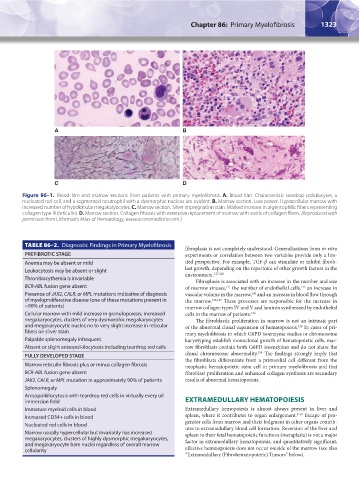
                  Figure 86–1.  Blood film and marrow sections from patients with primary myelofibrosis. A. Blood film. Characteristic teardrop poikilocytes, a
                  nucleated red cell, and a segmented neutrophil with a dysmorphic nucleus are evident. B. Marrow section. Low power. Hypercellular marrow with
                  increased number of hypolobular megakaryocytes. C. Marrow section. Silver impregnation stain. Marked increase in argentophilic fibers representing
                  collagen type III (reticulin). D. Marrow section. Collagen fibrosis with extensive replacement of marrow with swirls of collagen fibers. (Reproduced with
                  permission from Lichtman’s Atlas of Hematology, www.accessmedicine.com.)


                   TABLE 86–2.  Diagnostic Findings in Primary Myelofibrosis
                                                                        fibroplasia is not completely understood. Generalizations from in vitro
                   PREFIBROTIC STAGE                                    experiments or correlation between two variables provide only a lim-
                   Anemia may be absent or mild                         ited perspective. For example, TGF-β can stimulate or inhibit fibrob-
                   Leukocytosis may be absent or slight                 last growth, depending on the repertoire of other growth factors in the
                                                                        environment.
                                                                                  127,128
                   Thrombocythemia is invariable                            Fibroplasia is associated with an increase in the number and size
                   BCR-ABL fusion gene absent                           of marrow sinuses,  the number of endothelial cells,  an increase in
                                                                                                               135
                                                                                      111
                   Presence of JAK2, CALR, or MPL mutations indicative of diagnosis   vascular volume in the marrow,  and an increase in blood flow through
                                                                                               106
                   of myeloproliferative disease (one of these mutations present in   the marrow. 136,137  These processes are responsible for the increase in
                   ~90% of patients)                                    marrow collagen types IV and V and laminin synthesized by endothelial
                   Cellular marrow with mild increase in granulopoiesis; increased   cells in the marrow of patients. 126
                   megakaryocytes, clusters of very dysmorphic megakaryocytes   The  fibroblastic  proliferation  in  marrow  is  not an  intrinsic  part
                   and megakaryocytic nuclei; no to very slight increase in reticular   of the abnormal clonal expansion of hematopoiesis.  In cases of pri-
                                                                                                              138
                   fibers on silver stain                               mary myelofibrosis in which G6PD isoenzyme studies or chromosome
                   Palpable splenomegaly infrequent                     karyotyping establish monoclonal growth of hematopoietic cells, mar-
                   Absent or slight anisopoikilocytosis including teardrop red cells  row fibroblasts contain both G6PD isoenzymes and do not share the
                                                                                                 139
                   FULLY DEVELOPED STAGE                                clonal chromosome abnormality.  The findings strongly imply that
                                                                        the  fibroblasts  differentiate from  a  primordial  cell  different  from  the
                   Marrow reticulin fibrosis plus or minus collagen fibrosis  neoplastic hematopoietic stem cell in primary myelofibrosis and that
                   BCR-ABL fusion gene absent                           fibroblast proliferation and enhanced collagen synthesis are secondary
                   JAK2, CALR, or MPL mutation in approximately 90% of patients  results of abnormal hematopoiesis.
                   Splenomegaly
                   Anisopoikilocytosis with teardrop red cells in virtually every oil
                   immersion field                                      EXTRAMEDULLARY HEMATOPOIESIS
                   Immature myeloid cells in blood                      Extramedullary hemopoiesis is almost always present in liver and
                   Increased CD34+ cells in blood                       spleen, where it contributes to organ enlargement. 8–10  Escape of pro-
                   Nucleated red cells in blood                         genitor cells from marrow and their lodgment in other organs contrib-
                                                                        utes to extramedullary blood cell formation. Reversion of the liver and
                   Marrow usually hypercellular but invariably has increased   spleen to their fetal hematopoietic functions (metaplasia) is not a major
                   megakaryocytes, clusters of highly dysmorphic megakaryocytes,   factor in extramedullary hematopoiesis, and quantitatively significant,
                   and megakaryocyte bare nuclei regardless of overall marrow
                   cellularity                                          effective hematopoiesis does not occur outside of the marrow (see also
                                                                        “Extramedullary (Fibrohematopoietic) Tumors” below).


          Kaushansky_chapter 86_p1319-1340.indd   1323                                                                  9/18/15   10:23 AM

