


Page 1368 - Williams Hematology ( PDFDrive )
P. 1368
1342  Part X:  Malignant Myeloid Diseases                           Chapter 87:  Myelodysplastic Syndromes           1343


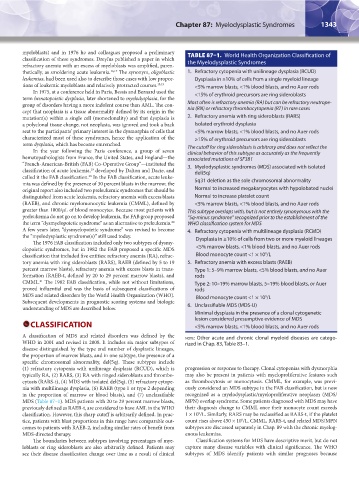
                  myeloblasts) and in 1976 he and colleagues proposed a preliminary   TABLE 87–1.  World Health Organization Classification of
                  classification of these syndromes. Dreyfus published a paper in which
                  refractory anemia with an excess of myeloblasts was amplified, paren-  the Myelodysplastic Syndromes
                  thetically, as smoldering acute leukemia. 16,17  The synonym, oligoblastic   1.  Refractory cytopenia with unilineage dysplasia (RCUD)
                  leukemias, had been used also to describe those cases with low propor-  Dysplasia in ≥10% of cells from a single myeloid lineage
                  tions of leukemic myeloblasts and relatively protracted courses. 18,19  <5% marrow blasts, <1% blood blasts, and no Auer rods
                     In 1975, at a conference held in Paris, Bessis and Bernard used the   <15% of erythroid precursors are ring sideroblasts
                  term hematopoietic dysplasia, later shortened to myelodysplasia, for the
                  group of disorders having a more indolent course than AML. The con-  Most often is refractory anemia (RA) but can be refractory neutrope-
                  cept that neoplasia is a tissue abnormality defined by its origin in the   nia (RN) or refractory thrombocytopenia (RT) in rare cases
                  mutation(s) within a single cell (monoclonality) and that dysplasia is   2.  Refractory anemia with ring sideroblasts (RARS)
                  a polyclonal tissue change, not neoplasia, was ignored and took a back   Isolated erythroid dysplasia
                  seat to the participants’ primary interest in the dysmorphia of cells that   <5% marrow blasts, <1% blood blasts, and no Auer rods
                  characterized most of these syndromes, hence the application of the   ≥15% of erythroid precursors are ring sideroblasts
                  term dysplasia, which has become entrenched.           The cutoff for ring sideroblasts is arbitrary and does not reflect the
                     In the year following the Paris conference, a group of seven   clinical behavior of this subtype as accurately as the frequently
                  hematopathologists from France, the United States, and England—the   associated mutations of SF3B1
                  “French-American-British (FAB) Co-Operative Group”—instituted the   3.  Myelodysplastic syndromes (MDS) associated with isolated
                                         19
                  classification of acute leukemia,  developed by Dalton and Dacie, and   del(5q)
                  called it the FAB classification.  In the FAB classification, acute leuke-
                                        20
                  mia was defined by the presence of 30 percent blasts in the marrow; the   5q31 deletion as the sole chromosomal abnormality
                  original report also included two preleukemic syndromes that should be   Normal to increased megakaryocytes with hypolobated nuclei
                  distinguished from acute leukemia, refractory anemia with excess blasts   Normal to increase platelet count
                  (RAEB), and chronic myelomonocytic leukemia (CMML), defined by   <5% marrow blasts, <1% blood blasts, and no Auer rods
                  greater than 1000/μL of blood monocytes. Because most patients with   This subtype overlaps with, but is not entirely synonymous with the
                  preleukemia do not go on to develop leukemia, the FAB group proposed   “5q-minus syndrome” recognized prior to the establishment of the
                                                                    20
                  the term “dysmyelopoietic syndrome” as an alternative to preleukemia.    WHO classification system for MDS
                  A few years later, “dysmyelopoietic syndrome” was revised to become   4.  Refractory cytopenia with multilineage dysplasia (RCMD)
                  the “myelodysplastic syndrome(s)” still used today.       Dysplasia in ≥10% of cells from two or more myeloid lineages
                     The 1976 FAB classification included only two subtypes of dysmy-
                  elopoietic syndromes, but in 1982 the FAB proposed a specific MDS   <5% marrow blasts, <1% blood blasts, and no Auer rods
                                                                                                   9
                  classification that included five entities: refractory anemia (RA), refrac-  Blood monocyte count <1 × 10 /L
                  tory anemia with ring sideroblasts (RARS), RAEB (defined by 5 to 19   5.  Refractory anemia with excess blasts (RAEB)
                  percent marrow blasts), refractory anemia with excess blasts in trans-    Type 1: 5–9% marrow blasts, <5% blood blasts, and no Auer
                  formation (RAEB-t, defined by 20 to 29 percent marrow blasts), and   rods
                        21
                  CMML.  The 1982 FAB classification, while not without limitations,     Type 2: 10–19% marrow blasts, 5–19% blood blasts, or Auer
                  proved influential and was the basis of subsequent classifications of   rods
                  MDS and related disorders by the World Health Organization (WHO).   Blood monocyte count <1 × 10 /L
                                                                                                   9
                  Subsequent developments in prognostic scoring systems and biologic
                  understanding of MDS are described below.              6.  Unclassifiable MDS (MDS-U)
                                                                              Minimal dysplasia in the presence of a clonal cytogenetic
                                                                            lesion considered presumptive evidence of MDS
                     CLASSIFICATION                                         <5% marrow blasts, <1% blood blasts, and no Auer rods
                  A classification of MDS and related disorders was defined by the   note: Other acute and chronic clonal myeloid diseases are catego-
                  WHO in 2001 and revised in 2008. It includes six major subtypes of   rized in Chap. 83, Table 83–1.
                  disease distinguished by the type and number of dysplastic lineages,
                  the proportion of marrow blasts, and in one subtype, the presence of a
                  specific chromosomal abnormality, del(5q). These subtypes include
                  (1) refractory cytopenia with unilineage dysplasia (RCUD), which is   progression or response to therapy. Clonal cytopenias with dysmorphia
                  typically RA, (2) RARS, (3) RA with ringed sideroblasts and thrombo-  may also be present in patients with myeloproliferative features such
                  cytosis (RARS-t), (4) MDS with isolated del(5q), (5) refractory cytope-  as thrombocytosis or monocytosis. CMML, for example, was previ-
                  nia with multilineage dysplasia, (6) RAEB (type 1 or type 2 depending   ously considered an MDS subtype in the FAB classification, but is now
                  in the proportion of marrow or blood blasts), and (7) unclassifiable   recognized  as a  myelodysplastic/myeloproliferative neoplasm  (MDS/
                  MDS (Table 87–1). MDS patients with 20 to 29 percent marrow blasts,   MPN) overlap syndrome. Some patients diagnosed with MDS may have
                  previously defined as RAEB-t, are considered to have AML in the WHO   their diagnosis change to CMML once their monocyte count exceeds
                  classification. However, this sharp cutoff is arbitrarily defined. In prac-  1 × 10 /L. Similarly, RARS may be reclassified as RARS-t, if the platelet
                                                                             9
                                                                                           9
                  tice, patients with blast proportions in this range have comparable out-  count rises above 450 × 10 /L. CMML, RARS-t, and related MDS/MPN
                  comes to patients with RAEB-2, including similar rates of benefit from   subtypes are discussed separately in Chap. 89 with the chronic myelog-
                  MDS-directed therapy.                                 enous leukemias.
                     The boundaries between subtypes involving percentages of mye-  Classification systems for MDS have descriptive merit, but do not
                  loblasts or ring sideroblasts are also arbitrarily defined. Patients may   capture  many  disease  variables  with  clinical  significance.  The  WHO
                  see their disease classification change over time as a result of clinical   subtypes of MDS identify patients with similar prognoses because


          Kaushansky_chapter 87_p1341-1372.indd   1343                                                                  9/21/15   11:04 AM

