


Page 1369 - Williams Hematology ( PDFDrive )
P. 1369
1344           Part X:  Malignant Myeloid Diseases                                                                                                                               Chapter 87:  Myelodysplastic Syndromes          1345


               patients with multilineage dysplasia and increasing blast percentages   Claims-based data suggest that conservatively, at least 30,000 new
               are at higher risk of AML transformation and death. However, dedi-  cases annually are diagnosed in the United States.  It is likely that many
                                                                                                         27
               cated prognostic models that include features not considered by the   additional elderly patients with unexplained cytopenias have MDS, but
               WHO classification system are better suited for the estimation of dis-  are incompletely evaluated because of severe comorbid conditions lim-
               ease  risk. Similarly, WHO-defined  subtypes do not necessarily share   iting life expectancy, clinician oversight of blood test results, or a sense
               common pathogenic elements or identify groups of patients most likely   of nihilism. Rates of MDS are similar in Western Europe and the United
               to respond to particular therapies. Our greater understanding about the   States. 28
               underlying molecular abnormalities that occur in MDS demonstrate   In certain Asian countries and Eastern Europe, MDS is diagnosed
               how clinically defined subtypes are genetically very heterogenous. It   at  a  younger  age  on  average  than  in  the  United  States  and  Western
               is likely that future classification systems will consider somatic muta-  Europe. 29–31  The subtypes of MDS that are diagnosed in different regions
               tions in MDS driver genes, genes responsible for the clonal outgrowth   of the world are also distinct 32,33 ; for instance, for unclear reasons RARS
                                                                                                   34
               and the eventual development of disease, as a basis for defining disease     is rare in Japan compared to the West.  Exposure to ionizing radia-
               subtypes.                                              tion from the 1945 Hiroshima and Nagasaki atomic bomb explosions
                                                                      continues to be associated with an increased MDS risk among exposed
                                                                      Japanese more than 50 years after the events. 35
                  EPIDEMIOLOGY                                            The median age at MDS diagnosis in the United States is approx-
                                                                                  36
                                                                      imately 71 years.  Onset of MDS before the age of 50 years is uncom-
               INCIDENCE BY AGE, SEX, AND OCCUPATION                  mon, except in cases preceded by irradiation or cytotoxic chemotherapy
               The incidence and prevalence of MDS have been difficult to estab-  given for another malignancy. 37–39  MDS, as defined by the WHO classifi-
               lish, in part because patients are not consistently reported to central     cation, occurs in children ages 5 months to 15 years at a rate of approx-
               cancer  registries. 22–24   Only  since  2001  has  the  United  States  (U.S.)   imately one per 1 million children per year. In contrast to adults, most
               National  Cancer  Institute  (NCI)  Surveillance,  Epidemiology  and   pediatric cases are oligoblastic myelogenous leukemia (RAEB); clonal
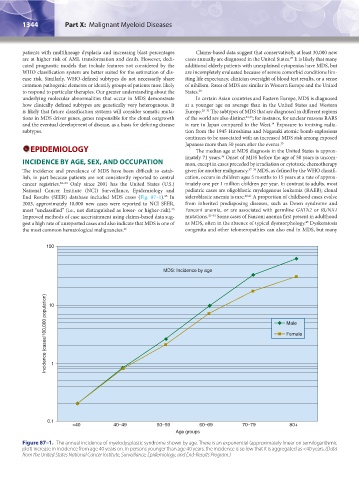
               End Results (SEER) database included MDS cases (Fig. 87–1).  In   sideroblastic anemia is rare. 40,41  A proportion of childhood cases evolve
                                                               25
               2003,  approximately 10,000  new cases  were  reported to  NCI  SEER,   from inherited predisposing diseases, such as Down syndrome and
               most “unclassified” (i.e., not distinguished as lower- or higher-risk).    Fanconi anemia, or are associated with germline  GATA2 or  RUNX1
                                                                 25
               Improved methods of case ascertainment using claims-based data sug-  mutations. 42–44  Some cases of Fanconi anemia first present in adulthood
                                                                                                              45
               gest a high rate of unreported cases and also indicate that MDS is one of   as MDS, often in the absence of typical dysmorphology.  Dyskeratosis
               the most common hematological malignancies. 26         congenita and other telomeropathies can also end in MDS, but many
                       100


                                                               MDS: Incidence by age


                       Incidence (cases/100,000 population)  10 1                                       Male


                                                                                                        Female


                        0.1
                                <40           40–49         50–59          60–69         70–79           80+
                                                                   Age groups
               Figure 87–1.  The annual incidence of myelodysplastic syndrome shown by age. There is an exponential (approximately linear on semilogarithmic
               plot) increase in incidence from age 40 years on. In persons younger than age 40 years, the incidence is so low that it is aggregated as <40 years. (Data
               from the United States National Cancer Institute, Surveillance, Epidemiology, and End-Results Program.)


          Kaushansky_chapter 87_p1341-1372.indd   1344                                                                  9/21/15   11:04 AM

