


Page 1372 - Williams Hematology ( PDFDrive )
P. 1372
1346  Part X:  Malignant Myeloid Diseases                           Chapter 87:  Myelodysplastic Syndromes           1347


                             A                           B                             C
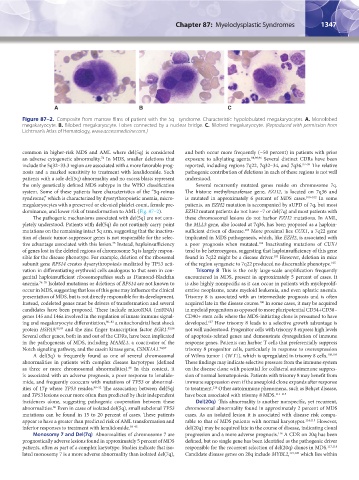
                  Figure 87–2.  Composite from marrow films of patient with the 5q– syndrome. Characteristic hypolobulated megakaryocytes. A. Monolobed
                  megakaryocyte. B. Bilobed megakaryocyte. Lobes connected by a nuclear bridge. C. Bilobed megakaryocyte. (Reproduced with permission from
                  Lichtman’s Atlas of Hematology, www.accessmedicine.com.)


                  common in higher-risk MDS and AML where del(5q) is considered   and both occur more frequently (~50 percent) in patients with prior
                  an adverse cytogenetic abnormality.  In MDS, smaller deletions that   exposure to alkylating agents. 88,89,96  Several distinct CDRs have been
                                            74
                  include the 5q32–33.3 region are associated with a more favorable prog-  reported, including regions 7q22, 7q32–34, and 7q36. 97–99  The relative
                  nosis and a marked sensitivity to treatment with lenalidomide. Such   pathogenic contribution of deletions in each of these regions is not well
                  patients with a sole del(5q) abnormality and no excess blasts represent   understood.
                  the only genetically defined MDS subtype in the WHO classification   Several recurrently mutated genes reside on chromosome 7q.
                  system. Some of these patients have characteristics of the “5q-minus   The histone methyltransferase gene,  EZH2, is located on 7q36 and
                  syndrome,” which is characterized by dyserythropoietic anemia, micro-  is mutated in approximately 6 percent of MDS cases. 100–102  In some
                  megakaryocytes with a preserved or elevated platelet count, female pre-  patients, an EZH2 mutation is accompanied by aUPD of 7q, but most
                  dominance, and lower risk of transformation to AML (Fig. 87–2).  EZH2 mutant patients do not have –7 or del(7q) and most patients with
                     The pathogenic mechanisms associated with del(5q) are not com-  these chromosomal lesions do not harbor EZH2 mutations. In AML,
                  pletely understood. Patients with del(5q) do not routinely carry point   the MLL3 gene, also located at 7q36, has been proposed as a haploin-
                  mutations on the remaining intact 5q arm, suggesting that the inactiva-  sufficient driven of disease.  More proximal lies CUX1, a 7q22 gene
                                                                                            103
                  tion of classic tumor-suppressor genes is not responsible for the selec-  implicated in MDS pathogenesis, which, like EZH2, is associated with
                  tive advantage associated with this lesion.  Instead, haploinsufficiency   a poor prognosis when mutated.  Inactivating mutations of  CUX1
                                                                                                 104
                                                75
                  of genes lost in the deleted regions of chromosome 5q is largely respon-  tend to be heterozygous, suggesting that haploinsufficiency of this gene
                  sible for the disease phenotype. For example, deletion of the ribosomal   found in 7q22 might be a disease driver.  However, deletion in mice
                                                                                                      104
                  subunit gene RPS14 creates dyserythropoiesis mediated by TP53 acti-  of the region syngeneic to 7q22 produced no discernable phenotype. 105
                  vation in differentiating erythroid cells analogous to that seen in con-  Trisomy 8  This  is  the  only  large-scale  amplification  frequently
                  genital  haploinsufficient ribosomopathies  such  as  Diamond-Blackfan   encountered in MDS, present in approximately 5 percent of cases. It
                  anemia. 76–79  Isolated mutations or deletions of RPS14 are not known to   is also highly nonspecific as it can occur in patients with myeloprolif-
                  occur in MDS, suggesting that loss of this gene may influence the clinical   erative neoplasms, acute myeloid leukemia, and even aplastic anemia.
                  presentation of MDS, but is not directly responsible for its development.   Trisomy 8 is associated with an intermediate prognosis and is often
                  Instead, codeleted genes must be drivers of transformation and several   acquired late in the disease course.  In some cases, it may be acquired
                                                                                                 106
                  candidates have been proposed. These include microRNA (miRNA)   in myeloid progenitors as opposed to more pluripotential CD34+CD38–
                  genes 145 and 146a involved in the regulation of innate immune signal-  CD90+ stem cells where the MDS-initiating clone is presumed to have
                  ing and megakaryocyte differentiation, 80–82  a mitochondrial heat shock   developed.  How trisomy 8 leads to a selective growth advantage is
                                                                                107
                  protein HSPA9, 83,84  and the zinc finger transcription factor EGR1. 85,86    not well understood. Progenitor cells with trisomy 8 express high levels
                  Several other genes, both in and out of the CDRs, have been implicated   of apoptosis-related genes and demonstrate dysregulation of immune
                  in the pathogenesis of MDS, including MAML1, a coactivator of the   response genes. Patients can harbor T cells that preferentially suppress
                  Notch signaling pathway, and the casein kinase gene, CSNK1A1. 74,87  trisomy 8 progenitor cells, particularly in response to overexpression
                     A del(5q) is frequently found as one of several chromosomal   of Wilms tumor 1 (WT1), which is upregulated in trisomy 8 cells. 108,109
                  abnormalities in  patients  with complex disease  karyotypes  (defined   These findings may indicate selective pressure from the immune system
                  as three or more chromosomal abnormalities).  In this context, it   on the disease clone with potential for collateral autoimmune suppres-
                                                     88
                  is associated with an adverse prognosis, a poor response to lenalido-  sion of normal hematopoiesis. Patients with trisomy 8 may benefit from
                  mide, and frequently cooccurs with mutations of TP53 or abnormal-  immune suppression even if the aneuploid clone expands after response
                  ities of 17p where TP53 resides. 89–92  The association between del(5q)   to treatment.  Other autoimmune phenomena, such as Behçet disease,
                                                                                  110
                  and TP53 lesions occur more often than predicted by their independent   have been associated with trisomy 8 MDS. 111–113
                  incidences alone, suggesting pathogenic cooperation between these   Del(20q)  This abnormality is another nonspecific, yet recurrent,
                  abnormalities.  Even in cases of isolated del(5q), small subclonal TP53   chromosomal abnormality found in approximately 2 percent of MDS
                            86
                  mutations can be found in 15 to 20 percent of cases. These patients   cases. As an isolated lesion it is associated with disease risk compa-
                  appear to have a greater than predicted risk of AML transformation and   rable to that of MDS patients with normal karyotypes. 114,115  However,
                  inferior responses to treatment with lenalidomide. 93–95  del(20q) may be acquired late in the course of disease, indicating clonal
                     Monosomy 7 and Del(7q)  Abnormalities of chromosome 7 are   progression and a more adverse prognosis.  A CDR on 20q has been
                                                                                                        116
                  prognostically adverse lesions found in approximately 5 percent of MDS   defined, but no single gene has been identified as the pathogenic driver
                  patients, often as part of a complex karyotype. Studies indicate that iso-  responsible for the recurrent selection of del(20q) clones in MDS. 117,118
                  lated monosomy 7 is a more adverse abnormality than isolated del(7q),   Candidate disease genes on 20q include MYBL2, 119,120  which lies within


          Kaushansky_chapter 87_p1341-1372.indd   1347                                                                  9/21/15   11:05 AM

