


Page 1413 - Williams Hematology ( PDFDrive )
P. 1413
1388           Part X:  Malignant Myeloid Diseases                                                                                                                           Chapter 88:  Acute Myelogenous Leukemia             1389


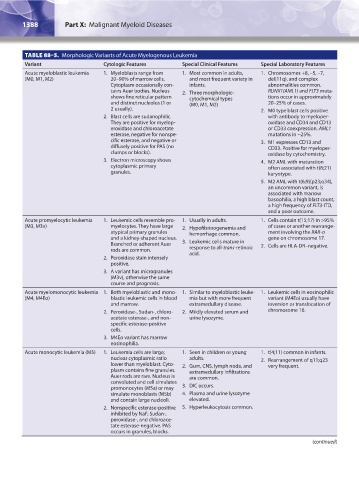
                TABLE 88–5.  Morphologic Variants of Acute Myelogenous Leukemia
                Variant                    Cytologic Features        Special Clinical Features  Special Laboratory Features
                Acute myeloblastic leukemia   1.  Myeloblasts range from   1.  Most common in adults,   1.  Chromosomes +8, –5, –7,
                (M0, M1, M2)                 20–90% of marrow cells.   and most frequent variety in   del(11q), and complex
                                             Cytoplasm occasionally con-  infants.                abnormalities common.
                                             tains Auer bodies. Nucleus   2.  Three morphologic-   RUNX1(AML1) and FLT3 muta-
                                             shows fine reticular pattern   cytochemical types    tions occur in approximately
                                             and distinct nucleolus (1 or    (M0, M1, M2)         20–25% of cases.
                                             2 usually).                                       2.  M0 type blast cells positive
                                           2.  Blast cells are sudanophilic.                      with antibody to myeloper-
                                             They are positive for myelop-                        oxidase and CD34 and CD13
                                             eroxidase and chloroacetate                          or CD33 coexpression. AML1
                                             esterase, negative for nonspe-                       mutations in ~25%.
                                             cific esterase, and negative or                   3.  M1 expresses CD13 and
                                             diffusely positive for PAS (no                       CD33. Positive for myeloper-
                                             clumps or blocks).                                   oxidase by cytochemistry.
                                           3.  Electron microscopy shows                       4.  M2 AML with maturation
                                             cytoplasmic primary                                  often associated with t(8;21)
                                             granules.                                            karyotype.
                                                                                               5.  M2 AML with t(6;9)(p23;q34),
                                                                                                  an uncommon variant, is
                                                                                                  associated with marrow
                                                                                                  basophilia, a high blast count,
                                                                                                  a high frequency of FLT3-ITD,
                                                                                                  and a poor outcome.
                Acute promyelocytic leukemia   1.  Leukemic cells resemble pro-  1.  Usually in adults.  1.  Cells contain t(15;17) in >95%
                (M3, M3v)                    myelocytes. They have large   2.  Hypofibrinogenemia and   of cases or another rearrange-
                                             atypical primary granules   hemorrhage common.       ment involving the RAR-α
                                             and a kidney-shaped nucleus.                         gene on chromosome 17.
                                             Branched or adherent Auer   3.  Leukemic cells mature in   2.  Cells are HLA-DR–negative.
                                             rods are common.          response to all-trans-retinoic
                                                                       acid.
                                           2.  Peroxidase stain intensely
                                             positive.
                                           3.  A variant has microgranules
                                             (M3v), otherwise the same
                                             course and prognosis.
                Acute myelomonocytic leukemia  1.  Both myeloblastic and mono-  1.  Similar to myeloblastic leuke-  1.  Leukemic cells in eosinophilic
                (M4, M4Eo)                   blastic leukemic cells in blood   mia but with more frequent   variant (M4Eo) usually have
                                             and marrow.               extramedullary disease.    inversion or translocation of
                                           2.  Peroxidase-, Sudan-, chloro-  2.  Mildly elevated serum and   chromosome 16.
                                             acetate esterase-, and non-  urine lysozyme.
                                             specific esterase-positive
                                             cells.
                                           3.  M4Eo variant has marrow
                                             eosinophilia.
                Acute monocytic leukemia (M5)  1.  Leukemia cells are large;   1.  Seen in children or young   1.  t(4;11) common in infants.
                                             nuclear cytoplasmic ratio   adults.               2.  Rearrangement of q11;q23
                                             lower than myeloblast. Cyto-  2.  Gum, CNS, lymph node, and   very frequent.
                                             plasm contains fine granules.   extramedullary infiltrations
                                             Auer rods are rare. Nucleus is   are common.
                                             convoluted and cell simulates
                                             promonocytes (M5a) or may   3.  DIC occurs.
                                             simulate monoblasts (M5b)   4.  Plasma and urine lysozyme
                                             and contain large nucleoli.  elevated.
                                           2.  Nonspecific esterase-positive  5.  Hyperleukocytosis common.
                                             inhibited by NaF; Sudan-,
                                             peroxidase-, and chloroace-
                                             tate esterase-negative. PAS
                                             occurs in granules, blocks.
                                                                                                                 (continued)


          Kaushansky_chapter 88_p1373-1436.indd   1388                                                                  9/21/15   11:01 AM

