


Page 1414 - Williams Hematology ( PDFDrive )
P. 1414
1388  Part X:  Malignant Myeloid Diseases                        Chapter 88:  Acute Myelogenous Leukemia             1389


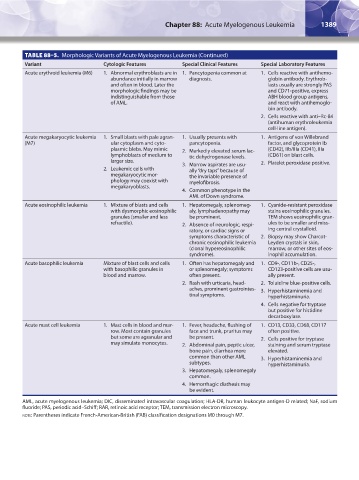
                   TABLE 88–5.  Morphologic Variants of Acute Myelogenous Leukemia (Continued)
                   Variant                   Cytologic Features        Special Clinical Features  Special Laboratory Features
                   Acute erythroid leukemia (M6)  1.  Abnormal erythroblasts are in  1.  Pancytopenia common at   1.  Cells reactive with antihemo-
                                               abundance initially in marrow   diagnosis.           globin antibody. Erythrob-
                                               and often in blood. Later the                        lasts usually are strongly PAS
                                               morphologic findings may be                          and CD71-positive, express
                                               indistinguishable from those                         ABH blood group antigens,
                                               of AML.                                              and react with antihemoglo-
                                                                                                    bin antibody.
                                                                                                  2.  Cells reactive with anti–Rc-84
                                                                                                    (antihuman erythroleukemia
                                                                                                    cell-line antigen).
                   Acute megakaryocytic leukemia   1.  Small blasts with pale agran-  1.  Usually presents with   1.  Antigens of von Willebrand
                   (M7)                        ular cytoplasm and cyto-   pancytopenia.             factor, and glycoprotein Ib
                                               plasmic blebs. May mimic   2.  Markedly elevated serum lac-  (CD42), IIb/IIIa (CD41), IIIa
                                               lymphoblasts of medium to   tic dehydrogenase levels.  (CD61) on blast cells.
                                               larger size.            3.  Marrow aspirates are usu-  2.  Platelet peroxidase positive.
                                             2.  Leukemic cells with      ally “dry taps” because of
                                               megakaryocytic mor-        the invariable presence of
                                               phology may coexist with   myelofibrosis.
                                               megakaryoblasts.
                                                                       4.  Common phenotype in the
                                                                          AML of Down syndrome.
                   Acute eosinophilic leukemia  1.  Mixture of blasts and cells   1.  Hepatomegaly, splenomeg-  1.  Cyanide-resistant peroxidase
                                               with dysmorphic eosinophilic   aly, lymphadenopathy may   stains eosinophilic granules.
                                               granules (smaller and less   be prominent.           TEM shows eosinophilic gran-
                                               refractile).            2.  Absence of neurologic, respi-  ules to be smaller and miss-
                                                                          ratory, or cardiac signs or   ing central crystalloid.
                                                                          symptoms characteristic of   2.  Biopsy may show Charcot-
                                                                          chronic eosinophilic leukemia   Leyden crystals in skin,
                                                                          (clonal hypereosinophilic   marrow, or other sites of eos-
                                                                          syndrome).                inophil accumulation.
                   Acute basophilic leukemia  Mixture of blast cells and cells   1.  Often has hepatomegaly and   1.  CD9-, CD11b-, CD25-,
                                             with basophilic granules in   or splenomegaly; symptoms   CD123-positive cells are usu-
                                             blood and marrow.            often present.            ally present.
                                                                       2.  Rash with urticaria, head-  2.  Toluidine blue-positive cells.
                                                                          aches, prominent gastrointes-  3.  Hyperhistaminemia and
                                                                          tinal symptoms.           hyperhistaminuria.
                                                                                                  4.  Cells negative for tryptase
                                                                                                    but positive for histidine
                                                                                                    decarboxylase.
                   Acute mast cell leukemia  1.  Mast cells in blood and mar-  1.  Fever, headache, flushing of   1.  CD13, CD33, CD68, CD117
                                               row. Most contain granules   face and trunk, pruritus may   often positive.
                                               but some are agranular and   be present.           2.  Cells positive for tryptase
                                               may simulate monocytes.  2.  Abdominal pain, peptic ulcer,   staining and serum tryptase
                                                                          bone pain, diarrhea more   elevated.
                                                                          common than other AML   3.  Hyperhistaminemia and
                                                                          subtypes.                 hyperhistaminuria.
                                                                       3.  Hepatomegaly, splenomegaly
                                                                          common.
                                                                       4.  Hemorrhagic diathesis may
                                                                          be evident.

                  AML, acute myelogenous leukemia; DIC, disseminated intravascular coagulation; HLA-DR, human leukocyte antigen-D related; NaF, sodium
                  fluoride; PAS, periodic acid–Schiff; RAR, retinoic acid receptor; TEM, transmission electron microscopy.
                  note: Parentheses indicate French-American-British (FAB) classification designations M0 through M7.


          Kaushansky_chapter 88_p1373-1436.indd   1389                                                                  9/21/15   11:01 AM

