


Page 1409 - Williams Hematology ( PDFDrive )
P. 1409
1384           Part X:  Malignant Myeloid Diseases                                                                                                                           Chapter 88:  Acute Myelogenous Leukemia             1385


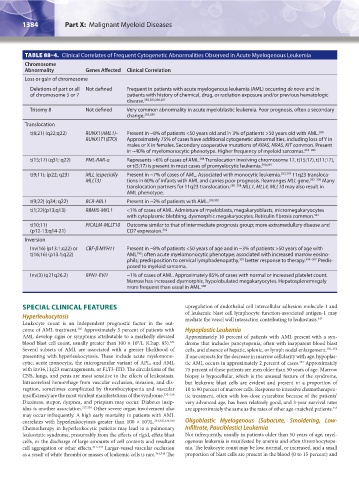
                TABLE 88–4.  Clinical Correlates of Frequent Cytogenetic Abnormalities Observed in Acute Myelogenous Leukemia
                Chromosome
                Abnormality          Genes Affected  Clinical Correlation
                Loss or gain of chromosome
                   Deletions of part or all  Not defined  Frequent in patients with acute myelogenous leukemia (AML) occurring de novo and in
                  of chromosome 5 or 7            patients with history of chemical, drug, or radiation exposure and/or previous hematologic
                                                  disease. 282,283,286,287
                  Trisomy 8          Not defined  Very common abnormality in acute myeloblastic leukemia. Poor prognosis, often a secondary
                                                  change. 283,289
                Translocation
                  t(8;21) (q22;q22)  RUNX1(AML1)–  Present in ~8% of patients <50 years old and in 3% of patients >50 years old with AML.
                                                                                                                   288
                                     RUNX1T1(ETO)  Approximately 75% of cases have additional cytogenetic abnormalities, including loss of Y in
                                                  males or X in females. Secondary cooperative mutations of KRAS, NRAS, KIT common. Present
                                                  in ~40% of myelomonocytic phenotype. Higher frequency of myeloid sarcomas. 263–266
                  t(15;17) (q31; q22)  PML-RAR-α  Represents ~6% of cases of AML.  Translocation involving chromosome 17, t(15;17), t(11;17),
                                                                           288
                                                  or t(5;17) is present in most cases of promyelocytic leukemia. 290,291
                  t(9;11); (p22; q23)  MLL (especially   Present in ~7% of cases of AML. Associated with monocytic leukemia. 292,293  11q23 transloca-
                                     MLLT3)       tions in 60% of infants with AML and carries poor prognosis. Rearranges MLL gene. 292–296  Many
                                                  translocation partners for 11q23 translocation. 295–298  MLL1, MLL4, MLL10 may also result in
                                                  AML phenotype.
                  t(9;22) (q34; q22)  BCR-ABL1    Present in ~2% of patients with AML. 299,300
                  t(1;22)(p13;q13)   RBMIS-MKL1   <1% of cases of AML. Admixture of myeloblasts, megakaryoblasts, micromegakaryocytes
                                                  with cytoplasmic blebbing, dysmorphic megakaryocytes. Reticulin fibrosis common. 301
                   t(10;11)          PICALM-MLLT10  Outcome similar to that of intermediate prognosis group; more extramedullary disease and
                  (p12-13;q14-21)                 CD7 expression. 302
                Inversion
                   Inv(16) (p13.1;q22) or   CBF-β MYH11  Present in ~8% of patients <50 years of age and in ~3% of patients >50 years of age with
                  t(16;16) (p13.1;q22)            AML ; often acute myelomonocytic phenotype; associated with increased marrow eosino-
                                                      288
                                                  phils; predisposition to cervical lymphadenopathy,  better response to therapy. 304–307  Predis-
                                                                                        303
                                                  posed to myeloid sarcoma.
                  Inv(3) (q21q26.2)  RPN1-EVI1    ~1% of cases of AML. Approximately 85% of cases with normal or increased platelet count.
                                                  Marrow has increased dysmorphic, hypolobulated megakaryocytes. Hepatosplenomegaly
                                                  more frequent than usual in AML. 308


               SPECIAL CLINICAL FEATURES                              upregulation of endothelial cell intercellular adhesion molecule-1 and
               Hyperleukocytosis                                      of leukemic blast cell lymphocyte function-associated antigen-1 may
                                                                      mediate the vessel wall interaction contributing to leukostasis.
                                                                                                                  349
               Leukocyte count is an independent prognostic factor in the out-
               come of AML treatment.  Approximately 5 percent of patients with   Hypoplastic Leukemia
                                  330
               AML develop signs or symptoms attributable to a markedly elevated   Approximately 10 percent of patients with AML present with a syn-
               blood blast cell count, usually greater than 100 × 10 /L (Chap. 83).     drome that includes pancytopenia, often with inapparent blood blast
                                                                 331
                                                      9
               Several subsets of AML are associated with a greater likelihood of     cells, and absence of hepatic, splenic, or lymph nodal enlargement. 350–352
               presenting with hyperleukocytosis. These include acute myelomono-  If one corrects for the decrease in marrow cellularity with age, hypoplas-
               cytic, acute monocytic, the microgranular variant of APL, and AML   tic AML occurs in approximately 2 percent of cases.  Approximately
                                                                                                            353
               with inv16,11q23 rearrangements, or FLT3-ITD. The circulations of the   75 percent of these patients are men older than 50 years of age. Marrow
               CNS, lungs, and penis are most sensitive to the effects of leukostasis.   biopsy is hypocellular, which is the unusual feature of the syndrome,
               Intracerebral hemorrhage from vascular occlusion, invasion, and dis-  but leukemic blast cells are evident and present in a proportion of
               ruption, sometimes complicated by thrombocytopenia and vascular   10 to 90 percent of marrow cells. Response to intensive chemotherapeu-
               insufficiency are the most virulent manifestations of the syndrome. 332–336    tic treatment, often with low-dose cytarabine because of the patients’
               Dizziness, stupor, dyspnea, and priapism may occur. Diabetes insip-  very advanced age, has been relatively good, and 3-year survival rates
               idus is another association. 337,338  Other severe organ involvement also   are approximately the same as the rates of other age-matched patients. 354
               may occur infrequently. A high early mortality in patients with AML
               correlates with hyperleukocytosis greater than 100 × 10 /L. 334,335,339,340    Oligoblastic Myelogenous (Subacute, Smoldering, Low-
                                                         9
               Chemotherapy in hyperleukocytic patients may lead to a pulmonary   Infiltrate, Pauciblastic) Leukemia
               leukostatic syndrome, presumably from the effects of rigid, effete blast   Not infrequently, usually in patients older than 50 years of age, myel-
               cells, or the discharge of large amounts of cell contents and resultant   ogenous leukemia is manifested by anemia and often thrombocytope-
               cell aggregation or other effects. 341–343  Larger-vessel vascular occlusion   nia. The leukocyte count may be low, normal, or increased, and a small
               as a result of white thrombi or masses of leukemic cells is rare. 344,348  The   proportion of blast cells are present in the blood (0 to 15 percent) and


          Kaushansky_chapter 88_p1373-1436.indd   1384                                                                  9/21/15   11:01 AM

